Showing posts with label Bungay. Show all posts

Thursday, 26 November 2020

Lilian Katie : 100 Years

This is a very special post which is dedicated to my maternal grandmother, Lilian Katie Humphries, who was born on this day 100 years ago.
I have written about her here

Nannie Lilian will always be fondly remembered for many things but the most important thing she taught me, whether intentionally or not, was that combing your hair and putting powder on your face and rouge on your cheeks made you look and feel much better, even if you didn't necessarily feel that way underneath. My Nannie spent almost all of her life unwell, mostly from asthma and bronchial ailments, as well as heart conditions, but she always managed to run a comb through her hair and apply some rouge on her cheeks. I used to watch her apply her favourite Bourjois rouge and I still have her last used blush pot in my archive box, given to me in more recent years by my mother. Nannie Lilian also passed on to me her passionate love for London. Regrettably, I haven't returned there for many years now but whenever I see it on television, in a movie, drama series or documentary, I can feel my heart automatically soar. London is such a wonderful place and as Samuel Johnson once famously said in 1777, "those who tire of London tire of life". For me, that saying lies deep within my psyche even today, because London has always made me feel recharged, fully present and energised whenever I am there. Not only that, I also feel a strong ancestral connection there and that fills me with honour.

I miss you every single day Nannie but please know that I always think of you and often recall childhood memories as I go about my daily life. I am forever grateful that you were a part of my childhood and teenage years. You were taken from us way too soon. I love you.


Sunday, 11 November 2018

Thank You... Armistice Day 2018


This is my first blog post in three and a half years *shock face* I have been away from blogging, writing and family history research and concentrating my energies elsewhere but I will never ever forget my ancestry. I will never forget the sacrifices, the losses, the struggles, and their strength and dedication. This is my promise to my ancestors, my living family, and especially my daughter.

This special post honors the centenary of the end of the Great War or World War One (WWI). At this solemn time I am once again reminded of those who fought for their country and lost their lives. Husbands, boyfriends, friends, school chums, work colleagues, brothers, cousins, nephews. uncles, sons, grandsons - lost, yet never forgotten. I would also like to acknowledge all the courageous women who served as nurses, both at home and overseas.

🌺James JOLLY
1880 - 1914 Norfolk Regiment
From Bungay, SFK  not married
🌺William Burgoine WATERS
1889 - 1917 Norfolk Regiment
From Beccles, SFK married, five children
🌺Sidney PRESTON
1889 - 1918 Essex Regiment
From Holt, NFK  married, no children

In April of this year I took a trip to Kings Park as it was the centenary of Sidney Preston's death. I made a special lanyard and attached his school photograph and a Preston family photo of happier times with his family, on a picnic at the beach, taken before the war broke out which changed everybody's life. I took photographs, as well as some video footage and I recited the Ode of Remembrance. These are a few of the photographs from that trip (10 April 2018):

Sidney Preston 1889 - 1918
Eternal Flame, Kings Park
My special lanyard made especially for Sidney

 ADDENDUM: 11 November 2018
I have just returned home from Kings Park where the centenary Armistice Day service was held. The crowds were on a much grander scale than in the previous years I've attended (2014/5/6/7). Not only was Mark McGowan (Premier of WA) in attendance this year but also Kim Beasley (Governor of WA) as well as several government dignitaries and officials. Most importantly, the soldiers who have served our country, who received respectful yet hearty applause at the closing of the service. This show of respect touched my heart and also moved a few of them to tears.
As I walked around looking at the sea of handmade poppies (over 61,000 were made for the occasion) and taking photographs with my phone, a young girl approached me and asked about my photographs. I told her who they were and she then told me her two of her 3xgreat-uncles served (and died) in WWI and their names are on the War Memorial. One of them was named Percy!
I was deeply moved by the events of today, and I am extremely grateful to have had the opportunity to attend the service. Seeing thousands of people, young and old, and feeling the depth of mutual respect. Some were wearing military medals and/or pins, some were wearing commemorative t-shirts or slouch hats, everyone was wearing poppies. Witnessing the sea of handmade poppies is something I will not forget for a long time to come. Here are some photographs from today's service (11 November 2018):

James Jolly 1880 - 1914
The rosary beads belonged to my great-grandmother Nellie
who was James' sister


🌺Lest We Forget🌺

Monday, 24 November 2014

James "Jumbo" Jolly

I have previously posted about my great grand-uncle James Jolly, particularly at times of Remembrance. He was killed in action on this day, one hundred years ago. The Great War was barely three months old when James was fighting on the front lines during the First Battle of Ypres.

James Jolly, circa 1899

James Jolly was born in 1880 in Bungay, county Suffolk. He was the son of William Jolly and Emma, nee Clarke. James was baptised at Bungay Holy Trinity Church on 16 November 1881. He joined the Norfolk Regiment at around the age of 19 and served with the 2nd Battalion in the Boer War from 1899-1902.

James' nickname was Jumbo. This could have stemmed from the fact that he had large ears. Bless him.

In 1894, when James was thirteen years old, he was sent before the Bungay Petty Sessions (with H. Rider Haggard presiding) for stealing seven rabbit traps, the property of Mr C French of St John Ilketshall. James did not work alone, he was with Arthur Ward and his brother Herbert Ward, and Edward Barber. Arthur Ward, who was twelve years old at the time, would go on to become my great-grandfather.

When war broke out in 1914, James served with the 1st Battalion Norfolk Regiment and was sent to France. According to the website http://www.1914-1918.net/norfolks.htm the 1st Battalion formed part of the 15th Brigade, 5th Division and landed at Le Havre in August 1914. The 5th Division were involved in the following:
The Battle of Mons and subsequent retreat, including the Action of Elouges
The Battle of Le Cateau and the Affair of Crepy-en-Valois
The Battle of the Marne
The Battle of the Aisne
The Battles of La Bassee and Messines 1914
The First Battle of Ypres


James Jolly, circa 1914

Grey field of Flanders, grim old battle-plain,
What armies held the iron line round Ypres in the rain,
From Bixschoote to Baeceleare and down to the Lys river?

Merry men of England,
Men of the green shires,
From the winding waters,
The elm-trees and the spires,
And the lone village dreaming in the downland yonder.
Half a million Huns broke over them in thunder,
Roaring seas of Huns swept on and sunk again,
Where fought the men of England round Ypres in the rain,
On the grim plain of Flanders, whose earth is fed with slaughter.

--- Margaret Louisa Woods (1845-1945)

Wednesday, 23 July 2014

Hilda Bowes : An unexpected surprise

I must have dreamt that I wrote up and published this blog post because I certainly planned it awhile back, but it doesn't appear to be here. A chance search on ebay, in December last year, led me to a quaint Edwardian picture postcard which had been written to my cousin four times removed, Hilda Bowes. It was from a person by the name of Fred and it was stamped 13 August 1912.

The postcard was addressed to:
Miss H Bowes
Broad Street
Bungay Suffolk

I knew that my three times great-grand uncle, George Bowes, lived in Broad Street so I put in a bid for the postcard. When I won it, I never expected it would lead to a second surprise.

Broad Street, Bungay c. 1923

Hilda Matilda Bowes was born in 1892 in Bungay. She was the daughter of George Bowes and his second wife, Mary Ann Margaret (nee Whurr). Mary Ann was the daughter of John Whurr and Eliza, nee Phillips. The Whurr family lived in Broad Street, Bungay all their lives, and when Mary Ann married widowed George Bowes in 1891, she continued to live in the same street. The census returns show that before she married George, who was a baker by trade, she was a Dressmaker. Mary Ann's life would have taken quite a different direction from dressmaking with her mother to baking with her husband. When she married George Bowes she was 40 years old.

When George Bowes died in March 1911, Hilda ran the family baker business in Broad Street with her mother. However, in 1920, Hilda married Allen Green. Allen was the son of Henry Green and Kate, nee Burgess. The Green family lived in Wingfield Street, Bungay. Allen was a printer compositor by trade, possibly at Clay & Sons Ltd of Bungay. The 1925 Kelly's Directory shows Hilda's mother, Mary Ann, was still trading as a baker at 48 Broad Street.

It is not yet known if Hilda and Allen ever had any children. What is known is that Allen died only a few months after Hilda, in 1972. When Mary Ann died in April 1941, she left a sum of money to her only daughter Hilda in a will.

Recently I went to the Ancestry website to search for information regarding Hilda Bowes's ancestry, and to my surprise I found a photograph of her. I was so excited to finally see what she looked like. I was also quite surprised to find that she bore a striking resemblance to my great-grandmother Eva Waters, nee Bowes and Eva's sister Winnie Bowes. Eva and Winnie were Hilda's first cousins, once removed. Judge for yourselves. Personally, I think it's the nose. And the curve of the lips...and the eyes.

Hilda Bowes (1892-1972)

Eva Bowes (1887-1966)

Winnie Bowes (1892-1948)

For more information about my Bowes ancestry, see here
A blog post about Fred Bowes (brother of Eva and Winnie) here
Photograph of Hilda Bowes: courtesy of Robert Alexander (Wangford, England). There is also a photograph of her husband Allen Green on the site also belonging to Robert Alexander
Photograph of Eva and Winnie Bowes: My personal photo collection


Friday, 9 May 2014

The Sampson Family of Suffolk

Following the interest and enthusiasm which my last two blog posts (Alden and Gilding families) brought to my step-family, I've since been asked to write up a family history. I am more than happy to do this for them as they have been a crucial part of my life for more than forty years.

While I am very tempted to write up the recently promised blog post on the Sampson family, I have now decided to postpone it for the time being. I don't want to give everything away, there will be nothing left to surprise my relatives with. Sorry :-)

If there is anybody out there, reading this, who is related to the Sampson, Alden or Gilding families of Suffolk, please know that I would love to hear from you. Just leave a comment below with an email address and I will get back to you. If anybody knows anything and feels willing to share stories or photographs of the aforementioned families, I would be really pleased to hear from you.

My step-grandfather was Alfred James Sampson, who was born in Mettingham in Suffolk. You can read more about my memories of him in my 2011 blog post here. Alfred was known to everyone as 'Buster' so if you don't recognise the name Alf or Alfred, you would have possibly have known him better by this nickname.

The Sampson family lived in Mettingham, and previously the Sampson lineage came from Redisham, Stoven, St James, St Elmham all in Suffolk.

 
Alice and James Sampson c.1970

Alf 'Buster' Sampson with his son and daughter-in-law

Grave site in Mettingham, Suffolk
of James & Alice Sampson

Thank you in advance. I look forward to hearing from you.

Saturday, 29 March 2014

The Gilding Family

Last time I wrote about my step-grandfather's first wife, Jean Alden and her family. Jean's mother was Mollie Joan Alden, daughter of Robert Alden and Emily Gilding. This blog post is dedicated to the Gilding family.

Emily Gilding was born in Bungay in 1871. She was one of eight* children. The census returns for that year were taken on the night of 2 April and Emily is listed as being two months old. Her parents, Jacob Gilding and Sarah Ann (nee Rogers) were then residing in Beccles Road, in Bungay.

Emily's father Jacob Gilding was a Wherryman/Waterman by trade, in the counties of Norfolk and North Suffolk - this being stated in the 1851, 1861 & 1871 census returns. By 1881, however, Jacob was a Railway Labourer, as part of the General Eastern Railway (G.E.R). Jacob and his wife and children were by that time residing in Beccles.

Jacob Gilding was born on 6 June 1838 in Smallburgh, county Norfolk. He was the son of Benjamin Langley Gilding and Mary, nee Cork. On 2 July 1838 Jacob was baptised at St Peter's Church, Smallburgh. In 1851 the Gilding family lived at Broad Fen in Dilham. Benjamin, Jacob's father was a Waterman by trade. I like to imagine him rowing his way through the Norfolk Broads on an early Spring day, chewing on a piece of reed.

Picking Water Lillies
http://www.theslideprojector.com/

Jacob left the county of Norfolk some time before 1860 and took up residence in Bungay, county Suffolk. Jacob married Sarah Ann Rogers, daughter of William Rogers, at Bungay Holy Trinity Church on 3 April 1860. Both signed the marriage register with an "X". The Rogers family were from Loddon, county Norfolk. William Rogers' first wife Mary Ann (nee Harris), Sarah Ann's biological mother, died in 1845 and William later married Amy Harris in 1849. Any relation?

Jacob and Sarah Ann's first child, George, was born in August 1860 but he did not thrive, and died on 3 September 1860. His burial service was held at Bungay Holy Trinity Church. Jacob and Sarah had only been married for five months. They went on to have eight more children:

Frederick George Gilding
George Rogers Gilding
Benjamin Gilding
Harry Gilding
Emily Gilding
Ernest William Gilding
Ellen Mary Gilding
Anne Gilding

They remained in Bungay until some time before 1881 when they moved with their children to Beccles: Emily, aged 10. Ernest William, aged 8. Ellen Mary, aged 6 and Anne, aged 5. What I find especially intriguing about the 1881 census return for the Gilding family is two-fold: 1) Jacob and Sarah Ann's sons George, then aged 16 and Benjamin, then aged 14, were "Inmates" (Students) at a Boys Reformatory School in Thorndon All Saints (near Eye); and 2) Jacob and Sarah Ann have an extra adopted child: Jeremiah Sturman, aged 1.

Upon further investigation, Jeremiah Sturman was born in Skelton in North Riding, county Yorkshire. He was the illegitimate son of Rebekah Sturman, a Domestic Servant. What I found to be even more intriguing was that the 1891 census return puts Jeremiah back with his mother Rebekah (along with a half-brother Harry and another Jeremiah Sturman aged 87) but this time they are all Inmates of the Loddon and Clavering Union Workhouse, in county Norfolk. This begs the question: What happened to the Sturman family and why did the Gilding family have temporary care of Jeremiah?

The 1901 census return has Jacob and Sarah Ann Gilding living at Knights Yard, Ravensmere with a grandson, Walter Belward Gilding. Walter was then aged 12, born to one of Jacob and Sarah Ann's children but which one? (Walter was living with the family in 1891 as well, when they resided at Northgate Street). He remained with his grandparents even in 1911, when he was aged 22. I don't believe he ever married. Another grandson appears on the 1911 census with Jacob and Sarah Ann: Ernest Alden, aged 18 (He was Mollie Joan Alden's eldest brother). What is interesting to note is that the 1911 census states Jacob and Sarah Ann had eight children, seven living and one who had died. But I know that they had at least nine children because I found George Gilding who was baptised and died in 1860, in Bungay. Why did they claim they had eight children instead of nine?

Jacob Alden, 1911 census return
(click on image to enlarge)

Jacob Gilding died in 1914, aged 75. Sarah Ann Gilding died in 1930, aged 94.

My next blog post will concentrate on my step-grandfather's SAMPSON family heritage.


ADDENDUM
The British Newspaper Archive brings up several previously unknown articles in regards to Jacob Gilding who was frequently brought up before the Beccles Petty Sessions in the 1880s because he repeatedly refused to pay the ordered one shilling per week in payment of his son at Thorndon Reformatory School. For example: The Ipswich Journal of Tuesday 25 January 1881 reported that Jacob Richard Gilding was "causing much trouble" from neglecting to make payments for his sons and was "22 weeks in arrears". Jacob's wages as a Railway Labourer at that time was stated in the paper as being 18 shillings 6 pence per week and that he had "five other children to provide for".
(In July 1879 The Ipswich Journal reported that brothers George Gilding and Benjamin were caught stealing fruit from a garden in Ravensmere, the property of Edward Masters. This was the reason they were sent to Reformatory School. They had previous convictions of stealing at Gillingham.)
In January 1885 Jacob Gilding was fined five shillings for neglecting to send his daughter Ellen Gilding, regularly to school


Sunday, 19 January 2014

It's All in the Numbers Geneameme

Not wanting to miss out on a genealogy-based blog challenge I decided to make my first blog post of 2014 about Alona Tester's geneameme.

I have many significant numbers in my family history but here are just ten to stir my memory and genealogy juices and share what these special numbers mean to me.


One - I am an only child (born of my mother and father before their divorce). My cousin is also an only child of her mother and father. Both my cousin and myself have only had one daughter. Whilst my cousin and I have what you would call "step-siblings" (though we loathe the term), her daughter and mine are definitely the only child.

Me with my babysitter & family
friend, outside our cottage
in Beccles, Suffolk
Three - The number of the cottage I lived in with my mother during the 1970s, in Beccles Suffolk. This cottage was so very significant in my childhood, it inspired me to include it in my novella Symphony of War.

Four - The number of sons my paternal grandparents had, including my dearest Dad. The eldest has since passed away ten years ago but the other three are still going strong. Four is also my lucky number. My 2xg/grandfather William and I were born on the same day (4th February), he in 1847 and me over one hundred years later!

Ten - This is the number of generations I have gone back to in my Preston ancestry. I am yet to confirm the eleventh ancestor but work is still underway. I have written two family history editions of Preston Origins, the second edition copies are currently held in both the Norfolk and Suffolk (Lowestoft) Record Offices.

Thirteen - The number of children in my 3xg/grandparents Josiah and Susan's family, including my 2xg/grandfather William who was the last born child. His eldest sister Maria was at least twenty years older than him. Thirteen is also a lucky number for my father.


Nineteen - This number recurs in my family tree, especially this very date in particular: January 19th. My 2xg/grandfather William was born on this day in 1853. My first cousin twice removed William was born on this day in 1890. My 3xg/grandparents Josiah and Susan married on this day in 1829. My 3xg/grandfather William died on this day in 1887. My 2xg/grandmother Jane died on this day in 1893.

Twenty Seven - This number recurs with my great-grandfather Albert who was married on the 27th and died on the 27th. Also my uncle (Albert's grandson) was born on the 27th. My 2xg/grand uncle was born on the 27th. Two of my 3xg/grand-uncles died and were buried on the 27th, both as a result of Cholera. I was baptised on the 27th.

Fulham, High Street. My ancestors lived at no.42.

Forty Two - This was the number of the Fulham High Street house which my 4xg/grandparents Joseph and Elizabeth lived in for many years during the early 1800s until my 3xg/grandparents William and Louisa continued to live there after Louisa's parents deaths. My 2xg/grandparents Richard and Louisa are also listed on the 1871 census as residing there with three of their children. Forty Two was also the number of the house I lived in with my current husband and where we lived when our daughter was conceived.

Fifty Eight - This number is special because this is the number of the boarding house which my great-grandmother Nellie ran in Bungay, Suffolk during the 1940s & 1950s. It holds very many happy memories for my mother who was born in the house and lived there from around the age of twelve until she left school to work full-time.

Ninety Four - This number is the age of my oldest surviving ancestor's age at death. Two others come very close at 92 and 93 but my 4xg/grandfather Zachariah was the winner! He was baptised in January 1777 and died in April 1871, in Beccles.


A belated "Happy New Year" to all my followers and thanks to Alona for the blog post idea.

Sunday, 21 April 2013

A Place To Call Home

I have neglected my blog here at "Pocketfull", but I do have a good excuse. Well, maybe not a good excuse but an excuse nonetheless. In recent months I've created a new blog which is dedicated to the history of my childhood hometown and I've been contributing to it almost twice weekly (See it here). For now at least, I've run out of steam so I've decided to devote some of my free time back here, amongst my family history.

A new Australian drama is set to start on the Seven Network next week called 'A Place To Call Home' and while I've been rather looking forward to watching this post-world-war-two drama it has got me thinking lately about "home" and what it means to me personally. Even though I have lived in Australia for most of my life, I still have a hankering for my childhood home. Beyond this, I have often found myself wondering what my family and my ancestors would have called home.

Both of my grandmothers were devoted to their homes. My maternal grandmother Lilian always proudly called herself a "Londoner", even long after the war ended in 1945, when she was married and living in a quiet market town in Suffolk. Then, in 1978 she emigrated to Australia. Yet, all her life, at every opportunity she could get, she went back to London. Her heart was always right there and when she died in 1983 of a massive heart attack, I always believed (and still do, to this day) that it was because her heart was broken for home.
My paternal grandmother Freda lived in Beccles all her life. She never moved away from the town, except for a few years when she moved to nearby Brampton but she quickly welcomed a return to Beccles. There was no question of her living anywhere else but Beccles. She was born there, she was married there, she raised four boys there, and it never entered her mind to travel further than was absolutely necessary. She believed in setting down your roots and staying put and, for the most part, she was content with that. It didn't make her small minded but it certainly made her homely and connected to her roots.
My grandfathers? My paternal grandfather Herbert lived in Bungay, London, and later, Beccles. I don't think that any one particular place meant more to him. I believe he went where "duty called" for the most part, even during the Second World War when he was stationed at Sutton Coldfield.
My maternal grandfather was born and lived all his life in Bungay. While he fudged his age slightly on enlistment with the Norfolk Regiment I don't think it was necessarily because he wanted to escape home life. He just wanted to do what he felt was right. He was to travel to India during his pre-World War Two service and later to Dunkirk before his capture and internment in a German Prisoner-of-War camp. Later, in 1944-45, he served with the Royal Army Medical Corps and was stationed at Epsom, county Surrey. After the war, when he married my grandmother Lilian, they remained in Bungay and raised their family there, trying (against impossible odds at times) to live by the post-war standards of a secure family life.

Aerial view of Beccles and the River Waveney

If I look back another generation, to my great-grandparents' idea of what home meant to them, it differs quite dramatically. For example, my maternal great-grandparents Albert and Elizabeth, were born in the exact same town in London. They were both from working-class families and both were baptised at the same church. Their families possibly knew one another and shared a similar social history. Albert was restless though, even as a young boy. He wanted to travel and see the world, stretch his wings and leave Putney well behind him forever. He lied about his age to get into the Royal Navy and his only reason for returning to Putney was to marry his sweetheart, Elizabeth, in 1905. After that they lived in Southwark, Fulham, Tooting, Bloomsbury and later, Sutton (where they settled and remained until Elizabeth's death in 1951).
My other maternal great-grandparents, Percy and Nellie, were much like my paternal grandmother. They remained in the Suffolk market town of Bungay all their lives. There was no question of moving away, although my great-grandfather Percy, as a younger man, did love the sea and he took to fishing on trawler boats off the coast of Lowestoft for many years before settling back to farm life after the Great War (1914-1918).

Putney, in Greater London

My paternal great-grandparents were also a mixed bunch. Albert and Eva were Becclesians to the last, although my great-grandmother Eva was born in Loddon (her parents were Loddon born and raised before moving to Beccles) but she never had a great need to return there. Beccles was her home and Great Yarmouth was her favourite family holiday destination. Albert was born and raised in Beccles, and he remained staunchly faithful to the town and its townsfolk; at home, in religious circles, and in his work.
My other paternal great-grandparents, Arthur and Barbara, lived as a married couple in the market town of Bungay and raised their family there but they were not knowingly tied to their roots. Barbara was born in Holdenhurst, county Hampshire and lived there until she was a young girl, when her father took on a new job as a Railway Gatekeeper in Woodsford, county Dorset. Less than five years later, her mother passed away, her father abandoned her and she moved to London to work in the Domestic Service. Arthur joined the Norfolk Regiment as a young man and served in both the Boer War and the Great War. It was during the Great War that Barbara moved back to London with the children (including my grandfather Herbert) while Arthur was away fighting for King and Country. When the war ended they went back, as a family, to Bungay.


So there we have it; a mixture of loyalties towards home and yet, across the board, so very similar. There are those who willingly left home to fight in the war. Those who wanted to leave their homes for broader horizons. Those who stayed in the same town all their lives, loyal to the last. Those who wanted to run from their past and never look back and those who couldn't let go of their past and so returned again and again.
To this day I share the same tug-of-war with my maternal grandmother Lilian, the Londoner, who always found a way to go back even though the memories of her childhood were not altogether pleasant or heart-warming ones. Something always called her back and she was deeply proud of her London roots, even in the impossible heat and vastness of Australia that she made home for the last remaining years of her life. My own tug-of-war calls me back to Beccles, and sometimes that call is overwhelming. It certainly reflects in my ability to write about it without getting completely caught up and swept away in a sea of nostalgia and sentiment! Even though Australia is now the place I call my home I still carry a piece of Beccles deep within my heart, and I always will. I could never let it go.

Tuesday, 19 March 2013

Body of a Child : My Ancestors Involved in a Mystery

My last blog post referred to two of my Jolly cousins - well, second cousins three times removed to be precise. This time I'm embarking on another Jolly story, as shared recently by my third cousin. She has contact with a Jolly descendent who sent her an article which involves our 3 x great-grandfather Josiah Jolly, who was with two of his sons Josiah Jolly (jnr) and Charles or David Jolly (our second great-grand uncles), when Josiah (jnr) discovered the body of a baby in a field.

*At the time of this event Josiah Jolly (snr) and his wife Susan were living in Plough Street, Bungay. The Plough Inn mentioned below was on this street. Today, Plough Street is known as Wingfield Street. Josiah Jolly (jnr) had married the previous December and the 1851 census return (taken 30 March 1851) puts them both at Shipmeadow Workhouse as Inmates.

The Bury and Norwich Post Newspaper, dated 27 August 1851, reported:

BUNGAY
Body of a child found: -- On Saturday evening, as a labouring man, named Jolly, was going home from his work, in the company of his father and brother, he went into a barley-field near St John's-Hill, to gather some rabbits' meat. He saw a parcel lying there, three or four yards from the gate, apparently done up in white cloth. He mentioned it to his father, who told him to leave it alone, as someone might have placed it there intentionally and would come for it. On the following Monday morning, on going to work, he again saw the parcel, and on examining it, found it was an old basket, wrapped up in a cloth, and inside another cloth he found the body of a female infant. The cloth round the body was marked with red cotton, "C.E.O.T." Information was sent to the police, and an inquest was held before Mr Lawrence, on Tuesday, at the Plough Inn*, where Chas. W. Currie, surgeon, who made a post-mortem examination of the body, deposed that it was that of a full-grown infant, and must have been perfectly healthy when born. He did not discover any external marks of violence : it had lived but a very short time, if it had lived at all...

Postcard

The article my cousin received was from The Bungay Society Journal, No 71, dated December 2010. Here is an extract:

A LOCAL VICTORIAN TRAGEDY
On Monday 18 August 1851 the police received information that the body of an infant had been found on a field near St John's Hill. Local Inspector Nagle went immediately to the spot, and was handed a basket, containing the body of a child by a labourer, Josiah Jolly, who had discovered it.
The following day an inquest into the death was held in the town. Mr Lawrence, a coroner from Ipswich had been summoned to attend, and the sessions were held at the Plough Inn, in Wingfield Street. At that time pubs were often used for such proceedings if there were no other public building available. The Plough was an ancient tavern, and was the last building in Bungay to retain a thatch when it was finally demolished in 1964.
The coroner heard this evidence from Josiah Jolly. "I am a labouring man, and live at Bungay. About half past seven on Saturday evening, as I, my father and brother went to the gate of a field near St John's Hill, intending to gather some rabbits' victuals, and as I was getting over the gate, I saw a parcel lying in the field, about four yards from me, which I pointed out to my father. He desired me to leave it alone...When we reached Mr Sewell's house on the Ollands, I saw him standing by the gate talking to three persons who appeared to be begging and I told him what I had seen...On the Monday morning, as I, my father and brother were going past the same field I went to the gate to see if the parcel was still there and on seeing it, took it up, and brought it into the road to my father. I untied the cloth and found an old basket, on opening which I saw something pinned up in a cloth. I took out the pin and began to remove the cloth, when I observed a child's foot...

On 22 August 1851 the police apprehended a woman named Leggate, against whom there were some peculiarly suspicious circumstances. She was remanded in custody until the 28th, and afterwards consented to a medical examination, but it was certified that she had not given birth to a child, and was discharged.
The final inquest was conducted on 6 September, with negative conclusions. The Jury returned a verdict that the child had "been found dead, but whether born alive or not, the Jury have not sufficient evidence".
It as further reported that many rumours had been in circulation, one traced to a man named George Codling, who was said to have stated that the parcel containing the body had been seen at Jolly's house on the Sunday preceding the day of the discovery in the field. As Codling refused to attend the inquest and confirm his statement before the Jury, the coroner concluded that it was just malicious fabrication: for which he regretted that there was no punishment...

Ordnance Survey Map of Bungay
Shows St John's Hill, The Ollands & Wingfield Street
Click to enlarge


It would appear that my Jolly ancestors had a penchant for being in the wrong place at the wrong time or were mixed up with and embroiled in misdemeanours, rumours, and, pardon me for saying so, a series of unfortunate events.


Wednesday, 20 February 2013

When Children Die In Strange Circumstances

Last night my cousin shared a photograph with me. It was taken after the 1908 hurricane hit Bungay and severely damaged two Cemetery chapels. What interested both of us about the photograph was the gravestone in front. It was a Jolly grave. Our common ancestors. Not only that, the grave was for two children - brothers - one aged twelve and the other aged nine, who had drowned. Putting my Miss Marple hat on, I went straight to the British Newspaper Archive website.

Bungay Cemetery Chapel; the aftermath of the 1908 hurricane
The Ipswich Journal dated 7 March 1882 reported the drowning death of nine-year-old James Jolly, the son of James and Charlotte Jolly of Bungay. The report states James was allegedly seen stealing from a broken shop window and upon being asked what he was doing, ran away. He was last seen by a school friend who spoke with James and asked where he was going in such a hurry. James replied that he was going on an errand and ran towards the direction of the Bungay Common. The next day a local butcher found a cap on the Common, by the river, belonging to James Jolly and went to alert Policeman Mann. Upon further searching, they found the body of James Jolly who was drowned. An inquest returned an open verdict of "accidental drowning".

Contacting my cousin with the news, we were both shocked about this newspaper article. Curiosity got the better of me an hour or so later and I went back to the British Newspaper Archive on the off-chance that James Jolly's brother Frederick may have also died under strange circumstances. You would be right in assuming that a large percentage of children died in Victorian times. Sickness, disease, inadequate (or expensive) health care and poverty were rife and it would be considered "normal" for a child to die before being given a proper chance at life. You can therefore imagine my total surprise when I found the newspaper report for Frederick.

The Ipswich Journal dated 27 December 1890 reported that Frederick Jolly "died suddenly". After a brief illness ( a common cold) Frederick, who was an errand boy for a local chemist, complained of feeling unwell and was sent home to recuperate. On the way home he met with some of his friends who began taunting him with snowballs. We all know that kids can be cruel but I am pretty certain that they did not anticipate that would be the last time they would see their friend. Frederick allegedly reported to his friends that he had eaten some poisoned sweets and felt unwell. The next day, after a night of vomiting and diarrhoea, Frederick was pronounced dead by the local surgeon, Mr Garneys. The coroner for the district decided that no inquest was necessary and Frederick had died of "sudden illness".

The gravestone of brothers, Frederick & James Jolly
What frustrates me as a twenty-first century genealogist and social historian is that the circumstances of these children's deaths was brushed aside and not properly dealt with. The newspaper reports throw up all kinds of unanswered questions and leaves me sorely wishing for a time machine. In the case of James, he was a nine-year-old boy. A cheeky larrikin perhaps, but a boy who had his whole life ahead of him. How did he come to drown? Why did he drown? Who is accountable for this boys death? Was it a mere accident or was something bigger going on?

In the case of Frederick, he was a twelve-year-old boy who had been sick with a common cold. The circumstances of how he came to ingest "poisoned sweets" is baffling. He worked for a chemist so it may be safe to assume that Frederick may have been curious about the powders and tablets and maybe the temptation to "try" some overcame him. Did he unwittingly kill himself? Why was this not mentioned in the report? It was just expected that he was a child, and children die every day. No big deal.

I am quite saddened that these two brothers died so young. Their parents James and Charlotte Jolly lost two of their sons to unfair and disadvantaged circumstances. I think I can better understand my great-grandmother Nellie Jolly today. She prayed every night, on her knees, beside her bed, with her rosary beads wrapped around her hands, for everyone in her family. She named every single one - immediate family and extended - and she would not raise from her kneeling position until she had mentioned every person.

It turns out that the photograph (pictured above) is actually on page 93 of Christopher Reeve's 2009 book "Bungay Through Time". The photograph's caption reads:
"Bungay Cemetery, Hillside Road: The Cemetery, established in the late nineteenth century, originally had three mortuary chapels. In 1908, a rare hurricane occured which blew down the north wall of one of them, and it was demolished soon afterwards..."

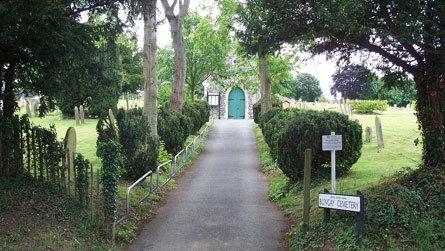
Bungay Cemetery today


Monday, 21 January 2013

2013 Australia Day Challenge : My First Ancestor To Reach Australian Shores

Nothing conjures up images of Australia quite like sheilas and blokes on crowded beaches, thongs, stubbies, barbecues, cricket, Aussie Rules football, Holden Utes, Vegemite, and Banana Boat sunscreen. With Australia Day just around the corner, Helen V Smith came up with the brilliant idea of telling the story of our first Australian ancestor. In November 2011 I wrote a blog post about my more "rebellious" ancestors. One of those was my 3 x great-grand uncle Frederick Ward. Born in 1821, Fred was the first ancestor (that I know of) to reach Australian shores from his humble hometown of Bungay in county Suffolk, England.

Remains of Bungay Castle, 1819
William Buckley welcomes Batman
William Buckley meeting John Batman's party, Australia 1835

The following is taken from my previous blog (basically, because I'm feeling lazy):

"My visits to my local genealogical society over the years has seen many interactions with Australians who rather proudly announce that they each have at least one Convict ancestor in their family tree. Many boast that without them they wouldn't be here today. White Australian settlement history rests largely on the shoulders of those Convicts who sailed on Convict ships, from as early as 1788 through to the mid 1840s when criminal transportation was put to an end. The last of those Convicts were known as 'Exiles' because, basically, they were not  really wanted anywhere. There was no room for them in England. Its prisons were fit to bursting, and many were placed on Prison Hulks off the coast until there was a place for them somewhere or a final decision from officials could be arrived at.
Frederick Ward, my third great-grand uncle, was one of those 'exiles'. In December 1844 he was sentenced, at the Beccles Quarter Sessions, to be transported for 7 years, for stealing three stones weight of cows flesh from James Skippon of Bungay. Unfortunately, this was not Fred's only crime. He had been convicted on two previous occasions; in 1843 and 1844, both on accounts of larceny, and was sent to Beccles Gaol.

In December 1844 Fred Ward was sent to Millbank Prison in London. Millbank was intended to house up to 1000 transportation prisoners at any one time. The average stay was for around three months, during which time prisoners would be assessed for future placement. By the early 1840s transportation sentences were ceased but there were still many prisoners who faced the possibility of being sent away.

In 1843 Millbank was converted to house general prisoners and transportation prisoners, including Fred Ward, were moved to Prison Hulks. Finally in January 1847 Fred Ward was placed on the 'Thomas Arbuthnot' with around 288 male prisoners from Millbank, Pentonville & Parkhurst Prisons and sailed from Spithead to Port Philip Settlement (Melbourne), arriving in May 1847. The 621 ton ship began her voyage at Portsmouth, then travelled to the Isle of Wight where she took on 90 Parkhurst boys. The Times newspaper had this to report:

"The Thomas Arthbuthnot convict ship, Captain Therason, sailed from Spithead this morning for Port Philip with a superior class of delinquents, officially called "exiles". These are the first "exiles" sent to the above settlement, which the inhabitants of that respectable place are very wroth at, and have memorialised the Government on the subject..."

Little is known about Fred Ward after his arrival to Port Philip. This is still a work in progress. What is known is that people such as Richard Deeks spent his precious time researching and transcribing all transportee records of Suffolk and turned it into a book. It was this invaluable book, printed in 2000 and entitled, 'Transportees from Suffolk to Australia 1787-1867' (held at the Suffolk Record Office), which helped me to locate and further research Fred Ward."


Tuesday, 1 January 2013

Percy and Nellie : Centenary Anniversary

Happy New Year to everyone! While we are all busy making resolutions for the year ahead I wanted to share something special with you. Today is a very special day in my family history calendar as it marks the centenary of the wedding day of my great-grandparents Percy Preston and Nellie Jolly.

Percy and Nellie were the last of my great-grandparents to marry (Before them, my other great-grandparents married in 1905, 1907 and 1909). Percy and Nellie were married at Holy Trinity Church in Trinity Street, Bungay (Suffolk, England) on 1 January 1913. The day would have been a Wednesday. I don't know what sort of weather they had but being winter, it would have been mightily cold. The following week saw recordings of heavy snowfall across the north of England.

Nellie would have perhaps worn a hand sewn dress (a collaborative effort with her older sister, Alice or one of her sisters-in-law?) made of warm fabric, with lace and/or embroidery detail, with long sleeves and possibly even a long coat to keep her warm during the walk to and from the church. Perhaps she wore a gown which had been passed down from somebody in the family. While it would not have been as expensive or elaborate as the one worn by Princess Patricia of Connaught (seen pictued below), I am certain that Nellie would have looked equally as beautiful.

Example of a late Edwardian Wedding Dress
Edwardian Era Hairstyles
No known photographs exist of Percy and Nellie's wedding day, so I do not know what Nellie would have worn on her wedding day. I can only speculate. However, I like to imagine her walking from her home in Gas House Lane to nearby Trinity Street, and walking with her father, William Jolly, along the stone pathway which leads into the church. It is so heartbreaking that there are no known photographs of Percy and Nellie together, in existence, at any time. I have plenty of photographs of Nellie with her children and Nellie with her brothers but not one single photograph of Nellie with her husband. When Percy died in 1936, Nellie remained a widow for the rest of her life and she always wore navy coloured clothes.

Postcard: Wrench Series
From the Bungay & District Town Guide 1971


Holy Trinity Church History
Holy Trinity Church dates back to Saxon times when the tower was dated at around 1041 with the nave being added about 100 years later. The dormer window in the roof was created in Victorian times to light the organ loft when the organ was installed. The south aisle is fourteenth century, and the chancel was built in 1926. The pulpit was recorded as being set up in 1558 (which cost all of 10 shillings). This is an account from the Suffolk Institute of Archeaology Vol. IV:
"That this tower is old for a round tower will not be doubte by those who examine the interior. The original design appears to have consisted of four circular windows, and directly under each of these (except that which faces the east) a semi-circular-headed window.
There is nothing in the poor Perpendicular architecture of the Church which calls for special notice. A payment was made for erecting a Screen in the Chancel in 1558. As to the conjecture that the original Chancel perished in the fire of 1688, it is certain that there was a chancel, mutilated indeed by the "improvements" of 1754, when the present tasteful east window was erected - but nevertheless a chancel..."

Postcard: HW Short

The 1912 Kelly's Directory describes Holy Trinity Church thus:
"The Church of the Holy Trinity, supposed to have been built in the eleventh century, is an edifice of rubble, faced on the south side with flints, in the Norman style, and consists of nave and aisles (without chancel), south porch and a round embattled western tower...The pulpit of black oak is a very fine example of Elizabethan work. There are 420 sittings, of which 125 are free..."

The Churchwardens' Book of Holy Trinity also makes for very interesting reading but this one rendered me most curious:
1581. Paid for whipping the dogs out of the churche for a whole year, 1/4.

I wonder, did that include the legendary Black Shuck?

My Great-Grandmother Nellie Jolly, aged 12-15