Showing posts with label history. Show all posts

Thursday, 26 November 2020

Lilian Katie : 100 Years

This is a very special post which is dedicated to my maternal grandmother, Lilian Katie Humphries, who was born on this day 100 years ago.
I have written about her here

Nannie Lilian will always be fondly remembered for many things but the most important thing she taught me, whether intentionally or not, was that combing your hair and putting powder on your face and rouge on your cheeks made you look and feel much better, even if you didn't necessarily feel that way underneath. My Nannie spent almost all of her life unwell, mostly from asthma and bronchial ailments, as well as heart conditions, but she always managed to run a comb through her hair and apply some rouge on her cheeks. I used to watch her apply her favourite Bourjois rouge and I still have her last used blush pot in my archive box, given to me in more recent years by my mother. Nannie Lilian also passed on to me her passionate love for London. Regrettably, I haven't returned there for many years now but whenever I see it on television, in a movie, drama series or documentary, I can feel my heart automatically soar. London is such a wonderful place and as Samuel Johnson once famously said in 1777, "those who tire of London tire of life". For me, that saying lies deep within my psyche even today, because London has always made me feel recharged, fully present and energised whenever I am there. Not only that, I also feel a strong ancestral connection there and that fills me with honour.

I miss you every single day Nannie but please know that I always think of you and often recall childhood memories as I go about my daily life. I am forever grateful that you were a part of my childhood and teenage years. You were taken from us way too soon. I love you.


Monday, 23 December 2013

Festive Greetings To One And All

As I make preparations for my upcoming trip to Melbourne for Christmas with my family, I am taking a moment out of the "headless chook" routine to reflect on the year that has been 2013.

It has definitely been a year of transition for both myself and my husband, both of us making inroads in our chosen career paths and paving the way to achieving what we truly want. My passions have laid in genealogy and family history for over ten years now and it has brought me so much satisfaction. Not only have I learnt about how my ancestors would have lived and worked but I have made many living friends and found distant cousins along the way, for which I am blessed and grateful.

At the start of 2013 I made the same old New Year resolutions. The longest running resolution had to be the one about starting work on my heritage scrapbook. I have made that resolution every single year since my daughter was born and now that she has recently turned twelve, I can finally say that this was the year that I achieved my goal. It took me around two months from start to finish and the end result was a fabulous piece of family history which I am quite proud of.


The biggest and best achievement I made in 2013 would have to be e-publishing my debut novella Symphony of War. This novella has been five years in the making, and is quite a massive personal achievement.

I have spent those five years re-writing, shelving, re-writing, shelving (and almost binning) but for the past three to four months I have stuck to my guns and finally finished it. I had many hurdles to overcome, the biggest of which was my self-confidence. Even when I knew in my heart of hearts that I had to finish the novella I was still unsure of "putting it out there" and publishing it for all the world to see. After I participated in this year's National November Writer's Month (or NaNoWriMo as it commonly known) I bit the bullet, took the plunge and uploaded Symphony of War on to Amazon.

If you are interested, you can find my ebook here: 

What will 2014 bring? I have written over 50,000 words for my next novel, and I am sure it will take much less time to refine, re-write and polish than my debut did! Also, I have plans to write a family history on my Humphries family line. This should prove especially interesting to research for as the family lived and worked in my favourite city in the world, London.

I wish you all a very Merry Christmas and a Happy New Year.

Love, Debra xx


Sunday, 10 November 2013

Ode To Remembrance

This is the time of year when I reflect on the year that has passed, my achievements and my mistakes, my ups and my downs. I think about the new year ahead, and what may come to pass. Every November though, I stop and think primarily of my ancestors who fought in the Great War.

Last year I wrote a blog post called We Will Remember Them: Lest We Forget as well as various war-based blog posts on my ancestors and Remembrance Day 2011. As I prepare to take the train and bus journey to Kings Park to witness the Remembrance Day service this coming Monday morning, I will have the war years firmly at the forefront of my mind.

I have a great and deep respect for all of my ancestors who fought in the wars, from the Boer War; the Great War; World War Two; and my cousin Jim who has valiantly served in several peace-keeping engagements in more recent times.


I want to take this opportunity to say a sincere and heartfelt THANK YOU to every man and woman all over the world, what ever your country of origin, who fought in all wars, and for my grandfathers' Percy and Herbert; my great-grandfather Albert (who almost died in 1914 after a u-boat sank his ship off the North Sea) and my great-grandfather Arthur who fought in the Boer War and the Great War; and to all of my great-uncle's who served in the Army, Navy and Air Force, and my three distant cousins Sidney, William and James who were taken from this world during the Great War, who died so young.

ODE TO REMEMBRANCE

They went with songs to the battle, they were young.
Straight of limb, true of eyes, steady and aglow.
They were staunch to the end against odds uncounted,
They fell with their faces to the foe.

They shall grow not old, as we that are left grow old:
Age shall not weary them, nor the years condemn.
At the going down of the sun and in the morning,
We will remember them.

They mingle not with their laughing comrades again;
They sit no more at familiar tables of home;
They have no lot in our labour of the day-time;
They sleep beyond England's foam.
Lest We Forget 


Tuesday, 17 September 2013

Dedicated to Trevor

On Sunday I enjoyed a lovely afternoon with my dear Mum, and while we sat eating cakes and drinking coffee she handed me a pile of old notebooks. When I looked closer, I saw that my name was written on the covers. They were my old school books, both from England and from Australia, and she had kept them all these years.

Some had been damaged over time while in storage but most were thankfully salvaged. What a complete joy it was to sit with my Mum and my husband and daughter, sharing a hearty laugh over my handwriting, my spelling test results, teachers comments and especially my drawings and doodles. There were projects on Japan and Holland and reflective writing exercises about my holiays, along with many coloured-in pictures. How strange it felt to sit down and read those when my daughter has been doing the exact same thing at school, writing reflective pieces and drawing pictures to complement the story.

One such story which struck a chord with me was the one I wrote, titled:

My Two Days Holiday

On Thursday I went to my friends house for a little while. Then I went home with Mummy and Norman. I stayed up until 10 o'clock because I watched The Six Million Dollar Woman. And then I went to bed and read and wrote some letters until 10 to 10.
On Friday I went to work like I did Thursday morning and took my teaset and my doll and I played with my friend Trevor. He was Daddy and I was Mummy and my doll was baby. We played in the ballroom where ladies and gentlemen go in there for meetings and so on. 
When it was home time which is 12 o'clock Trevor and Mummy and me went home. When we got home we all had some dinner at 1 o'clock. Then we went outside playing with Josie our dog. Then at half past 3 we took Trevor back to the Kings Head and then did some shopping. Then we went home and had some tea. Then Grandad and we watched Gambit at 7 o'clock and had a cup of tea. Then Grandad went and I stayed up until half past 8.

Trevor and me

Trevor's life was tragically and painfully cut short when he became terminally ill in his late teens. Before he reached his twenty-third birthday he had passed away. I went to visit him shortly before he died, and we had some laughs together about the "old days" when we played at the Kings Head Hotel in Beccles (Trevor's Mum and my Mum both worked there as chambermaids and that was how Trevor and I became friends). We used to fight like mad some days and he followed me around a lot which used to irritate me, especially if I just wanted to go off wandering around by myself. I never would have imagined in my wildest dreams that my childhood friend's life would be cut short in such terrible circumstances.

I have written a novella which I have dedicated to my childhood friend Trevor and he also makes a very special posthumous cameo appearance as one of my characters.

Trevor with his beloved dog

Trevor's grave, 1993

Tuesday, 19 March 2013

Body of a Child : My Ancestors Involved in a Mystery

My last blog post referred to two of my Jolly cousins - well, second cousins three times removed to be precise. This time I'm embarking on another Jolly story, as shared recently by my third cousin. She has contact with a Jolly descendent who sent her an article which involves our 3 x great-grandfather Josiah Jolly, who was with two of his sons Josiah Jolly (jnr) and Charles or David Jolly (our second great-grand uncles), when Josiah (jnr) discovered the body of a baby in a field.

*At the time of this event Josiah Jolly (snr) and his wife Susan were living in Plough Street, Bungay. The Plough Inn mentioned below was on this street. Today, Plough Street is known as Wingfield Street. Josiah Jolly (jnr) had married the previous December and the 1851 census return (taken 30 March 1851) puts them both at Shipmeadow Workhouse as Inmates.

The Bury and Norwich Post Newspaper, dated 27 August 1851, reported:

BUNGAY
Body of a child found: -- On Saturday evening, as a labouring man, named Jolly, was going home from his work, in the company of his father and brother, he went into a barley-field near St John's-Hill, to gather some rabbits' meat. He saw a parcel lying there, three or four yards from the gate, apparently done up in white cloth. He mentioned it to his father, who told him to leave it alone, as someone might have placed it there intentionally and would come for it. On the following Monday morning, on going to work, he again saw the parcel, and on examining it, found it was an old basket, wrapped up in a cloth, and inside another cloth he found the body of a female infant. The cloth round the body was marked with red cotton, "C.E.O.T." Information was sent to the police, and an inquest was held before Mr Lawrence, on Tuesday, at the Plough Inn*, where Chas. W. Currie, surgeon, who made a post-mortem examination of the body, deposed that it was that of a full-grown infant, and must have been perfectly healthy when born. He did not discover any external marks of violence : it had lived but a very short time, if it had lived at all...

Postcard

The article my cousin received was from The Bungay Society Journal, No 71, dated December 2010. Here is an extract:

A LOCAL VICTORIAN TRAGEDY
On Monday 18 August 1851 the police received information that the body of an infant had been found on a field near St John's Hill. Local Inspector Nagle went immediately to the spot, and was handed a basket, containing the body of a child by a labourer, Josiah Jolly, who had discovered it.
The following day an inquest into the death was held in the town. Mr Lawrence, a coroner from Ipswich had been summoned to attend, and the sessions were held at the Plough Inn, in Wingfield Street. At that time pubs were often used for such proceedings if there were no other public building available. The Plough was an ancient tavern, and was the last building in Bungay to retain a thatch when it was finally demolished in 1964.
The coroner heard this evidence from Josiah Jolly. "I am a labouring man, and live at Bungay. About half past seven on Saturday evening, as I, my father and brother went to the gate of a field near St John's Hill, intending to gather some rabbits' victuals, and as I was getting over the gate, I saw a parcel lying in the field, about four yards from me, which I pointed out to my father. He desired me to leave it alone...When we reached Mr Sewell's house on the Ollands, I saw him standing by the gate talking to three persons who appeared to be begging and I told him what I had seen...On the Monday morning, as I, my father and brother were going past the same field I went to the gate to see if the parcel was still there and on seeing it, took it up, and brought it into the road to my father. I untied the cloth and found an old basket, on opening which I saw something pinned up in a cloth. I took out the pin and began to remove the cloth, when I observed a child's foot...

On 22 August 1851 the police apprehended a woman named Leggate, against whom there were some peculiarly suspicious circumstances. She was remanded in custody until the 28th, and afterwards consented to a medical examination, but it was certified that she had not given birth to a child, and was discharged.
The final inquest was conducted on 6 September, with negative conclusions. The Jury returned a verdict that the child had "been found dead, but whether born alive or not, the Jury have not sufficient evidence".
It as further reported that many rumours had been in circulation, one traced to a man named George Codling, who was said to have stated that the parcel containing the body had been seen at Jolly's house on the Sunday preceding the day of the discovery in the field. As Codling refused to attend the inquest and confirm his statement before the Jury, the coroner concluded that it was just malicious fabrication: for which he regretted that there was no punishment...

Ordnance Survey Map of Bungay
Shows St John's Hill, The Ollands & Wingfield Street
Click to enlarge


It would appear that my Jolly ancestors had a penchant for being in the wrong place at the wrong time or were mixed up with and embroiled in misdemeanours, rumours, and, pardon me for saying so, a series of unfortunate events.


Wednesday, 20 February 2013

When Children Die In Strange Circumstances

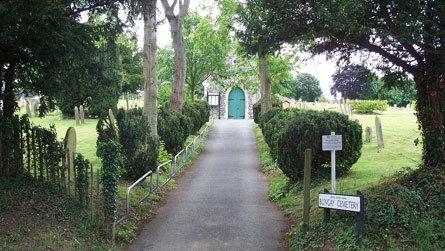
Last night my cousin shared a photograph with me. It was taken after the 1908 hurricane hit Bungay and severely damaged two Cemetery chapels. What interested both of us about the photograph was the gravestone in front. It was a Jolly grave. Our common ancestors. Not only that, the grave was for two children - brothers - one aged twelve and the other aged nine, who had drowned. Putting my Miss Marple hat on, I went straight to the British Newspaper Archive website.

Bungay Cemetery Chapel; the aftermath of the 1908 hurricane
The Ipswich Journal dated 7 March 1882 reported the drowning death of nine-year-old James Jolly, the son of James and Charlotte Jolly of Bungay. The report states James was allegedly seen stealing from a broken shop window and upon being asked what he was doing, ran away. He was last seen by a school friend who spoke with James and asked where he was going in such a hurry. James replied that he was going on an errand and ran towards the direction of the Bungay Common. The next day a local butcher found a cap on the Common, by the river, belonging to James Jolly and went to alert Policeman Mann. Upon further searching, they found the body of James Jolly who was drowned. An inquest returned an open verdict of "accidental drowning".

Contacting my cousin with the news, we were both shocked about this newspaper article. Curiosity got the better of me an hour or so later and I went back to the British Newspaper Archive on the off-chance that James Jolly's brother Frederick may have also died under strange circumstances. You would be right in assuming that a large percentage of children died in Victorian times. Sickness, disease, inadequate (or expensive) health care and poverty were rife and it would be considered "normal" for a child to die before being given a proper chance at life. You can therefore imagine my total surprise when I found the newspaper report for Frederick.

The Ipswich Journal dated 27 December 1890 reported that Frederick Jolly "died suddenly". After a brief illness ( a common cold) Frederick, who was an errand boy for a local chemist, complained of feeling unwell and was sent home to recuperate. On the way home he met with some of his friends who began taunting him with snowballs. We all know that kids can be cruel but I am pretty certain that they did not anticipate that would be the last time they would see their friend. Frederick allegedly reported to his friends that he had eaten some poisoned sweets and felt unwell. The next day, after a night of vomiting and diarrhoea, Frederick was pronounced dead by the local surgeon, Mr Garneys. The coroner for the district decided that no inquest was necessary and Frederick had died of "sudden illness".

The gravestone of brothers, Frederick & James Jolly
What frustrates me as a twenty-first century genealogist and social historian is that the circumstances of these children's deaths was brushed aside and not properly dealt with. The newspaper reports throw up all kinds of unanswered questions and leaves me sorely wishing for a time machine. In the case of James, he was a nine-year-old boy. A cheeky larrikin perhaps, but a boy who had his whole life ahead of him. How did he come to drown? Why did he drown? Who is accountable for this boys death? Was it a mere accident or was something bigger going on?

In the case of Frederick, he was a twelve-year-old boy who had been sick with a common cold. The circumstances of how he came to ingest "poisoned sweets" is baffling. He worked for a chemist so it may be safe to assume that Frederick may have been curious about the powders and tablets and maybe the temptation to "try" some overcame him. Did he unwittingly kill himself? Why was this not mentioned in the report? It was just expected that he was a child, and children die every day. No big deal.

I am quite saddened that these two brothers died so young. Their parents James and Charlotte Jolly lost two of their sons to unfair and disadvantaged circumstances. I think I can better understand my great-grandmother Nellie Jolly today. She prayed every night, on her knees, beside her bed, with her rosary beads wrapped around her hands, for everyone in her family. She named every single one - immediate family and extended - and she would not raise from her kneeling position until she had mentioned every person.

It turns out that the photograph (pictured above) is actually on page 93 of Christopher Reeve's 2009 book "Bungay Through Time". The photograph's caption reads:
"Bungay Cemetery, Hillside Road: The Cemetery, established in the late nineteenth century, originally had three mortuary chapels. In 1908, a rare hurricane occured which blew down the north wall of one of them, and it was demolished soon afterwards..."

Bungay Cemetery today


Monday, 21 January 2013

2013 Australia Day Challenge : My First Ancestor To Reach Australian Shores

Nothing conjures up images of Australia quite like sheilas and blokes on crowded beaches, thongs, stubbies, barbecues, cricket, Aussie Rules football, Holden Utes, Vegemite, and Banana Boat sunscreen. With Australia Day just around the corner, Helen V Smith came up with the brilliant idea of telling the story of our first Australian ancestor. In November 2011 I wrote a blog post about my more "rebellious" ancestors. One of those was my 3 x great-grand uncle Frederick Ward. Born in 1821, Fred was the first ancestor (that I know of) to reach Australian shores from his humble hometown of Bungay in county Suffolk, England.

Remains of Bungay Castle, 1819
William Buckley welcomes Batman
William Buckley meeting John Batman's party, Australia 1835

The following is taken from my previous blog (basically, because I'm feeling lazy):

"My visits to my local genealogical society over the years has seen many interactions with Australians who rather proudly announce that they each have at least one Convict ancestor in their family tree. Many boast that without them they wouldn't be here today. White Australian settlement history rests largely on the shoulders of those Convicts who sailed on Convict ships, from as early as 1788 through to the mid 1840s when criminal transportation was put to an end. The last of those Convicts were known as 'Exiles' because, basically, they were not  really wanted anywhere. There was no room for them in England. Its prisons were fit to bursting, and many were placed on Prison Hulks off the coast until there was a place for them somewhere or a final decision from officials could be arrived at.
Frederick Ward, my third great-grand uncle, was one of those 'exiles'. In December 1844 he was sentenced, at the Beccles Quarter Sessions, to be transported for 7 years, for stealing three stones weight of cows flesh from James Skippon of Bungay. Unfortunately, this was not Fred's only crime. He had been convicted on two previous occasions; in 1843 and 1844, both on accounts of larceny, and was sent to Beccles Gaol.

In December 1844 Fred Ward was sent to Millbank Prison in London. Millbank was intended to house up to 1000 transportation prisoners at any one time. The average stay was for around three months, during which time prisoners would be assessed for future placement. By the early 1840s transportation sentences were ceased but there were still many prisoners who faced the possibility of being sent away.

In 1843 Millbank was converted to house general prisoners and transportation prisoners, including Fred Ward, were moved to Prison Hulks. Finally in January 1847 Fred Ward was placed on the 'Thomas Arbuthnot' with around 288 male prisoners from Millbank, Pentonville & Parkhurst Prisons and sailed from Spithead to Port Philip Settlement (Melbourne), arriving in May 1847. The 621 ton ship began her voyage at Portsmouth, then travelled to the Isle of Wight where she took on 90 Parkhurst boys. The Times newspaper had this to report:

"The Thomas Arthbuthnot convict ship, Captain Therason, sailed from Spithead this morning for Port Philip with a superior class of delinquents, officially called "exiles". These are the first "exiles" sent to the above settlement, which the inhabitants of that respectable place are very wroth at, and have memorialised the Government on the subject..."

Little is known about Fred Ward after his arrival to Port Philip. This is still a work in progress. What is known is that people such as Richard Deeks spent his precious time researching and transcribing all transportee records of Suffolk and turned it into a book. It was this invaluable book, printed in 2000 and entitled, 'Transportees from Suffolk to Australia 1787-1867' (held at the Suffolk Record Office), which helped me to locate and further research Fred Ward."


Monday, 5 November 2012

Family History Through The Alphabet Blog Challenge : Z is for...

Here we are, the last post (bugle sounds) for the Alphabet Blog Challenge and once again I have to credit somebody else for the topic of the most baffling letter of all. My amazingly perceptive daughter came up with Zeppelin. How could I refuse when I've already blogged about my 4xgreat-grandfather Zachariah Rudd?


It makes perfect sense to write about the Zeppelin raids which affected my ancestors, not least because my ancestors lived in London and along the East Coast of England (the counties of Suffolk, Norfolk, Essex and Kent were repeatedly raided from 1915-17) but because my paternal grandmother Freda often spoke of her parents who saw the Zeppelins as they came across the North Sea.

Before the First World War, Count Ferdinand von Zeppelin developed an airship specifically for long-distance passenger flights. When the war broke out in August 1914, these airships were taken over by the German army. Throughout the war the Germans were prepared to try new forms of warfare and in January 1915 they mounted the first airship raid on England.

On the night of 19 January, two Zeppelins bombed the docks at King's Lynn and Great Yarmouth (county Norfolk) which killed four people. The East Suffolk Gazette reported that a Mr T W Holmes of Denmark Road, Beccles "believes he heard an airship coming over the town, possibly on its way back after its tour in Norfolk". Other raids followed and much damage was inflicted across the Eastern Counties. In the Autumn of 1915 a raid on the City of London killed 38 people and caused extensive damage.

A Zeppelin over Cuffley, county Kent
They look eerily like Alien space-craft

During my research into the Zeppelin raids I was amazed to discover how they were made. Zeppelin airships had a metal frame containing large bags of hydrogen gas, which lifted the craft into the air. They were powered by engines mounted outside the craft. Crew and bombs were carried in a gondola which hung underneath the craft. There was no protection which meant the men were exposed in all weather conditions, and there was nowhere to sit in the gondola which meant long periods of having to stand up. In the early part of the war the bombs had to be dropped by hand!

Most Zeppelins flew too high for British aircraft to catch and attack them but by the autumn of 1916 British airplanes were equipped with explosive shells (and later, incendiary bullets) and on 2 September the first Zeppelin was shot down by a British pilot. After two more unsuccessful raids, the Zeppelins stopped coming. By 1917 most German airships were restricted to reconnaissance work at sea. According to the Illustrated History of the First World War by John Keegan, "Germany flew a total of 115 military Zeppelins during the war, of which 77 were destroyed, 7 captured, 22 scrapped and 9 surrendered to the Allies".

Raid on Great Yarmouth, Norfolk 1915
Zeppelin Raid on Bury St Edmunds, Suffolk 1915

My great-grandparents may not have been directly affected by the Zeppelin raids of 1915-17 but they were certainly witness to its overall destruction and reign of terror across England. I know that my great-grandparents would have seen continual wreckage through both the Zeppelin raids and the Gotha Raids in London.

During the early part of the First World War my great-grandmother Elizabeth was living in Fulham, raising four children alone whilst her husband, my great-grandfather Albert, was fighting off the coast of Turkey with the Royal Navy Reserve. It is known that areas nearby to Fulham were repeatedly targeted and bombed in the 1917 Gotha Raids. I believe that is why Elizabeth and my great-aunts and great-uncles subsequently moved to Edmonton around 1917-18.

My paternal great-grandparents were living close to the coastline of Suffolk during the First World War. My great-grandfather Arthur Ward may have been on the Western Front serving his King and Country but his wife, my great-grandmother Barbara, was living in the heart of London with four of their children, including my grandfather Herbert. It is no small wonder that following 1917, they moved back to Suffolk.


Monday, 29 October 2012

Family History Through The Alphabet Challenge : Y is for...

In this, the second last week of the Alphabet Blog Challenge I'm currently recovering from a bad back so please bear with me if I type any nonsensical sentences. And we're off and racing. This week's topic: Y is for Yorkshire.

In the early days of my family tree research I narrow mindedly assumed that my ancestry was distinctly East Anglian (aside from my maternal grandmother who I knew, from childhood, hailed from London). As my research deepened however, I discovered that my father's side boasted ancestors from county Hampshire, Dorset & Somerset, and Cheshire. When I first found out my maternal grandfather's ancestors were from Yorkshire I was so delighted, I did a merry dance in front of everyone at the Genealogical Society!


To learn more about my ancestors' Yorkshire roots, I read Lettice Cooper's 1950 County Book: Yorkshire West Riding. There I found the following description of the village of Horbury, where my ancestors lived for well over a century, painting an idyllic picture of their lives: "Horbury was a characteristic village. Its narrow streets, climbing the hill between stone houses, were linked by narrower ginnels and snickets, paths just big enough for two people to walk almost enclosed by stone walls...Horbury is situated up the hill-side above the River Calder, about half way between Dewsbury and Wakefield."

The county of Yorkshire was so named as it is the Shire of the city of York. North Yorkshire is the biggest county in England, formed in part by the old North Riding of Yorkshire. The term 'riding' is of Viking origin and derives from Threthingr meaning a third part. Historically, there were three ridings in Yorkshire - the East Riding, West Riding and North Riding. Today Yorkshire is made up of South Yorkshire, North Yorkshire, West Yorkshire and East Riding of Yorkshire (after the introduction of the 1974 Local Government Act).

South Yorkshire has a population of around *1.34 million and consists of four metropolitan boroughs: Barnsley, Doncaster, Rotherham and Sheffield.
North Yorkshire covers over 8,000 square kilometres of non-metropolitan Dales and Moors, making up over 40% of Yorkshire's National Parks area. Local government districts consist of: Craven, Hambleton, Harrogate, Richmondshire, Ryedale, Scarborough and Selby.
West Yorkshire (where my ancestors hail from) has a population of around *2.2 million and has five metropolitan boroughs: City of Bradford, Calderdale, Kirklees, City of Leeds and City of Wakefield.
East Riding is a ceremonial county of England which includes the city of Kingston upon Hull and the non-metropolitan county of Humberside.
*N.B. Population statistics as from 2011


North York Moors
Yorkshire Moors
Old Cote Cottages, Oxenhope
Horbury Town Hall and Library
Cusworth Hall, Doncaster

Things I personally associate with Yorkshire:
My Preston ancestors who lived in: Horbury : Thornton : Hull : Huddersfield : Wakefield : Dewsbury : Thornhill : Ossett
Yorkshire Terriers : Yorkshire pudding : Moors & Dales : The Bronte sisters (especially Wuthering Heights) : All Creatures Great and Small : Heartbeat : Emmerdale : Pulp


Yorkshire is definitely on my Bucket List


Monday, 24 September 2012

Family History Through The Alphabet Challenge : T is for...

I could have chosen a name for this week's Alphabet Challenge post as there are several names in my ancestry that start with the letter T. For example, Thomas (son of) Thomas, (son of) Thomas etcetera. Rather than bore you all with that, I have chosen to write about Travel as my ancestors have proven, they moved around a lot.


In the times we live in today, we think nothing of walking out of our front doors expecting to access all modes of transport such as cars, mopeds, buses, trains, taxis and ferries. It is easy to take it for granted and forget that our humble ancestors had to rely (most often) on one method of travel: Walking. My London ancestors for example, would not have been able to afford the luxury of owning their own horse and cart or liveried carriage and when bicycles became popular in the Edwardian era, not everybody felt safe riding London's busy streets.
 
Let's cast our minds back to the days well before cars and buses. Before well-paved roads were in demand, our ancestors highways were mere ditches and tracks, potholed and uneven, flooded and thick with mud. If you were rich enough to be able to travel by coach or horse and cart you were at the mercy of the highwaymen. I would bet our ancestors were thankful for the likes of Scottish civil engineer Thomas Telford, who singlehandedly changed the way people travelled forever. The Industrial Revolution also put travel on the map, so to speak. Roads, canals, railway, bridges, even the penny post system, which was introduced in 1840, made travel an exciting thing for our ancestors to contemplate. My ancestors used these methods of travel to move from county to county; village to market town. Where before, in the 1600s and 1700s they remained in one village, they were now branching out and exploring a world outside of their own backyards.
 
Thomas Telford
(1757 - 1834)


Before my 4 x great-grandfather moved to Beccles around the year 1809, he came from an unknown area of Norfolk. How did he come to settle for the village of nearby Barnby? I have this rather romantic notion that he travelled by canal boat or wherry. He saw the village from the Waveney River and thought to himself, "This is pretty, this is peaceful, this will do me" and he settled there, married and he later moved to Beccles with his wife where they raised their eight children.
 
My London ancestors moved around a lot. They are found each ten years (by the census return) living in a different street. For example, one family who lived in Putney had moved two or three streets apart, every ten years. When I travelled to Putney in late 2006, I visited all the streets they had lived in and discovered that although the addresses were in close proximity, they were still quite a distance apart in terms of moving house. How did they move their personal effects from one house to another? I had visions of them having to carry everything they owned or perhaps they borrowed a neighbour's cart to put their mattresses and humble effects into. In times past, our ancestors' homes were not heavily furnished. In particular, the working classes of England who possessed little in the way of dining tables, chairs, beds, cabinets, dressers, sideboards and wardrobes. I wonder what they would make of an IKEA store if they could see one today!
 
Image courtesy of www.rushdenheritage.co.uk
 
In the past one hundred years transport and travel methods have vastly improved and we have seen many changes and upgrades with railways, cars, ships and airplanes. My first cousin 3 x removed was the first to embark on a journey from London to New York by airplane in 1947. She well and truly caught the travel bug, as passenger list records prove she travelled back and forth from England and America regularly, both by ship and by plane up until her death in 1975.
 
My great-grandfather refused to drive a motor vehicle, choosing instead to ride a bicycle. He used this method of travel wherever he went and would happily ride for miles and miles at any given journey. He was seen daily in Beccles, from the early 1900s up until around 1970, riding to and from work and to and from church, as well as neighbouring villages and market towns. When he grew much older and age robbed him of his eyesight, his family were very concerned for his safety but he was stubborn and could not bear to part with his trusty cycle. No amount of coercion convinced him to give it up until one day his sons were forced to hide his bicycle away. This story still breaks my heart when I tell it, because I know full well how my great-grandfather must have grieved this enforced loss. I do not drive either. I refuse to just as my great-grandfather did. Instead, I rely on buses, trains, lifts from family and friends, and my two size-seven feet.
 

Edwardian Gent with his Bicycle


Monday, 27 August 2012

Family History Through The Alphabet Challenge : P is for...


This week I changed my mind three times. First of all I was going to write my P post about Putney, where my great-grandparents were born. Then I decided that I wanted to include Perth, Australia in my post. Then came my third choice. A post dedicated only to Perth.


My relatives came to Perth from the early 1970s through to the late 1980s. I assumed that we had no known ancestry living in Australia before that time until I began seriously delving into my family history. That was when I discovered that I had two distant great-grand uncles that landed on Australian soil well before we did. One lived in what is known today as Melbourne (it was known as Van Diemen's Land when he arrived off a convict ship in 1847) and the other emigrated to Queensland in the 1960s (and later lived on Magnetic Island).

Before European colonisation, Perth was inhabited by the Whadjuk Noongar people for over 40,000 years. Evidence of this was discovered through archaeological findings along the Swan River. The area where the city of Perth now stands was called Boorloo by the Aboriginals living there at the time of their first contact with white people in 1827. Perth was named by Captain James Stirling in 1829 after Perth, Scotland (in honour of British Army Officer, Sir George Murray 1772-1846). Queen Victoria announced the city status of Perth in 1856.


St Georges Terrace, circa 1903
Perth's main CBD street
St Georges Terrace today
Trinity Church still stands amongst the skyscrapers
 
Forest Place or Chase, once a thoroughfare with Boans
Department Store on the left
(My Mother & Aunt worked at Boans
when they first came to Perth)
The GPO Building can just be seen on the right,
halfway up the street
Today Forest Chase is closed to traffic and Boans has
long since been demolished.
The GPO Building (the brown building) still stands
Swan Brewery, circa 1879
 
Swan Brewery today, following redevelopment in 2001
 
Perth Skyline 1935
Perth Skyline c. 1945
Perth Skyline 1964
Image courtesy of J McCall

My grandmother Lilian in Kings Park
City Skyline in the background, 1982
Perth Skyline 2012
Perth Skyline at night
My favourite way to see the City, from Kings Park


My favourite reasons for living in Perth are its historical buildings and early twentieth century architecture, its Aboriginal heritage and diverse 21st century culture, the Swan River and City foreshore, Kings Park and Botanical Gardens, the endless stretches of white, sandy coastline, Fremantle, the black Swans and the National Parks from Mundaring to the Darling Scarp. Perth is still growing, still changing, still developing and re-developing. We may be isolated from other cities in Australia but we're lucky for it. We might be thought of as selfish or snobbish to some outsiders but we are staunchly proud of our City.

Perth's state symbol, the Black Swan

Acknowledgements and thanks to Battye Library Perth, West Australian Museum, Royal West Australian Historical Society, Australian Institute of Landscape Architects (AILA) and author Tom Austen.