Showing posts with label local history. Show all posts

Monday, 8 July 2013

William Sibley : In the wrong place at the wrong time?

My 3xgreat-grandfather William Sibley (1826-1889) was charged, and later acquitted, in 1860 for conspiring to steal from the publican Thomas Rule of the Coopers' Arms public-house in Putney. When I discovered his name in the Police Intelligence section of The Morning Post (at British Newspaper Archive), I was initially shocked. As I read on, however, I found out that William Sibley was innocent. What follows is an extract from the aforementioned newspaper, dated 30 January 1861:

William Carlton, who described himself as a photographer, and William Sibley, a wheelwright, were placed in the dock before Mr Ingham, charged with being concerned with stealing £5 from the Coopers' Arms public-house in Putney, the property of the landlord Mr Thomas Rule.
The robbery was committed on the 11th of December 1860 and the money, consisting of gold, silver, and halfpence was taken from the bureau in Rule's bedroom. The bureau was locked but not the bedroom. William Sibley was in the house during the said afternoon and was in and out several times and in different parts of the premises. He had a cart at the back door and he went out two or three times to examine it. William Carlton was at the bar with another man, and they had some gin-and-water at the bar. They appeared very fidgety, for they kept going out and returning alternately, and they both left without drinking their gin-and-water. It further appeared that Sibley lived in Putney [in 1861 census he lived at Stratford Grove] and Carlton formerly carried on his photography business opposite to the Coopers' Arms.
My 3xgreat-grandfather denied all knowledge of the robbery, and explained the reason for the cart being at the back of the public-house. He had it to repair and was waiting for assistance to drag it home. Thomas Rule claimed that Sibley had been in his bedroom before, to do repairs to a set of drawers but that he and his daughter [Caroline Rule] were unable to say whether Sibley and Carlton had actually communicated with one another on the day in question.
Mr Ingham refused to allow bail for Sibley, despite Sergeant Blanchard knowing nothing against Sibley before. The evidence of the witness [who was not named during the trial] was that he had evidence that Sibley had known about the robbery one week before it occured.
According to the Criminal Registers on Ancestry, William Sibley and William Carlton were acquitted at Newington on 18 February 1861.

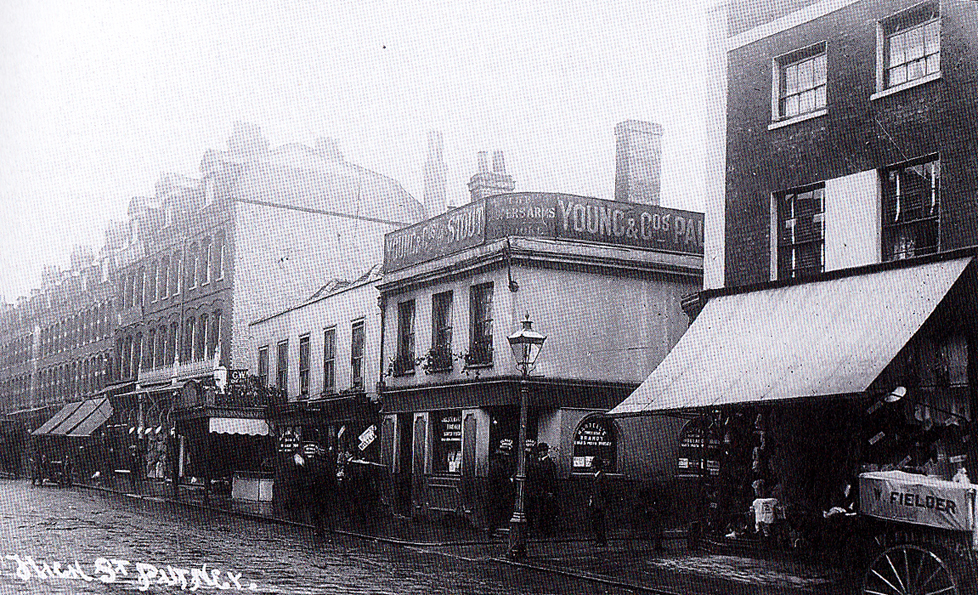
Coopers' Arms public-house, Putney circa 1905

The Coopers' Arms public-house gave its name to Coopers' Arms Lane, which was later renamed Lacy Road. Coopers' Arms Lane was formerly known as Warpell-Way, warp meaning "distinct pieces of ploughed land seperated by the furrows". A thoroughfare in Putney partly preserves the ancient nomenaclature in Warpole Road. The Putney High Street was largely unchanged until Edwardian times when the pub and cottages alongside were demolished and replaced by Edwardian shops. These were removed in the 1980s to make way for the Putney Exchange shopping centre.

Sources used for this blog post: British Newspaper Archive & Ancestry
Putney & Roehampton by Patrick Loobey
 

Tuesday, 19 March 2013

Body of a Child : My Ancestors Involved in a Mystery

My last blog post referred to two of my Jolly cousins - well, second cousins three times removed to be precise. This time I'm embarking on another Jolly story, as shared recently by my third cousin. She has contact with a Jolly descendent who sent her an article which involves our 3 x great-grandfather Josiah Jolly, who was with two of his sons Josiah Jolly (jnr) and Charles or David Jolly (our second great-grand uncles), when Josiah (jnr) discovered the body of a baby in a field.

*At the time of this event Josiah Jolly (snr) and his wife Susan were living in Plough Street, Bungay. The Plough Inn mentioned below was on this street. Today, Plough Street is known as Wingfield Street. Josiah Jolly (jnr) had married the previous December and the 1851 census return (taken 30 March 1851) puts them both at Shipmeadow Workhouse as Inmates.

The Bury and Norwich Post Newspaper, dated 27 August 1851, reported:

BUNGAY
Body of a child found: -- On Saturday evening, as a labouring man, named Jolly, was going home from his work, in the company of his father and brother, he went into a barley-field near St John's-Hill, to gather some rabbits' meat. He saw a parcel lying there, three or four yards from the gate, apparently done up in white cloth. He mentioned it to his father, who told him to leave it alone, as someone might have placed it there intentionally and would come for it. On the following Monday morning, on going to work, he again saw the parcel, and on examining it, found it was an old basket, wrapped up in a cloth, and inside another cloth he found the body of a female infant. The cloth round the body was marked with red cotton, "C.E.O.T." Information was sent to the police, and an inquest was held before Mr Lawrence, on Tuesday, at the Plough Inn*, where Chas. W. Currie, surgeon, who made a post-mortem examination of the body, deposed that it was that of a full-grown infant, and must have been perfectly healthy when born. He did not discover any external marks of violence : it had lived but a very short time, if it had lived at all...

Postcard

The article my cousin received was from The Bungay Society Journal, No 71, dated December 2010. Here is an extract:

A LOCAL VICTORIAN TRAGEDY
On Monday 18 August 1851 the police received information that the body of an infant had been found on a field near St John's Hill. Local Inspector Nagle went immediately to the spot, and was handed a basket, containing the body of a child by a labourer, Josiah Jolly, who had discovered it.
The following day an inquest into the death was held in the town. Mr Lawrence, a coroner from Ipswich had been summoned to attend, and the sessions were held at the Plough Inn, in Wingfield Street. At that time pubs were often used for such proceedings if there were no other public building available. The Plough was an ancient tavern, and was the last building in Bungay to retain a thatch when it was finally demolished in 1964.
The coroner heard this evidence from Josiah Jolly. "I am a labouring man, and live at Bungay. About half past seven on Saturday evening, as I, my father and brother went to the gate of a field near St John's Hill, intending to gather some rabbits' victuals, and as I was getting over the gate, I saw a parcel lying in the field, about four yards from me, which I pointed out to my father. He desired me to leave it alone...When we reached Mr Sewell's house on the Ollands, I saw him standing by the gate talking to three persons who appeared to be begging and I told him what I had seen...On the Monday morning, as I, my father and brother were going past the same field I went to the gate to see if the parcel was still there and on seeing it, took it up, and brought it into the road to my father. I untied the cloth and found an old basket, on opening which I saw something pinned up in a cloth. I took out the pin and began to remove the cloth, when I observed a child's foot...

On 22 August 1851 the police apprehended a woman named Leggate, against whom there were some peculiarly suspicious circumstances. She was remanded in custody until the 28th, and afterwards consented to a medical examination, but it was certified that she had not given birth to a child, and was discharged.
The final inquest was conducted on 6 September, with negative conclusions. The Jury returned a verdict that the child had "been found dead, but whether born alive or not, the Jury have not sufficient evidence".
It as further reported that many rumours had been in circulation, one traced to a man named George Codling, who was said to have stated that the parcel containing the body had been seen at Jolly's house on the Sunday preceding the day of the discovery in the field. As Codling refused to attend the inquest and confirm his statement before the Jury, the coroner concluded that it was just malicious fabrication: for which he regretted that there was no punishment...

Ordnance Survey Map of Bungay
Shows St John's Hill, The Ollands & Wingfield Street
Click to enlarge


It would appear that my Jolly ancestors had a penchant for being in the wrong place at the wrong time or were mixed up with and embroiled in misdemeanours, rumours, and, pardon me for saying so, a series of unfortunate events.


Wednesday, 20 February 2013

When Children Die In Strange Circumstances

Last night my cousin shared a photograph with me. It was taken after the 1908 hurricane hit Bungay and severely damaged two Cemetery chapels. What interested both of us about the photograph was the gravestone in front. It was a Jolly grave. Our common ancestors. Not only that, the grave was for two children - brothers - one aged twelve and the other aged nine, who had drowned. Putting my Miss Marple hat on, I went straight to the British Newspaper Archive website.

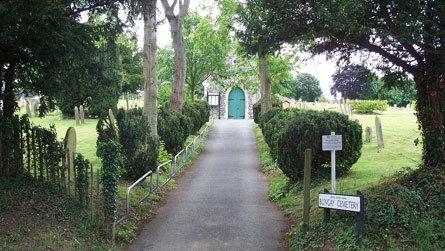
Bungay Cemetery Chapel; the aftermath of the 1908 hurricane
The Ipswich Journal dated 7 March 1882 reported the drowning death of nine-year-old James Jolly, the son of James and Charlotte Jolly of Bungay. The report states James was allegedly seen stealing from a broken shop window and upon being asked what he was doing, ran away. He was last seen by a school friend who spoke with James and asked where he was going in such a hurry. James replied that he was going on an errand and ran towards the direction of the Bungay Common. The next day a local butcher found a cap on the Common, by the river, belonging to James Jolly and went to alert Policeman Mann. Upon further searching, they found the body of James Jolly who was drowned. An inquest returned an open verdict of "accidental drowning".

Contacting my cousin with the news, we were both shocked about this newspaper article. Curiosity got the better of me an hour or so later and I went back to the British Newspaper Archive on the off-chance that James Jolly's brother Frederick may have also died under strange circumstances. You would be right in assuming that a large percentage of children died in Victorian times. Sickness, disease, inadequate (or expensive) health care and poverty were rife and it would be considered "normal" for a child to die before being given a proper chance at life. You can therefore imagine my total surprise when I found the newspaper report for Frederick.

The Ipswich Journal dated 27 December 1890 reported that Frederick Jolly "died suddenly". After a brief illness ( a common cold) Frederick, who was an errand boy for a local chemist, complained of feeling unwell and was sent home to recuperate. On the way home he met with some of his friends who began taunting him with snowballs. We all know that kids can be cruel but I am pretty certain that they did not anticipate that would be the last time they would see their friend. Frederick allegedly reported to his friends that he had eaten some poisoned sweets and felt unwell. The next day, after a night of vomiting and diarrhoea, Frederick was pronounced dead by the local surgeon, Mr Garneys. The coroner for the district decided that no inquest was necessary and Frederick had died of "sudden illness".

The gravestone of brothers, Frederick & James Jolly
What frustrates me as a twenty-first century genealogist and social historian is that the circumstances of these children's deaths was brushed aside and not properly dealt with. The newspaper reports throw up all kinds of unanswered questions and leaves me sorely wishing for a time machine. In the case of James, he was a nine-year-old boy. A cheeky larrikin perhaps, but a boy who had his whole life ahead of him. How did he come to drown? Why did he drown? Who is accountable for this boys death? Was it a mere accident or was something bigger going on?

In the case of Frederick, he was a twelve-year-old boy who had been sick with a common cold. The circumstances of how he came to ingest "poisoned sweets" is baffling. He worked for a chemist so it may be safe to assume that Frederick may have been curious about the powders and tablets and maybe the temptation to "try" some overcame him. Did he unwittingly kill himself? Why was this not mentioned in the report? It was just expected that he was a child, and children die every day. No big deal.

I am quite saddened that these two brothers died so young. Their parents James and Charlotte Jolly lost two of their sons to unfair and disadvantaged circumstances. I think I can better understand my great-grandmother Nellie Jolly today. She prayed every night, on her knees, beside her bed, with her rosary beads wrapped around her hands, for everyone in her family. She named every single one - immediate family and extended - and she would not raise from her kneeling position until she had mentioned every person.

It turns out that the photograph (pictured above) is actually on page 93 of Christopher Reeve's 2009 book "Bungay Through Time". The photograph's caption reads:
"Bungay Cemetery, Hillside Road: The Cemetery, established in the late nineteenth century, originally had three mortuary chapels. In 1908, a rare hurricane occured which blew down the north wall of one of them, and it was demolished soon afterwards..."

Bungay Cemetery today


Monday, 10 September 2012

Family History Through The Alphabet Challenge : R is for...

I've decided to write this Alphabet Challenge post about two of my family lines that start with this week's letter - R. My 4 x great-grandfather was Zachariah Rudd and my 4 x great-grandmother was Sarah Rivett. Both of these families are from my father's side.


Sitting down to write this post brought home the startling reality that I know very little about these two families. I owe what I do know to my second cousin Terry, who was researching his family tree long before I got serious about it. He was able to determine that the Rudd family originated from Thelveton in Norfolk before moving to Loddon and Beccles. The Rivett family lived in the villages of Ringsfield and Shipmeadow, in Suffolk (both of which are located between the market towns of Beccles and Bungay).
 
Zachariah Rudd (born about 1778) was recorded in the census returns as a cotton weaver, a jobbing gardener, and a boot and shoe maker. Every ten years his address appears to change from Beccles in 1841 (Smallgate Street)  to Loddon in 1851 (with his daughter and son-in-law William Leman, who I posted about a few weeks ago) and then back again to Beccles (Old Market in 1861 and Northgate in 1871). Zachariah Rudd died in 1871 at the ripe old age of 94. I wonder what his secret to long life was back then!
 
Sarah Rivett (born about 1780) in Shipmeadow, Suffolk. Today there is scarcely nothing to the village of Shipmeadow. It has no shop, public-house or church (the latter was made redundant in 1980) but its parish workhouse still stands today, as a testiment to its history, even if it has been converted into modern housing and flats. Sarah married Issac Turrell in 1807 and they had at least six known children. They lived in nearby Ringsfield but unfortunately the census returns of 1841 and 1851 does not give an actual street address. Ringsfield was a small village with over 1,000 acres of agricultural land and farm-houses; today it has a primary school, a village hall and a public-house. The church of All Saints is a Grade II listed building and the churchyard contains the grave and memorial of Napoleon Bonaparte's  great-niece Princess Caroline Murat.
 
Ringsfield Church, a sketch from 1819

Ringsfield Church, 2011

Princess Caroline Murat's Memorial Gravestone
 
Interior of Ringsfield Church, 2011
Ringsfield Hall
http://www.ringsfield-hall.co.uk/


The Three Horseshoes, Ringsfield
Photo courtesy of Tony Green
http://pubshistory.com/Suffolk/Ringsfield/ThreeHorseshoes.shtml


I do not know who either Zachariah Rudd or Sarah Rivett's parents were. There is more work to be done on these family lines. It takes a blog post like this one to make you notice the gaps in your genealogy research. Turns out this post had more to do with Ringsfield, which is probably just as well as it still covered the letter R for the week!


Monday, 3 September 2012

Family History Through The Alphabet Challenge : Q is for...

This week's letter was a challenging one I confess. I have no ancestry names that start with Q (unless you count my first cousin four times removed, Charlotte Foster who married George Quinton in 1888). No, I thought my best bet was to write about Quarter Sessions but with a Becclesian twist (being Beccles, in county Suffolk).


What are Quarter Sessions exactly? Researching Records of the Court can be daunting and just a tad mind-boggling to the average amateur genealogist, such as yours truly. Terms such as Minute Books, Order Books, Assizes, Session Rolls, and Judicial Proceedings leave my brain swimming. I can easily explain, however, that Quarter Sessions were held four times in a year (hence the name, Quarter) at: Easter, Midsummer, Michaelmas and Epiphany (January). Quarter Sessions were presided over by the town sheriff or his deputy; or a Justice of the Peace (magistrates).

The Beccles Charter of 1584 granted the right for a gaol to be built in the town. Beccles historian E. A Goodwyn wrote: "The holding of Quarter Sessions at Beccles indicates the importance of the town in the country. Theft, poaching, assault and bastardy orders here the most cases..." Public interest in crime was strong and many books on crime and criminals were sold in Beccles shops, such as Horth the chemist. A body on a gibbet was common in large towns and in market towns such as Beccles public whipping frequently followed the Quarter Sessions. It is interesting to note that public whipping was carried out to coincide with Market Days. This was done on purpose; it drew in large crowds from both Beccles and neighbouring visitors. Public whipping of women was abolished in 1791.

Image courtesy of Rictor Norton

Beccles sessions were held at the Town Hall (on the site of the old Market Cross), in the New Market-place. Beccles also had a Custom House, Assembly Rooms and a House of Correction (Gaol) near Newgate. In the first half of the nineteenth century the Earl of Gosford (then Lord of the Manor) held court in the town. The chairman was Colonel Henry Bence Bence (that is not an error, that really was his name).

Beccles House of Correction was situated on the site of the Game Place which is now covered by Tesco Supermarket (formerly, Clowes Printing Works), bordering Gaol Lane and Newgate. In 1679 it was agreed that the House of Correction should be placed on the Game Place, a former open-air theatre where plays took place by travelling acting companies. In the 1780s the Public Hall (orgininally called the Assembly Rooms) was built.

In 1865 Quarter Sessions in Beccles came to an end and all cases were transferred to Ipswich, despite initial opposition from the magistrates and townsfolk of Beccles. After this time, the House of Correction was used as a County Police Station in which there was accommodation for a married inspector and his family and three constables. The building was remodelled in 1874 which included eight cells and a large airing-yard for prisoners. Petty sessions and Police Courts continued to be carried out in Beccles.

Image courtesy of Eugene Ulph
"Time Remembered"

The Beccles Quarter Sessions paint some pretty disturbing images in history. What follows may make you laugh or cry but they are an insightful look into the life of our ancestors:

1764. Elizabeth Thornton, being disorderly, idle and refusing to work, to be publicly whipped "until bloody".
1766. Fines imposed on 5 Beccles men for non-appearance when chosen as Jury men.
1769. A woman of Beccles to be publicly whipped in the Market Place for reeling false yarn. Commited to the Bridewell for 14 days.
1771. Martha Mash and Hannah Peake for stealing 13 turkeys and one goose. Mash to be transported to America for 7 years. Peake to be publicly whipped on the next Market Day.
1777. Bejamin Eves stealing a pig. Publicly whipped the next Market Day.
1771. John Poll, charged with bastardy, to enlist for a soldier.
1774. Sarah Calver, for feloniously stealing 3 loaves of bread out of the house of John Sratford of Wenhaston, to be publicly whipped and discharged.
1790. Will Burroughs. Petty Larceny. 3 months hard labour and publicly whipped the next market day in Beccles.
1794. Ely Leggett leaving poor house at Shipmeadow and taking away apparel belonging to the same. Sentenced to 2 months hard labour and solitary confinement in Beccles Gaol.


Beccles Town Hall

A Beccles guidebook of 1888: Town Hall of Beccles now used as a Public Library and contains 6,000 volumes. In 1904 it was said to hold over 9,000 volumes and was under the control of 12 committee members. However, in 1911 the East Suffolk Gazette newspaper reported thus: The Council intends to recover possession of the old Town Hall, near the Church, now used as a Public Library, to use it as a Council Chamber and offices for the Borough Surveyor.

If you are interested in knowing more about the history of Beccles you may like to subscribe or follow my Twitter page @RelicsofBeccles where I regularly "tweet" historical facts and anecdotes of Beccles.

Monday, 30 July 2012

Family History Through The Alphabet Challenge : L is for...

This week I present to you another alphabet blog challenge double whammy. A couple of weeks ago I wrote a post about my 3xgreat-grandfather Josiah Jolly, and this week I am writing all about my ancestors, the Leman's of Loddon.


My ancestors - the Leman's (pronounced like the fruit, lemon) lived in the county Norfolk market town of Loddon in the 1700s through to the early 1900s. Situated about 12 miles from Norwich, Loddon is thought to mean muddy river (Celtic meaning). The Norfolk Broads is connected by the river Chet that runs through Loddon. In the past Loddon was largely agricultural but nowadays it is a commuter settlement for those who work in Norwich, Lowestoft and beyond.
My 4xgreat-grandfather William Leman was born about 1767 and lived in Loddon until his death in 1839. Writing this post has brought to my attention that I know nothing else about him, not even his occupation (I will order his death certificate, pronto). He may have had a brother, John Leman, who died in Loddon in 1843. John can be found in the 1841 census as 'Independent', living in The Grove. There is also William's son, John Leman, who was a Grocer & Draper on the High Street. William's youngest son, born in 1814 was my 3xgreat-grandfather.

Leman's Grocer & Draper Store (right)
Image courtesy of Before Your Time: http://www.loddonhistory.org.uk

William Leman was a Saddler & Harness Maker by trade. He was listed in various Trade Directories such as Kelly's and Pigot's. In 1838 William married a local girl from Thelveton (more about her family will be written in my letter R post). They had at least seven known children, including twin daughters. One of those twin daughters was my 2xgreat-grandmother. It is not entirely clear who introduced the Methodist faith to the Leman family but sometime in the 1800s they were known for this religious practice both in Loddon and surrounding districts, such as Beccles.

William's brother John Leman, mentioned above, had a son John Spence Leman. He carried on the grocer & draper business in the High Street for many years, until his death in 1908, when his son Ernest Spence Leman carried on the trade. Of the two brothers, John Leman seemed to have faired better, business-wise. William Leman's humble, yet important for the time, trade of Saddler was not carried on by any of his sons. In fact, they followed in their uncle John's footsteps and became Tailors, Clothier Assistants and Drapers.


Leman's Universal Stores
Image courtesy of Before Your Time http://www.loddonhistory.org.uk

The Leman family owned land right up both sides of the High Bungay Road as well as several other throughout the village. On the Tithe Map of 1838, John Leman owned some property in The Pits, while he owned and occupied The Grove - the cottage right on the point between High and Low Bungay Road. Today this Grove is called Leman Grove which intersects with Leman Close and High Bungay Road.


"Leman's Universal Stores sold everything from bacon to best hats. The first floor rooms were only 5' high and were used as a mini sweat shop with girls and ladies sewing the orders in the shop below. The rails outside supported a blind which pulled out to shade the articles in the window and shelter window shoppers if it rained. The Leman family were ardent Methodists and were extensively involved in the community."

My small claim-to-fame is that my auntie used to play tennis with the sister of Davy Jones (of Monkees fame) during the 1960s. Davy and his family lived in Loddon for a time. Also, my mother met an Irish pop group in Loddon, called The Bachelors. The photographs in her collection are so sweet, the boys are sat at a table with cups of tea whilst they meet and greet the fans!

Monday, 16 July 2012

Family History Through The Alphabet Challenge : J is for...

My cousin Angie has been waiting ever so patiently for this one...and at last, without further ado, here it is. My 'J' alphabet challenge is dedicated to our 3 x great-grandfather Josiah Jolly (Two J's covered in one post, talk about killing two birds with one stone!).


Josiah Jolly was born in Laxfield, county Suffolk around 1806. He was the fifth known son of Robert Jolly, an agricultural labourer. Before coming to Laxfield, the Jolly families were believed to originate from Wortham. Laxfield is from Saxon times and is mentioned in the Domesday book. Its church, All Saints, dates back to at least the fourteenth century. From the seventeenth century, Laxfield became a strong Puritanical village, not least because William Dowsing (1596-1668) who was born in Laxfield, visited many Suffolk churches and was responsible for defacing items such as altar rails, chancel steps, and crucifixes.

All Saints Church, Laxfield

Josiah Jolly married local girl, Susan Short, in 1829 and shortly after this, for reasons unknown, they left Laxfield to start a new life in Bungay with their first born child, Mary. This was a rocky time in their lives if workhouse records and quarter sessions accounts are anything to go by. By the time their second son, Josiah (jnr) was born in 1830, they had sought parish relief at Shipmeadow Workhouse four times.

On the off chance of finding any anecdotal criminal records as part of my local studies research, I ordered the Gaol Books Card Index for Beccles, Suffolk microfilm. I found some treasures, such as one woman who was gaoled for ten days for "Swearing one profane oath" in 1841. When I discovered Josiah Jolly among the records, my heart plummeted.  On 8 February 1831 Josiah Jolly was gaoled for twenty-one days for "Refusing to work at Shipmeadow". By this I assume this meant the Workhouse. In 1841 the master and matron of Shipmeadow Workhouse was Thomas and Anna Balls. See here for more information about the Wangford Union Workhouse: http://www.workhouses.org.uk/Wangford/

Bleak House, I mean...Shipmeadow Workhouse
taken from the main drive from Beccles Road

I am not in the least dismayed by Josiah's apparent "bad behaviour". If you sift through the local newspapers of the time, Beccles and surrounding districts of Suffolk were experiencing unimaginable unrest. There were Tithe Riots, incendiarism, agricultural riots and repeated cases of damage to threshing machines. Agricultural practices were changing and some felt the very real threat of machinery taking away jobs from whole families whose income heavily relied on menial farm labouring tasks. Josiah would not have been alone in feeling this voracious unrest.

However torn his ties to agricultural change were, Josiah and Susan went on to have a total of thirteen known children. The last born, William, was my 2 x great-grandfather. Josiah and Susan lived in Plough Street, Bungay which later became known as Wingfield Street. It was formerly known as Plough Street due to its notable thatched roof publichouse, The Plough Inn. This street is better known today for its Board Schools (known today as Bungay Primary School) which was established in 1877, two years before Josiah died, aged 73.

Plough Street was renamed Wingfield Street after the first school master of the Bungay Grammar School, Thomas Wingfield (founded in 1565). Kelly's Directory 1883: Board Schools, erected in 1877, for boys, girls & infants, with class-rooms to hold about 600 scholars average attendance; boys 162, girls 139, infants 113.

Wingfield Street, Bungay c. 1900
Board Schools was further down, on the left hand-side


Monday, 2 July 2012

Family History Through the Alphabet Challenge : H is for...

H...H...H...I am spoilt for choice for topics for this week's challenge. There is Holt of course, the Norfolk market town where my ancestors lived for many years. There is also Horbury, which is in West Yorkshire. This is where the maternal side of my story began, as far back as 1664...


For those who are not familiar with Horbury, I shall introduce a short history. Situated near the river Calder, Horbury is a village north of the City of Wakefield. When my ancestors lived in Horbury in the 17th century, the largest industry was wool and cloth manufacture. My ancestors are recorded in parish registers as weavers, clothiers and dyers.

Notable people of Horbury include John Carr. Born in 1723, John Carr became an architect like his mason-architect father before him. Among his many designs are Fairfax House, The Crescent at Buxton, as well as churches, prisons, racecourse grandstands, hospitals and bridges in Yorkshire, Nottingham and Derbyshire.

John Carr

Music was a strong influence on two well known men of Horbury. From David Turton (1768 - 1847) to William Baines (1899 - 1922), these two musicians and composers made a name for themselves. Turton combined his love of music with the flannel weaving industry and quite possibly, he was the one who influenced my four times great-grandfather to leave the declining woollen industry behind and pursue music as a career.

Another of my genealogy passions (aside from photographs, postcards and graveyards) is House Histories. I absolutely love to pour over census returns and trade directories, delving in to the lives of people who lived in my ancestors houses and I would go so far as to admit, the whole street. Even my own childhood street, which is the subject of my work-in-progress house history project.

My Childhood Street
There is nothing more satisfying to me than finding out who lived in your house before you. Earlier this year I thoroughly enjoyed reading Julie Myerson's "Home: The Story of Everyone Who Ever Lived in our House" and I also loved the Australian ABC production "Who's Been Sleeping in my House?" both of which have fuelled my, already keen, desire to write up my own house history.

Last week I visited the city library because it has an excellent genealogy reference section. There I ravished house histories books by Trevor Yorke, Nick Barratt, Bill Breckon et al, and Melanie Backe-Hansen's beautifully presented book was also there too. I made pages of notes and came away with my head swimming with ideas for my own book. Who knows if it will ever come to fruition. As it is, I am currently keeping myself busy writing two novels, a short story, and a family history book. I have the preliminary notes prepared at least.

Beyond this Door in Bloomsbury Square is Where my
Grandmother Was Born
What story lies in wait beyond your Front Door?


Monday, 18 June 2012

Family History Through the Alphabet Challenge : F is for...

Welcome to another week, and this week is the letter F. I thought about a post dedicated to fathers as it was Fathers Day in the UK and USA yesterday but, instead, I have chosen to write a post about Fakenham:

My ancestors lived in the Norfolk market town of Fakenham during the 1800s. Around 1825 they left Kings Lynn for Fakenham, which was then nineteen miles away. Situated on the River Wensum, Fakenham is the Saxon name for "fair place" or "fair place on a fair river". The population of Fakenham in 1831 was 2, 085.
The 1839 Pigot's Directory states that Fakenham once had salt pits. Indeed, the Salt Pans are mentioned in the Domesday Book, but these had long since disappeared by the 1830s. Fakenham's economy was later replaced by crepe manufacturing, Fakenham Mill, corn growers markets and a renowned printing industry. Thomas Miller was the first person to bring the printing press to the town in the 1800s. My 3 x great-grandfather learnt the printing trade himself and established a successful business in the nearby Norfolk market town of Holt.
Fakenham Market Place
Poppyland Publishing

In Jim Baldwin's ©1982 book Fakenham: Town on the Wensum he says, "The town of Fakenham developed around Tunn Street and Swan Street. In fact the oldest original house remaining in the town is situated at the junction of these two streets...Oak Street formed part of the early development of Fakenham...". My 4 x great-grandfather lived in Oak Street and, later in Swan Street and White Horse Street. He was the town's organist and musical instrument seller. The church of Fakenham is St Peter and is well noted for its tower which can be seen from many distant views. In 1826 a brand new organ was bought for the church by the late Rector. My 4 x great-grandfather would have been a part of this celebrated day and he would have played this new organ to the congregation of Fakenham.
St Peter's Church
Norfolk's Past on Canvas: BBC Website

The 1839 Pigot's Directory likes to boast the Robert Bloomfield, "celebrated as the author of The Farmer's Boy and many other sweet poems of a rural and domestic character, has, in a pleasing tale, called The Fakenham Ghost, eulogized this town in a very pretty manner". Others argue that Bloomfield referred to Fakenham Magna in Suffolk. Here are the first four stanzas:
Benighted was an ancient dame,
And fearful haste she made
To gain the vale of Fakenham,
And hail its willow shade.

Her footsteps knew no idle stops,
But followed faster still;
And echo'd to the darksome copse
That whispered on the hill.
Darker it grew, and darker fears
Came o'er her troubled mind;
When now, a short quick step hears
Came patting close behind.
She turned; it stopt! naught could she see
Upon the gloomy plain!
But as she strove the Sprite to flee,
She heard the same again.

Finally, this from a Most Haunted message board: Wondered why it rains nearly every market day in Fakenham? Well the story is that years ago Walsingham used to hold a market, but then moved to Fakenham. There was a witch of Walsingham who was upset by this and so put a curse on the market of Fakenham. She said: "There will be more wet than dry days for Fakenham market." People who have heard of this call this the story of the Walsingham witch. You can always guarantee that there will be more wet market days than dry - is it just a coincidence?

Fakenham Wood, Euston Hall
Robert Bloomfield

Monday, 28 May 2012

Family History Through the Alphabet Challenge : C is for...

Last week I mentioned that this post would be about Cross Street, which I decided to incorporate with my topic about Bungay for the letter B. Cross Street was where my mother lived during the 1960s with her parents and siblings. They lived in the biggest house in Cross Street, and they ran the tearooms at 6 Cross Street.


Cast your mind back to the 1960s. It was a heady time for the youth, with popular music and fashion being at the forefront of most young people's minds. Where would you go in a small market town where you could get together with your friends? And, what about the older generation who didn't want all that noisy parlava? They went to Alfo's Cafe in Cross Street.

There you could get a decent, greasy fry-up meal all day (and sometimes very late at night if you were a passing lorry driver). And bottomless cups of tea. If you went to Alfo's in the 1960s, chances are you were served by a member of the Preston family.

Alfo's circa 1966
Back of Alfo's in 1966
Man on far left: My godfather, Tony Moore
Second from left: My grandmother Lilian
Boy in front with football, my uncle Raymond
Young man with cup and saucer, my uncle Malcolm
The Tearooms have changed hands many times over the years, and during family visits back to England various photographs have been taken of what was once the family business, albeit for a short time. I believe it was listed in August 1972 as a Grade II Listed Building. Later known as The Buttercross Tearooms, its namesake cleverly taken from the famous buttercross in the Market Square around the corner, it looks like this:


For an interesting blog review of Cross Street Tearooms, see the Fry Up Inspector.

During the 1960s my mother and family lived in the big house in Cross Street. This early nineteenth century, three storey, limewashed brick house is also a Grade II Listed Building (listed in August 1972). The house is situated directly opposite the Buttercross Tearooms (once Alfo's). Conveniently, not too far to walk from home to work. :-)


Next door to the house were a block of public conveniences, the gents entrance being closer to the house. My mother and aunt still love to giggle as they recount the story of times spent together, hanging out of the first floor window calling out, "We know what you're doing!" to unsuspecting members of the public.

  
History of Cross Street
Cross Street had two publichouses in the nineteenth century - The Crown Inn and The Jolly Butchers, the latter of which was run by James & Susannah Laws.
Until 1930 Cross Street was home of the Bungay Fire Engine Station (This was situated next door to the Cross Street house). In 1889 a fire engine was purchased by subscription at a cost of £187 15s. The town reeve contributed £50 to the total cost. In 1892 John Howlett was Captain and had eight men.
In 1904 a fire escape was provided. The 1912 Kelly's Directory describes the Cross Street Fire Engine Station as a plant consisting of 3 manuals, and 1 fire escape. William Richards Norman (victualler of the nearby Fleece Hotel) was the Captain and had fourteen men.
In December 1930 the new Fire Engine Station was opened in Lower Olland Street and by 1937 was equipped with a steam fire engine, a 35 h.p. Daimler tender, 2 manuals and a fire escape. James W Jeffries was Captain.
The site of the old Fire Engine Station in Cross Street was converted and extended by Wightman's Drapery & Furniture store but suffered severe bomb damage shortly after completion, during the Second World War.
Acknowledgements: Chris & Terry Reeve of Bungay
All photographs from my private collection


Tuesday, 22 May 2012

Family History Through The Alphabet Challenge: B is for...

Posting a blog on the letter B really is a no-brainer for me because my hometown is Beccles and my mother comes from Bungay; both are Suffolk market towns and both are very dear to my heart. A cousin of mine joked that my letter B post should be called, "Beccles, Bungay and Best Cousin". ;-)

For the purposes of this blog post I have decided to focus on Bungay and incorporate the letters B and C in my Family History Alphabet Blog Challenge because one particular street in Bungay, which is dearest to my mother's family story, is Cross Street.

Bungay is steeped in history, though if you passed through it not knowing anything about its story, you will not find it at all obvious. Bungay has never been one to boast so I will happily boast on its behalf. It has a Castle, a Printing Works (Clays, who were responsible for the printing of Harry Potter books), a theatre,  a web of hidden and blocked-in tunnels which once linked Church to Castle, the infamous legend of the Black Dog (or Shuck as it also known by), a headless horseman ghost, as well as famous people such as Elizabeth Bonhote (nee Mapes) who was the 18th Century author of the gothic novel, Bungay Castle and author Chateaubriand who sought refuge in Bungay during the French Revolution in 1757 (which brings to my mind another, more recent "refugee" in Julian Assange who also stayed in Bungay). Yet another famous author and one-time Chairman of the Bungay Petty Sessions, was Henry Rider Haggard.
Bigod Castle Bungay
Taken by MJ Preston
Bungay has two parishes (St Mary's and Holy Trinity) and upon researching my family tree, I discovered that some of my ancestors were baptised, married and buried in either the St Mary's parish or the Holy Trinity parish. Searching the census returns of 1841-1911 there are clear indications which parish the people of Bungay lived and worked in.

My first known ancestor from Bungay was my five times great-grandfather, Henry Ward. I am yet to find where he was baptised but one avenue I have investigated hinted that he may have come from nearby Flixton. Henry married Rosamund Curtis in 1771 in Bungay St Mary. They had five known children, four boys and one girl. I am descended from the only girl; Mary Ward. She never married but she did have six children. Her eldest, Henry (Harry) Ward was my three times great-grandfather.
Around the year 1830 another of my ancestral lines - Jolly - came to Bungay from Laxfield. My three times great-grandfather Josiah Jolly moved with his wife Susan and their first-born, Mary. Finances were at the bare minimum though for Josiah, who got his living as an Agricultural Labourer and Farmer, and on the birth of their second child Josiah junior in 1830, was recorded as seeking Relief at the Shipmeadow Workhouse.
It was not until the middle 1890s that my ancestral line - Preston - came to Bungay from Norwich in county Norfolk. Here, my great-grandfather Percy Preston, the tenth child of eleven, married a Jolly girl who was also the tenth child of eleven! They had three children, including my maternal grandfather, Percy junior.
Postcard Image of Bungay, circa 1905
What I love most about Bungay is its wealth of local history authors, past and present. One family that immediately springs to mind are the Reeve family - Chris, Terry and their late grandmother Iris. Others are Ethel Mann, Frank Honeywood (the Town Recorder), Malcolm Bedingfield and Charles Patrick. I must single out Frank Honeywood here as he went one step further than merely writing about Bungay. He went out and took copious amounts of photographs of the town, and some of these can be found in published works, as well as at the Bungay Museum in Broad Street or, I would imagine, at the Lowestoft Record Office.
St Mary's Church
Taken by Debs_Dwelling
Holy Trinity Church
Taken by MJ Preston
The Old Pump Site, Looking Towards Bridge Street
Taken by Debs_Dwelling

Earsham House, Grade II Listed Building
One-time Home of Ethel Mann
Taken by Debs_Dwelling
If you are interested in the history of Bungay, please check out these wonderful websites:
Packed with local history and information on Bungay today
Make sure you check out the 'Theatre History' link

Next week, Cross Street...