Showing posts with label churches. Show all posts

Wednesday, 20 February 2013

When Children Die In Strange Circumstances

Last night my cousin shared a photograph with me. It was taken after the 1908 hurricane hit Bungay and severely damaged two Cemetery chapels. What interested both of us about the photograph was the gravestone in front. It was a Jolly grave. Our common ancestors. Not only that, the grave was for two children - brothers - one aged twelve and the other aged nine, who had drowned. Putting my Miss Marple hat on, I went straight to the British Newspaper Archive website.

Bungay Cemetery Chapel; the aftermath of the 1908 hurricane
The Ipswich Journal dated 7 March 1882 reported the drowning death of nine-year-old James Jolly, the son of James and Charlotte Jolly of Bungay. The report states James was allegedly seen stealing from a broken shop window and upon being asked what he was doing, ran away. He was last seen by a school friend who spoke with James and asked where he was going in such a hurry. James replied that he was going on an errand and ran towards the direction of the Bungay Common. The next day a local butcher found a cap on the Common, by the river, belonging to James Jolly and went to alert Policeman Mann. Upon further searching, they found the body of James Jolly who was drowned. An inquest returned an open verdict of "accidental drowning".

Contacting my cousin with the news, we were both shocked about this newspaper article. Curiosity got the better of me an hour or so later and I went back to the British Newspaper Archive on the off-chance that James Jolly's brother Frederick may have also died under strange circumstances. You would be right in assuming that a large percentage of children died in Victorian times. Sickness, disease, inadequate (or expensive) health care and poverty were rife and it would be considered "normal" for a child to die before being given a proper chance at life. You can therefore imagine my total surprise when I found the newspaper report for Frederick.

The Ipswich Journal dated 27 December 1890 reported that Frederick Jolly "died suddenly". After a brief illness ( a common cold) Frederick, who was an errand boy for a local chemist, complained of feeling unwell and was sent home to recuperate. On the way home he met with some of his friends who began taunting him with snowballs. We all know that kids can be cruel but I am pretty certain that they did not anticipate that would be the last time they would see their friend. Frederick allegedly reported to his friends that he had eaten some poisoned sweets and felt unwell. The next day, after a night of vomiting and diarrhoea, Frederick was pronounced dead by the local surgeon, Mr Garneys. The coroner for the district decided that no inquest was necessary and Frederick had died of "sudden illness".

The gravestone of brothers, Frederick & James Jolly
What frustrates me as a twenty-first century genealogist and social historian is that the circumstances of these children's deaths was brushed aside and not properly dealt with. The newspaper reports throw up all kinds of unanswered questions and leaves me sorely wishing for a time machine. In the case of James, he was a nine-year-old boy. A cheeky larrikin perhaps, but a boy who had his whole life ahead of him. How did he come to drown? Why did he drown? Who is accountable for this boys death? Was it a mere accident or was something bigger going on?

In the case of Frederick, he was a twelve-year-old boy who had been sick with a common cold. The circumstances of how he came to ingest "poisoned sweets" is baffling. He worked for a chemist so it may be safe to assume that Frederick may have been curious about the powders and tablets and maybe the temptation to "try" some overcame him. Did he unwittingly kill himself? Why was this not mentioned in the report? It was just expected that he was a child, and children die every day. No big deal.

I am quite saddened that these two brothers died so young. Their parents James and Charlotte Jolly lost two of their sons to unfair and disadvantaged circumstances. I think I can better understand my great-grandmother Nellie Jolly today. She prayed every night, on her knees, beside her bed, with her rosary beads wrapped around her hands, for everyone in her family. She named every single one - immediate family and extended - and she would not raise from her kneeling position until she had mentioned every person.

It turns out that the photograph (pictured above) is actually on page 93 of Christopher Reeve's 2009 book "Bungay Through Time". The photograph's caption reads:
"Bungay Cemetery, Hillside Road: The Cemetery, established in the late nineteenth century, originally had three mortuary chapels. In 1908, a rare hurricane occured which blew down the north wall of one of them, and it was demolished soon afterwards..."
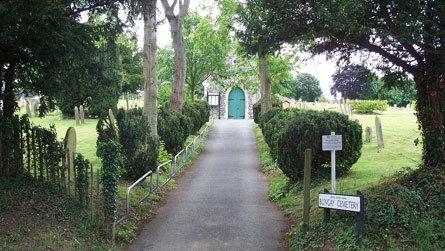
Bungay Cemetery today


Tuesday, 1 January 2013

Percy and Nellie : Centenary Anniversary

Happy New Year to everyone! While we are all busy making resolutions for the year ahead I wanted to share something special with you. Today is a very special day in my family history calendar as it marks the centenary of the wedding day of my great-grandparents Percy Preston and Nellie Jolly.

Percy and Nellie were the last of my great-grandparents to marry (Before them, my other great-grandparents married in 1905, 1907 and 1909). Percy and Nellie were married at Holy Trinity Church in Trinity Street, Bungay (Suffolk, England) on 1 January 1913. The day would have been a Wednesday. I don't know what sort of weather they had but being winter, it would have been mightily cold. The following week saw recordings of heavy snowfall across the north of England.

Nellie would have perhaps worn a hand sewn dress (a collaborative effort with her older sister, Alice or one of her sisters-in-law?) made of warm fabric, with lace and/or embroidery detail, with long sleeves and possibly even a long coat to keep her warm during the walk to and from the church. Perhaps she wore a gown which had been passed down from somebody in the family. While it would not have been as expensive or elaborate as the one worn by Princess Patricia of Connaught (seen pictued below), I am certain that Nellie would have looked equally as beautiful.

Example of a late Edwardian Wedding Dress
Edwardian Era Hairstyles
No known photographs exist of Percy and Nellie's wedding day, so I do not know what Nellie would have worn on her wedding day. I can only speculate. However, I like to imagine her walking from her home in Gas House Lane to nearby Trinity Street, and walking with her father, William Jolly, along the stone pathway which leads into the church. It is so heartbreaking that there are no known photographs of Percy and Nellie together, in existence, at any time. I have plenty of photographs of Nellie with her children and Nellie with her brothers but not one single photograph of Nellie with her husband. When Percy died in 1936, Nellie remained a widow for the rest of her life and she always wore navy coloured clothes.

Postcard: Wrench Series
From the Bungay & District Town Guide 1971


Holy Trinity Church History
Holy Trinity Church dates back to Saxon times when the tower was dated at around 1041 with the nave being added about 100 years later. The dormer window in the roof was created in Victorian times to light the organ loft when the organ was installed. The south aisle is fourteenth century, and the chancel was built in 1926. The pulpit was recorded as being set up in 1558 (which cost all of 10 shillings). This is an account from the Suffolk Institute of Archeaology Vol. IV:
"That this tower is old for a round tower will not be doubte by those who examine the interior. The original design appears to have consisted of four circular windows, and directly under each of these (except that which faces the east) a semi-circular-headed window.
There is nothing in the poor Perpendicular architecture of the Church which calls for special notice. A payment was made for erecting a Screen in the Chancel in 1558. As to the conjecture that the original Chancel perished in the fire of 1688, it is certain that there was a chancel, mutilated indeed by the "improvements" of 1754, when the present tasteful east window was erected - but nevertheless a chancel..."

Postcard: HW Short

The 1912 Kelly's Directory describes Holy Trinity Church thus:
"The Church of the Holy Trinity, supposed to have been built in the eleventh century, is an edifice of rubble, faced on the south side with flints, in the Norman style, and consists of nave and aisles (without chancel), south porch and a round embattled western tower...The pulpit of black oak is a very fine example of Elizabethan work. There are 420 sittings, of which 125 are free..."

The Churchwardens' Book of Holy Trinity also makes for very interesting reading but this one rendered me most curious:
1581. Paid for whipping the dogs out of the churche for a whole year, 1/4.

I wonder, did that include the legendary Black Shuck?

My Great-Grandmother Nellie Jolly, aged 12-15

Monday, 8 October 2012

Family History Through The Alphabet Challenge : V is for...

When I wrote out my alphabet plan on an index card over three months ago (has it really been that long?) I had no problem deciding what I would write for this week's letter. Be warned, dear readers, for this week's blog post is taking a religious slant as I present you with the humble Verger.


My great-grandfather Albert Waters was very active in the Methodist Church of Beccles from his youth until his dying breath. I only have vague memories of him (he passed away when I was six years old) but I remember him being present at Hungate Church when I attended the Sunday School next door. When I was little, my grandmother told me many family stories and one was the story of her father Albert joining the Methodist Church after a rather miserable time at home. Albert's father (my 2 x great-grandfather) liked a drink or six each day and when he wasn't working as a Municipal Superintendent at the Beccles Bathing Place (in Puddingmoor), he would be found next door at the Pickerel Inn.

In Albert's time there were two Methodist Churches in Beccles which he frequented and volunteered for, one in Hungate and the other in Station Road. After researching the duties of a verger I was quite humbled to think that my great-grandfather did these duties without pay and with little in the way of recognition. I also realised that my mother did the work of a verger, on top of her myriad clerical duties, at her local church in the Swan Valley up until last year when she retired.

Station Road, Beccles (Author postcard)
Methodist Church spires can be seen on the left
No longer exists today

Hungate Methodist Church, Beccles
Still exists today

The following extract is taken from the 7 March 1942 Beccles and Bungay Newspaper:

METHODISTS: A century ago the Wesleyans in Beccles were described as “lively and consistent Christians”. Their chapel was a neat building, and though small, yet it will contain about 200 persons. In front of the chapel is a schoolroom and yard so there is plenty of room for enlarging the chapel without the purchase of more ground. A resident minister in this place would soon make this a work of necessity. This building was the present Salvation Army Hall in Northgate. Originally the Methodists were connected with the Lowestoft circuit, remaining so until their services were discontinued in 1853 for a short time.
A few faithful friends were not satisfied, and still wished to remain Methodists, so they asked the Bungay circuit to take over Beccles. This was done, but in 1855 services were restarted at Northgate.After a few years two families removed from Loddon to Beccles and were dissatisfied with the hired chapel, so they set themselves to work for and provide a better building. Station Road was then being laid out, and on a site given by Mr John Crisp the present chapel was built in 1872, the schoolroom and vestries being added in 1887. Beccles was made head of a circuit in 1890, the Rev TE Sharp being the first superintendent, but there was return to the Lowestoft circuit in 1906.

The Methodist Church in Station Road was pulled down sometime during the early 1980s after the union of the Methodists and the Congregationalists, becoming the United Reformed Church. Now, sadly, there is private housing on this spot.

The Office of Verger is an ancient one and comes from the meaning ‘He who carries the Virge before the procession’. The ‘Verge’ is the rod of office (Latin - Virga; Old French-Vergier), and was used to ensure that the many processions were not impeded during worship. Duties of a Verger include/d:
  • Opening up and locking of Church premises
  • Preparation for various weekday services and Sunday services
  • Preparation for Weddings and Funerals
  • Setting out vestments
  • Changing altar frontals according to liturgical year
  • Care of linen and altar cloths
  • Cleaning of Chalice and Paten
  • Ensuring adequate supplies of Wine and Altar Bread
  • Ensuring supplies of Candles
  • Housekeeping, cleaning, polishing, floors and furniture
  • Keeping entrance to porch or entrance clean and tidy
  • Care of churchyard
  • Care and welcome of visitors
  • Preparation of Service Registers
I'm sure there are many more "behind the scenes" duties that a Verger once had. Sadly, today so many churches are closed to the public, except for special services, due to the lack of people willing to volunteer their time to undertake these weekly (and most often, daily) tasks. Men such as my great-grandfather did them out of love and duty to his Church and to his community.
 
Albert Waters, seen on the far right
With my grandparents, my aunt & uncle and
my three cousins at a Wedding at Hungate Church

Monday, 16 July 2012

Family History Through The Alphabet Challenge : J is for...

My cousin Angie has been waiting ever so patiently for this one...and at last, without further ado, here it is. My 'J' alphabet challenge is dedicated to our 3 x great-grandfather Josiah Jolly (Two J's covered in one post, talk about killing two birds with one stone!).


Josiah Jolly was born in Laxfield, county Suffolk around 1806. He was the fifth known son of Robert Jolly, an agricultural labourer. Before coming to Laxfield, the Jolly families were believed to originate from Wortham. Laxfield is from Saxon times and is mentioned in the Domesday book. Its church, All Saints, dates back to at least the fourteenth century. From the seventeenth century, Laxfield became a strong Puritanical village, not least because William Dowsing (1596-1668) who was born in Laxfield, visited many Suffolk churches and was responsible for defacing items such as altar rails, chancel steps, and crucifixes.

All Saints Church, Laxfield

Josiah Jolly married local girl, Susan Short, in 1829 and shortly after this, for reasons unknown, they left Laxfield to start a new life in Bungay with their first born child, Mary. This was a rocky time in their lives if workhouse records and quarter sessions accounts are anything to go by. By the time their second son, Josiah (jnr) was born in 1830, they had sought parish relief at Shipmeadow Workhouse four times.

On the off chance of finding any anecdotal criminal records as part of my local studies research, I ordered the Gaol Books Card Index for Beccles, Suffolk microfilm. I found some treasures, such as one woman who was gaoled for ten days for "Swearing one profane oath" in 1841. When I discovered Josiah Jolly among the records, my heart plummeted.  On 8 February 1831 Josiah Jolly was gaoled for twenty-one days for "Refusing to work at Shipmeadow". By this I assume this meant the Workhouse. In 1841 the master and matron of Shipmeadow Workhouse was Thomas and Anna Balls. See here for more information about the Wangford Union Workhouse: http://www.workhouses.org.uk/Wangford/

Bleak House, I mean...Shipmeadow Workhouse
taken from the main drive from Beccles Road

I am not in the least dismayed by Josiah's apparent "bad behaviour". If you sift through the local newspapers of the time, Beccles and surrounding districts of Suffolk were experiencing unimaginable unrest. There were Tithe Riots, incendiarism, agricultural riots and repeated cases of damage to threshing machines. Agricultural practices were changing and some felt the very real threat of machinery taking away jobs from whole families whose income heavily relied on menial farm labouring tasks. Josiah would not have been alone in feeling this voracious unrest.

However torn his ties to agricultural change were, Josiah and Susan went on to have a total of thirteen known children. The last born, William, was my 2 x great-grandfather. Josiah and Susan lived in Plough Street, Bungay which later became known as Wingfield Street. It was formerly known as Plough Street due to its notable thatched roof publichouse, The Plough Inn. This street is better known today for its Board Schools (known today as Bungay Primary School) which was established in 1877, two years before Josiah died, aged 73.

Plough Street was renamed Wingfield Street after the first school master of the Bungay Grammar School, Thomas Wingfield (founded in 1565). Kelly's Directory 1883: Board Schools, erected in 1877, for boys, girls & infants, with class-rooms to hold about 600 scholars average attendance; boys 162, girls 139, infants 113.

Wingfield Street, Bungay c. 1900
Board Schools was further down, on the left hand-side


Monday, 18 June 2012

Family History Through the Alphabet Challenge : F is for...

Welcome to another week, and this week is the letter F. I thought about a post dedicated to fathers as it was Fathers Day in the UK and USA yesterday but, instead, I have chosen to write a post about Fakenham:

My ancestors lived in the Norfolk market town of Fakenham during the 1800s. Around 1825 they left Kings Lynn for Fakenham, which was then nineteen miles away. Situated on the River Wensum, Fakenham is the Saxon name for "fair place" or "fair place on a fair river". The population of Fakenham in 1831 was 2, 085.
The 1839 Pigot's Directory states that Fakenham once had salt pits. Indeed, the Salt Pans are mentioned in the Domesday Book, but these had long since disappeared by the 1830s. Fakenham's economy was later replaced by crepe manufacturing, Fakenham Mill, corn growers markets and a renowned printing industry. Thomas Miller was the first person to bring the printing press to the town in the 1800s. My 3 x great-grandfather learnt the printing trade himself and established a successful business in the nearby Norfolk market town of Holt.
Fakenham Market Place
Poppyland Publishing

In Jim Baldwin's ©1982 book Fakenham: Town on the Wensum he says, "The town of Fakenham developed around Tunn Street and Swan Street. In fact the oldest original house remaining in the town is situated at the junction of these two streets...Oak Street formed part of the early development of Fakenham...". My 4 x great-grandfather lived in Oak Street and, later in Swan Street and White Horse Street. He was the town's organist and musical instrument seller. The church of Fakenham is St Peter and is well noted for its tower which can be seen from many distant views. In 1826 a brand new organ was bought for the church by the late Rector. My 4 x great-grandfather would have been a part of this celebrated day and he would have played this new organ to the congregation of Fakenham.
St Peter's Church
Norfolk's Past on Canvas: BBC Website

The 1839 Pigot's Directory likes to boast the Robert Bloomfield, "celebrated as the author of The Farmer's Boy and many other sweet poems of a rural and domestic character, has, in a pleasing tale, called The Fakenham Ghost, eulogized this town in a very pretty manner". Others argue that Bloomfield referred to Fakenham Magna in Suffolk. Here are the first four stanzas:
Benighted was an ancient dame,
And fearful haste she made
To gain the vale of Fakenham,
And hail its willow shade.

Her footsteps knew no idle stops,
But followed faster still;
And echo'd to the darksome copse
That whispered on the hill.
Darker it grew, and darker fears
Came o'er her troubled mind;
When now, a short quick step hears
Came patting close behind.
She turned; it stopt! naught could she see
Upon the gloomy plain!
But as she strove the Sprite to flee,
She heard the same again.

Finally, this from a Most Haunted message board: Wondered why it rains nearly every market day in Fakenham? Well the story is that years ago Walsingham used to hold a market, but then moved to Fakenham. There was a witch of Walsingham who was upset by this and so put a curse on the market of Fakenham. She said: "There will be more wet than dry days for Fakenham market." People who have heard of this call this the story of the Walsingham witch. You can always guarantee that there will be more wet market days than dry - is it just a coincidence?

Fakenham Wood, Euston Hall
Robert Bloomfield

Saturday, 22 October 2011

An ancestral town remembered : Bungay

Bungay is a market town of much significance to my ancestry. Three of my family lines came from Bungay, the earliest record of which is a marriage which took place in 1771, at St Mary's Church.

Bungay is rich with history:  Bigod's Castle, a Benedictine Priory, two parish churches (St Mary's and Holy Trinity), secret tunnels, and perhaps more notably, the legend of the Black Shuck. For lovers of gothic tales and the macabre, Bungay is the town for you.

Bigod Castle
Elizabeth Bonhote (1744 - 1818), wife of Daniel Bonhote (an attorney), was born in Bungay and wrote novels and essays. Her most gothic novel Bungay Castle was written in 1796 and is still in print today. Set during the War of the Roses, Bonhote's novel included gothic themes of mystery, wicked uncles and long-lost sons.

In August 1577 while the congregation of St Mary's Church were assembled for worship, a thunderstorm blew up suddenly, plunging the church into darkness. Then, before the terrified congregation, appeared a black dog. Described as "the divel in such a likeness" it ran along the body of the church with great swiftness and incredible haste, seizing upon two people who sat praying for mercy. Known as a "Straunge and Terrible Wunder" the Black Shuck is still an ongoing legend in the town of Bungay and there are several shops in the town named after the legendary dog, one being Black Dog Antiques on Earsham Street.

St Mary's Church
My ancestors lived and worked in Bungay from the late 1700s, my first ancestors gaining their living in Ostlery and Agricultural labouring. One family line, the Jolly's, originated from nearby Laxfield. My 3 x great-grandfather Josiah Jolly arrived in Bungay in 1829/30 with his new bride Susan and they remained in the town, having at least 13 known children! Another family line, the Preston's, didn't come to Bungay until the late 1890s from Norwich (formerly Holt) but they also remained in the town.
Bungay must have been a particularly cold place to live in as two of my family lines were kept busy raising large families. Josiah and Susan had 13 children, as I have already mentioned, and another family line, William and Eliza Ward were also kept busy with a family of 12. Jokes aside, it would have been more common to raise large families in Victorian rural areas, as the eldest children usually worked on the land alongside their parents, whilst the middle children invariably stayed at home with the youngest infants. Given time, the entire family would be out working, side by side come rain, hail or shine. Their livelihood would have been dependent on the seasons. More often than not, my male ancestry spent their "leisure hours" esconced in a local publichouse. Two known favourites were 'The Swan' and 'The Three Tuns'. Life was hard, money was scarce and children were prone to infant death or crime. Indeed, there is at least one known ancestor of mine who was transported to Australia in 1847, after stealing from a Butcher in Earsham Street. Before leaving England for good, he was sent to Millbank Prison for 3 years. He was 22 years old.

Earsham Street circa 1910
I remember Bungay with a deep fondness. I have always been attracted to the gothic feel in Bungay and its familial connection with my dearest grandmother Lilian and dearest great-grandmother Nellie Jolly. My grandmother worked in the Buttercross Tearooms (known in her day as Alfo's) during the 1960s and my great-grandmother ran a Boarding House for single working men in Lower Olland Street during the 1940s and 1950s. Both women were strong, fiercely independent, loyal to their faith, and family-oriented.

As a child I remember walking through Bungay town with my mother, bicycling to nearby Earsham, Mettingham and Ditchingham, walks through the churchyard  of St Mary's and nearby ruins of the Priory, the Outney Common, and Falcon Meadow.
The last time I visited Bungay I was pleased to see so much history still alive and well in the town, especially with the Castle and the Museum. Fisher Theatre in Broad Street is open once again (originally opened by David Fisher in 1828) and Bungay can still boast many literary people such as George Crabbe, Henry Rider Haggard, Elizabeth Bonhote, Ethel Mann, and Parson James Woodforde. Even Chateaubriand, during a period of exile, resided in Bungay in the 1790s (rather reminiscent of the more recent exile of Julian Assange!).
In recent years the continued efforts of people such as Frank Honeywood, and Christopher & Terry Reeve keep the history of Bungay very much in our hearts and minds.

Song of "Old Bungay"
(First Stanza of Eight)
Written by Samuel Taylor in 1816
Sung at the Theatre, by Mr Fisher, to the tune of: "The Roast Beef of old England"
I
Of London and Plymouth, and fifty more such,
Enough has been said, aye, and some say too much:
Of all the fam'd Town's this fam'd Island can boast,
Where's the like of Old Bungay? search thro' the whole host!
Then of all places, this is the place of renown;
Oh, what a place is Old Bungay!
Old Bungay's a wonderful town!


Aerial view of Bungay showing both Churches: St Mary's Church (left) and Holy Trinity (right)