Showing posts with label newspapers. Show all posts

Monday, 8 July 2013

William Sibley : In the wrong place at the wrong time?

My 3xgreat-grandfather William Sibley (1826-1889) was charged, and later acquitted, in 1860 for conspiring to steal from the publican Thomas Rule of the Coopers' Arms public-house in Putney. When I discovered his name in the Police Intelligence section of The Morning Post (at British Newspaper Archive), I was initially shocked. As I read on, however, I found out that William Sibley was innocent. What follows is an extract from the aforementioned newspaper, dated 30 January 1861:

William Carlton, who described himself as a photographer, and William Sibley, a wheelwright, were placed in the dock before Mr Ingham, charged with being concerned with stealing £5 from the Coopers' Arms public-house in Putney, the property of the landlord Mr Thomas Rule.
The robbery was committed on the 11th of December 1860 and the money, consisting of gold, silver, and halfpence was taken from the bureau in Rule's bedroom. The bureau was locked but not the bedroom. William Sibley was in the house during the said afternoon and was in and out several times and in different parts of the premises. He had a cart at the back door and he went out two or three times to examine it. William Carlton was at the bar with another man, and they had some gin-and-water at the bar. They appeared very fidgety, for they kept going out and returning alternately, and they both left without drinking their gin-and-water. It further appeared that Sibley lived in Putney [in 1861 census he lived at Stratford Grove] and Carlton formerly carried on his photography business opposite to the Coopers' Arms.
My 3xgreat-grandfather denied all knowledge of the robbery, and explained the reason for the cart being at the back of the public-house. He had it to repair and was waiting for assistance to drag it home. Thomas Rule claimed that Sibley had been in his bedroom before, to do repairs to a set of drawers but that he and his daughter [Caroline Rule] were unable to say whether Sibley and Carlton had actually communicated with one another on the day in question.
Mr Ingham refused to allow bail for Sibley, despite Sergeant Blanchard knowing nothing against Sibley before. The evidence of the witness [who was not named during the trial] was that he had evidence that Sibley had known about the robbery one week before it occured.
According to the Criminal Registers on Ancestry, William Sibley and William Carlton were acquitted at Newington on 18 February 1861.

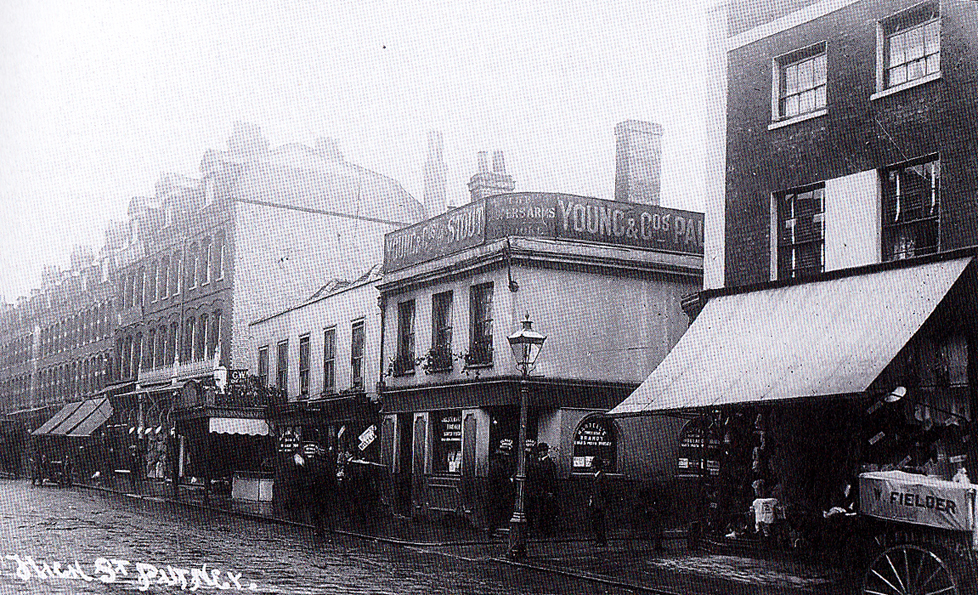
Coopers' Arms public-house, Putney circa 1905

The Coopers' Arms public-house gave its name to Coopers' Arms Lane, which was later renamed Lacy Road. Coopers' Arms Lane was formerly known as Warpell-Way, warp meaning "distinct pieces of ploughed land seperated by the furrows". A thoroughfare in Putney partly preserves the ancient nomenaclature in Warpole Road. The Putney High Street was largely unchanged until Edwardian times when the pub and cottages alongside were demolished and replaced by Edwardian shops. These were removed in the 1980s to make way for the Putney Exchange shopping centre.

Sources used for this blog post: British Newspaper Archive & Ancestry
Putney & Roehampton by Patrick Loobey
 

Wednesday, 20 February 2013

When Children Die In Strange Circumstances

Last night my cousin shared a photograph with me. It was taken after the 1908 hurricane hit Bungay and severely damaged two Cemetery chapels. What interested both of us about the photograph was the gravestone in front. It was a Jolly grave. Our common ancestors. Not only that, the grave was for two children - brothers - one aged twelve and the other aged nine, who had drowned. Putting my Miss Marple hat on, I went straight to the British Newspaper Archive website.

Bungay Cemetery Chapel; the aftermath of the 1908 hurricane
The Ipswich Journal dated 7 March 1882 reported the drowning death of nine-year-old James Jolly, the son of James and Charlotte Jolly of Bungay. The report states James was allegedly seen stealing from a broken shop window and upon being asked what he was doing, ran away. He was last seen by a school friend who spoke with James and asked where he was going in such a hurry. James replied that he was going on an errand and ran towards the direction of the Bungay Common. The next day a local butcher found a cap on the Common, by the river, belonging to James Jolly and went to alert Policeman Mann. Upon further searching, they found the body of James Jolly who was drowned. An inquest returned an open verdict of "accidental drowning".

Contacting my cousin with the news, we were both shocked about this newspaper article. Curiosity got the better of me an hour or so later and I went back to the British Newspaper Archive on the off-chance that James Jolly's brother Frederick may have also died under strange circumstances. You would be right in assuming that a large percentage of children died in Victorian times. Sickness, disease, inadequate (or expensive) health care and poverty were rife and it would be considered "normal" for a child to die before being given a proper chance at life. You can therefore imagine my total surprise when I found the newspaper report for Frederick.

The Ipswich Journal dated 27 December 1890 reported that Frederick Jolly "died suddenly". After a brief illness ( a common cold) Frederick, who was an errand boy for a local chemist, complained of feeling unwell and was sent home to recuperate. On the way home he met with some of his friends who began taunting him with snowballs. We all know that kids can be cruel but I am pretty certain that they did not anticipate that would be the last time they would see their friend. Frederick allegedly reported to his friends that he had eaten some poisoned sweets and felt unwell. The next day, after a night of vomiting and diarrhoea, Frederick was pronounced dead by the local surgeon, Mr Garneys. The coroner for the district decided that no inquest was necessary and Frederick had died of "sudden illness".

The gravestone of brothers, Frederick & James Jolly
What frustrates me as a twenty-first century genealogist and social historian is that the circumstances of these children's deaths was brushed aside and not properly dealt with. The newspaper reports throw up all kinds of unanswered questions and leaves me sorely wishing for a time machine. In the case of James, he was a nine-year-old boy. A cheeky larrikin perhaps, but a boy who had his whole life ahead of him. How did he come to drown? Why did he drown? Who is accountable for this boys death? Was it a mere accident or was something bigger going on?

In the case of Frederick, he was a twelve-year-old boy who had been sick with a common cold. The circumstances of how he came to ingest "poisoned sweets" is baffling. He worked for a chemist so it may be safe to assume that Frederick may have been curious about the powders and tablets and maybe the temptation to "try" some overcame him. Did he unwittingly kill himself? Why was this not mentioned in the report? It was just expected that he was a child, and children die every day. No big deal.

I am quite saddened that these two brothers died so young. Their parents James and Charlotte Jolly lost two of their sons to unfair and disadvantaged circumstances. I think I can better understand my great-grandmother Nellie Jolly today. She prayed every night, on her knees, beside her bed, with her rosary beads wrapped around her hands, for everyone in her family. She named every single one - immediate family and extended - and she would not raise from her kneeling position until she had mentioned every person.

It turns out that the photograph (pictured above) is actually on page 93 of Christopher Reeve's 2009 book "Bungay Through Time". The photograph's caption reads:
"Bungay Cemetery, Hillside Road: The Cemetery, established in the late nineteenth century, originally had three mortuary chapels. In 1908, a rare hurricane occured which blew down the north wall of one of them, and it was demolished soon afterwards..."

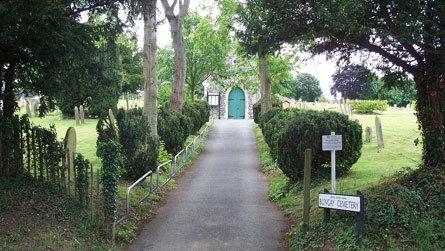
Bungay Cemetery today


Thursday, 23 February 2012

Finding Traces of Your Ancestors Lives in Unexpected Places

We are all familiar with the buzz you get from making contact with a distant cousin who just happens to have a wealth of family photographs that they are happy to share. I know I do, and thanks to some very special people I have come to know over the years (June, Angie, Jim), I have looked into the faces of my great-grandparents, some for the very first time.

This past month or so I have investigated different avenues of research into my family history, largely using archive newspapers (http://www.britishnewspaperarchive.co.uk/) and local history society transcriptions. These websites have proven to be invaluable resources into the lives of my ancestors, from discovering advertisements to Quarter Sessions reports. This past week alone I have found two ancestors from the same family line (uncle & nephew) in newspaper reports, sixty years apart. In 1882 one of my great-grand uncles, then aged thirteen, was charged with stealing fruit from a garden, and later the following year, he was charged for stealing a purse from a six-year-old boy. Subsequently, he was sent to Buxton Reformatory for five years. This news was equally disturbing and surprising, but in the end I had to concede that I have discovered a truly valuable addition to my family story.

Sixty years on, one of his nephews (my maternal grandfather), was in the newspaper for an entirely different reason. In 1943 he was repatriated home to England from Germany, where he had spent three years in a Prisoner of War Camp after being captured in Dunkirk in June 1940. His return home made local news and he even managed to get his mug shot on the front page!

The first paragraph brought unexpected tears to my eyes

Then there is one of my favourite resources for local history: eBay. That's right, I did say eBay. An unexpected source I grant you, but one that I have come to value almost as much as postcard fairs and emails from distant cousins. A few years ago, whilst conducting a google image search for one of my favourite childhood locations there were several links to the eBay website. At first I ignored them all because I didn't believe it would be relevant to my search. Then I relented, and I haven't looked back since. Not only have I found postcards of my own home town in Suffolk but several of those of my ancestors; a variety of towns, villages, and locations in Norfolk, Suffolk, London, Surrey, and Yorkshire.

I found one faded black & white or sepia toned postcard image of an ancestral town or picnic spot or a street, which turned into another find, and yet another and another. Sometimes I win the bid, sometimes I miss out. It has become my one weakness (thank you Dorcas Lane). One postcard that stands out in my memory from last year was an image of Holt Lodge in Norfolk. This building was not particularly relevant to my ancestry but the seller had also uploaded the back of the postcard which had been written on. It was from my 2 x great-grand uncle (in Norfolk) to his nephew (in Hampstead). I missed out on the item, but I did manage to keep a copy.

The back of a Postcard sent by my 2 x great-grand Uncle to his Nephew
Last week I bid on a postcard from Holt. It was a fairly ordinary image (a pond!), quite faded with the heavy-handed postmark stamp creating a nice little crater on the top left corner. I never expected to have it arrive on my doorstep and find it was written to my first cousin, three times removed. My initial findings had me thinking it was written by my 2 x great-grand uncle - the same one as described above - but further investigations and cross-referencing of the handwriting, proved that it was written by an unknown person. Even so, it was definitely addressed to my cousin who was then living in Richmond, county Surrey. Four years after the postcard was sent, she was married and living in Richmond with her widowed husband and step-daughter.

Postcard sent to my distant Cousin in 1904
The moral of this post is, leave no stone unturned. Investigate every possible avenue, and when you think it couldn't be likely, it really could be likely. If you don't ask, you won't find out. I took the chance on my grandfather's newspaper report. I already had several sources of information into his repatriation and I had found a link to a local newspaper report but until I approached the local Record Office, not only did I gain a personal account of his return from my great-grandmother (who had obviously been interviewed for the story) but I also gained a new photograph, albeit grainy.


My Grandfather in the Local Newspaper

And as far as eBay is concerned: it is game of chance. It is pot-luck. Sometimes I have found some treasures, and sometimes I have missed out. Sometimes I have paid pittance and sometimes I have paid exorbitant amounts. What I have discovered and gained from it all though, is absolutely priceless.

This post is dedicated to my Uncle who is currently recovering from a recent hospital stay following an operation and intensive health issues. Get Well Soon M xxx

xxxxxxx