Showing posts with label photograph. Show all posts

Monday, 17 September 2012

Family History Through The Alphabet Challenge : S is for...

For this week's Alphabet Challenge blog post I have chosen a topic which is close to my heart - Scrapbooking. Besides genealogy, reading and writing historical fiction, and collecting old postcards I love to play with photographs and create layouts in a scrapbook album.


For those who may not know, scrapbooking is a method for preserving personal and family history in the form of a scrapbook. Scrapbook albums usually contain memorabilia such as photographs, postcards, poems, letters, cards, recipes, and artwork. The first scrapbooks appeared as far back as the 15th century when it became popular in England to keep "commonplace books". I often wonder whether any of my ancestors kept scrapbooks and what happened to them. Did anybody keep them, pass them on, or were they destroyed by disinterested parties. My great-grandmother Nellie kept her precious memorabilia in an old biscuit tin and both of my grandmother's had an assortment of albums and leather-bound satchels for their photographs.
 
I began scrapbooking in earnest back in 2001 after I attend a Babies & Children's Expo. I still remember the "Creative Memories" display like it was yesterday. Layed out on tressel tables were rows of scrapbooks of all colours and sizes and the ideas flooded in my over-active mind. I wanted to create something unique and special for my then unborn child and in that moment, I was determined to ensure that all of my photographs would be lovingly displayed and preserved. Thus, my love of scrapbooking was born (pardon the pun).
 
Three generations of photograph albums
My grandmother Lilian's, My mother's and mine


To date I have made nine scrapbook albums. I would really like to say I have made ten if it included my intended heritage scrapbook but that is still on my "to-do" list. Why haven't I made it yet, I hear you ask? Simple, it's one word: fear. I confess that I am a perfectionist (eat your heart out Jim Cameron) and more especially when it comes to creating scrapbooks. I have all the necessary implements, papers (acid free, of course) and tons of photographs but I just cannot bring myself to sit down and actually do it. I am terrified of mucking the whole thing up. Crazy, I know.
 
I can proudly say that I have accumulated a lot of favourite scrapbook "how-to" books and these are a few of my absolute favourites, which I return to again and again:
 
The Complete Guide to Creating Heritage Scrapbooks (Memory Makers)
Scrapbook Journaling Made Simple (Memory Makers)
Scrapbooking Your Family History (Maureen A. Taylor)
Uncovering Your Ancestry Through Family Photographs (Maureen A. Taylor)
Scrapbooking Your Family History (Laura Best)
Scrapbooking Family in Historical Events (Laura Best)
'Good Housekeeping' Wartime Scrapbook (Barbara Dixon)
The Altered Book Scrapbook (Susan Ure)

A sample of some of my personal scrapbooks
My personal tips for scrapbooking: Don't ever use your original photographs. Always use copies; that way if you make a mistake during the cropping process you can always print off another. Always ensure that you use acid-free papers and scrapbooking materials. If you don't feel confident when it comes to journaling, practise on a separate sheet of paper and use the photograph as a narrative guide. Remember, every photograph tells a story.
 
Lastly, I picked up this invaluable tip and I want to pass it on to you. When you create a scrapbook or photograph/memorabilia album, include an "About the Author" and paste it on the inside front page and remember to include a small photograph of yourself. Write a brief introduction: tell the person who will be looking at your album who you are, why you made the album, what your hobbies are, what date it was when you made the album and where you were living at the time. Below is an example, taken from one of my personal scrapbooks that I made in 2003. Please, try not to laugh at my photo (it was the 1980s, come on!).
 
"About The Author"
Fom my personally made childhood scrapbook


My favourite websites to order my scrapbooking supplies from:
http://www.creativememories.com.au/ (Companies in Australia, New Zealand, United Kingdom, Germany, Austria, Canada, USA, Japan)
http://www.familytreefolk.co.uk/ (UK based, but overseas orders welcome)
http://www.gould.com.au/ (Australia based, but overseas orders welcome)


Friday, 11 November 2011

Remembrance Day 11/11/2011

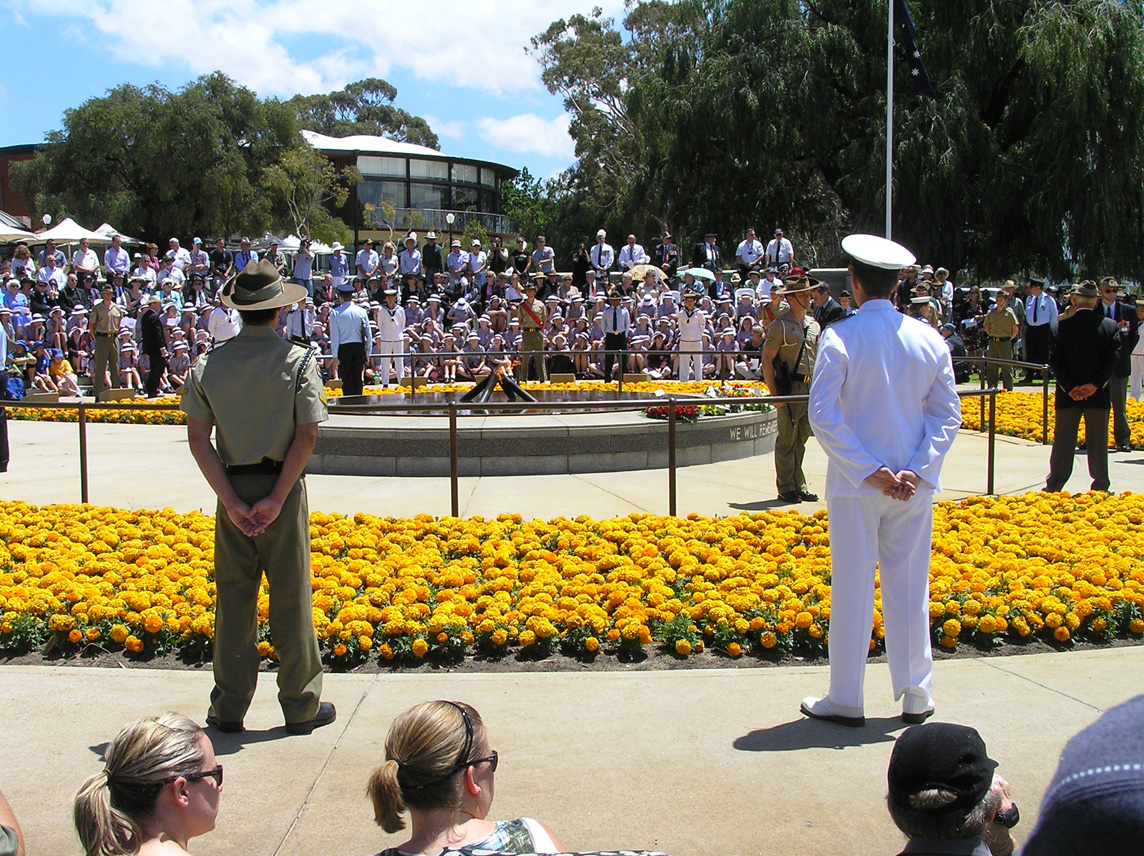
Today I attended The Remembrance Day ceremony at Kings Park and Botanic Gardens: http://www.bgpa.wa.gov.au/events/calendar/details/760-remembrance-day
The weather was glorious, the atmosphere subdued and contemplative, and yet there was a distinct air of mutual respect and contentment. We were all there to honour the fallen of World War One - the "so-called" war to end all wars. We were all joined in our reflection on our lives as it stands today, and how blessed we are to live in such a beautiful city and be a part of the absolute picture-perfect scenery and surroundings of Kings Park. We share in the gratitude of our freedom and we share in the pain of the past.
Apart from the constant squawking of crows and magpies, there was a mass solitude. The band began their practice, as the RSL members milled about, greeting one another and sharing a hearty laugh, finding friends and comrades, holding wreaths, and selling poppies.
The band sounds lovely as they practise their scales, so perfectly timed! A large cloud drifts over the sun, taking away its rather nasty bite. I had to re-apply my sunscreen as well, it certainly is needed today.
The Leake Memorial and The Grand Walk 1910
The Leake Memorial 2011
The crowds are thickening now, as the commencement of service draws nearer. School children, RSL members and their wives, widows, children and grandchildren, politicians and dignitaries, and the media are all out in force. Before the service I walked around to take some photographs, and then found a spot to sit for the proceedings. The sun was biting harder and a few cadets from the Catapult Party are feeling the pressure.

The State War Memorial 1929
Her Majesty Queen Elizabeth II and HRH The Duke of Edinburgh
visit the State War Memorial in 1954
The State War Memorial 2011
Eerie sounds of the band warming up, puts me in mind of the 'Titanic' soundtrack; the track that plays at the end, after the ship had sunk. It is very moving, very sad, and very eerie.
The service is drawing to a close and the 'National Anthem' is sung. The wreaths have all been laid, the Catapult Party has marched away, the crowd wanders around the Flame of Remembrance to say a quiet prayer, look at the wreaths and take photographs. It was a very poignant, emotional morning. One I shall remember for a very long time.


Saturday, 15 October 2011

Postcards & Photographs : Each One Tells a Story

This morning I visited the Nexus Toy Fair with my science-fiction-loving family, and there was one senior chap who was selling old postcards. Did I look at the wonderful array of Star Wars figurines and sci-fi DVDs? Did I heck as like. I went straight to the postcards table, and oggled his vast collection!


Recently a dear friend at  oldpostcardsetc.co.uk  said: "Think about it - why do people collect old postcards? The main reason is nostalgia..." This got me seriously thinking.

A dictionary definition of nostalgia is: A sentimental longing for the past, typically for a place or period with happy personal associations. When it comes to old postcards I certainly love to see places as they once were. Also, for me personally, it captivates me to see how a place looked in my ancestors time. I am fascinated with scenes of old streets, old houses and businesses, seaside attractions, and churches.

On the left you can see a postcard scene of the church tower of St Michaels in Beccles. The church itself has not changed over time but its surroundings have significantly changed. Housing and businesses have altered and changed hands, been demolished and some buildings which were once publichouses or mills are now private homes.

I love to collect old postcards so that I can see places through the eyes of my ancestry. Beccles, my hometown, has seen much progress and alteration throughout the centuries, and yet local history books and photography show how little has really changed. The shopfronts and the people may have changed but the historical flavour remains when you walk the streets or sit by the Quayside.

Postcards are a window to the past, no doubt about it. Not only do they provide a valuable historical resource for genealogists and social historians alike, but they also allow us a glimpse into how our ancestors once communicated with each other. I have many postcards that have scrawled messages such as: "I will be with you in two days time. The train leaves at 8.15am..." Soldiers relied on the exchange of postcards with their families and loved ones, mothers and lovers fervently sent postcards of home, and holiday postcards were delivered far and wide at the envy of their recipients. The famouse catchphrase "Wish you were here..." was coined by the sending of a postcard.

Over 100 years ago my Norfolk ancestors sold postcards in their stationer's shop. They didn't just sell them, they went out to the various places within a twenty-mile radius and took the photographs that ended up on the postcards. Historical documents prove that they travelled from place to place on bicycles and snapped local scenes such as churches, farms, houses and halls, prominent local businesses and organisations, as well as taking photographs of a journalistic nature. In particular, they took photographs of the damaging effects of the 1912 East Anglia flood.

Photographs are my passion. Not just simple portraits of men, women, children and pets. Not just landscapes and scenery. Not just buildings and architecture. For me it goes beyond the subject matter. For me it is about the story photographs tell. When you look beyond the composition and the framing, recognition of the subject matter lights up the photograph in an entirely new way.Just sit with a group of elderly people and watch their faces as they recall the subject in the photograph, the memories they inspire and evoke, and the hearty conversation that follows. Sit with any family member and their photo album and listen (and watch) as they regale you with the finer details such as where the photograph was taken, what the weather was like, where the clothes they were wearing came from (and what colour the fabric was, if it is a black and white photograph) and, before you know it, all kinds of history (family and social) comes pouring out.

That is how my love of family history began. Back when I was a child and my beautiful grandmothers sat me down and showed me their photograph albums. For hours we would sit together, pouring lovingly over each page. With each photograph I learned who the people behind the faces were, where they had lived, what they loved and who they loved, and the variety of special events the photographs had captured. Some photographs are blurred, some are over-exposed, some have faded or lost their vibrancy and some are stained or damaged but each one is cherished and loved. They are a very special, very real link to the past. A photograph can tell the viewer so much. Perhaps that is why I love scrapbooking and journaling. Many of my scrapbooks are filled, not only with the photograph itself, but the story behind the photograph.

If you love genealogy and social history, photographs and postcards provide a vital visual aid to your story. They bring your ancestry alive in ways that pure words alone cannot convey. Telling your story is so much more than just names and dates. With today's technology it isn't too hard to open a Google Images search engine and begin a visual journey to your family's past. Better yet, why not visit a Fair, your local history centre, a car-boot sale or a charity shop? You never know what you might find. There is a wealth of visual history out there, waiting to be found. Let the stories begin...

Image from Ultimate Photo Guide website

Sunday, 4 September 2011

My Grandfathers

Inspired by the fact that today is Father’s Day in Australia and that I have just seen one of the saddest movies of all time, my next blog is dedicated to my grandfathers.
I was blessed to have four grandfathers, although I only really knew one of them well enough to write anything about with any real heartfelt emotion.

My paternal grandfather died when I was 10 years old and I curse my childhood memories sometimes, as they are not rich with any memories of him. What I do recall are only fractured scenes, like from a movie that you saw years ago and only remember snippets of. He left an indelible impression on me though, and his death caused my father such an outpouring of grief. I vividly remember being told to go to my father’s bedroom one afternoon, only to be told that Grandad Ward had passed away in hospital earlier that day. I shall never forget my father’s tears. For a child my age, it was an especially poignant moment for me.

Herbert Ambrose Ward was a quiet man, a somewhat serious man, and a bit of a loner I think. The opposite of this was his enormous sense of humour. He really enjoyed a good joke and liked to play pranks from time to time. My childhood memories of going to visit my grandparents are marked by the fact that he spent much of his time away from the hustle and bustle of noisy visitors and us over zealous grandchildren, preferring to stay in the kitchen preparing the pot for tea or going outside to tend to his garden.
Born 5 August 1910, in the market town of Bungay, he was the first-born son of Arthur Ward and Barbara Hargreaves. Having served in the Boer War Arthur was a strict, austere man who my father remembers, kept a rifle in his hallway by the front door! This is quite ironic of character given that Arthur gave his son the name Ambrose, from the surname of the man who ran his favourite local drinking establishment.

Herbert Ward, doing what he loved most
Herbert was a keen cinemagoer and he loved film all his life (one of all-time favourite actresses was Mary Pickford). During the war years he kept a diary of films he showed the troops at Barracks, as part of his service with the Royal Army Service Corps was with the Army Kinema Services. An electrician by trade before the war, Herbert's love of cinema won out and despite taking on a post-war job at Beccles Maltings, he worked in the evenings and weekends as a Projectionist at both the Regal Cinema and the Beccles Cinema in Saltgate.

I do recall visiting Grandad in the Projection Room after I had been with my father to see a film at Beccles. He would take me up the back stairs and we would enter this dark, pokey room filled with cigarette smoke and I would be deafened by the loud, clacking sound of film running through the reels.

My parents divorced when I was still quite young and my father married the second daughter of Frank William Denson and Mildred Alice Leach. Frank was born 18 April 1914 in Beccles, the son of William Denson and Frances Lillian Leon.

Frank Denson (left), taken at Beccles Museum
opening ceremony in 1975
My childhood memories of him is with a pipe permanently in his mouth. He looked stern and serious on first glance, but he was funny too. He liked to tell me about local affairs, more of a historical nature than current. Frank is a renowned Beccles historian and Borough Archivist, and for many years worked at the Museum. He has spent many years of his life transcribing and researching the history of the town. Frank is still very much alive, having celebrated his 97th birthday this year.

My maternal grandfather passed away one year before I was born and my grandmother married again two years later. By this time I was about 18 months old.
I grew up hearing countless stories about Percy Preston, not all of them very flattering. My mother certainly missed him terribly when he died (and, naturally, still does 44 years on), not least because their relationship was not always smooth sailing.
Percy could be a hardened man, made bitter from his war experiences, but he also possessed a heart of gold, which endeared him to many local townsfolk of Bungay.
(What struck me when I started researching the family history was that both my grandfathers were born (and lived during their formative years) in the same street of Bungay! If they knew one another back then, I was never made aware of it.)

Percy Preston, with his wife Lilian
Percy was the first-born son of Percy Preston (senior) and Ellen May Jolly, born 29 September 1913. Better known to everyone as Pat, he was well known in the town for his participation in the Salvation Army Band, and, in his post-war years, for his job as Dust Collector in Bungay, and CafĂ© owner in Cross Street. Percy would open his doors for anybody in need of a cup of tea and a plate of bacon & eggs. Lorry drivers would detour off the main road to Bungay based solely on Percy’s goodwill reputation around the district.

Since researching the family history in-depth I have acquired Percy’s army records and set about meticulously researching each individual service he completed. What unravelled was a gallant and sometimes heart-wrenching story.

From his pre-war service in Dacca, India to his capture at Dunkirk in 1940, his years spent in a Prisoner of War Camp on the Polish borders to his rehabilitation in 1943, and finally to his Medical training at Aldershot and subsequent service with the Ambulance Trains in Epsom, county Surrey, Percy spent a total of 29 loyal years in the British Army.

My grandmother married two years after Percy had passed away. This is the grandfather I remember best of all, and spent the most amounts of quality time with. I remember him for all sorts of different things, such as his tobacco (Drum), his use of Blycream and Old Spice, his love of Westerns (especially John Wayne movies) and reading crime novels. He worked hard all his life, and was not afraid of getting ”stuck in” wherever he was needed.

Alf "Buster" Sampson, with my mother Denise
Alfred James Sampson was born 3 July 1926 in Mettingham, county Suffolk and was the first-born son of James Sampson and Alice Trett. James Sampson ran a farm in Mettingham and all of his sons helped out, and none were adverse to the hard graft. I have many happy childhood memories of Grandad digging and planting in the allotment patch that he lovingly kept. He was always outdoors, getting his hands (and his clothes!) dirty and muddy, and frequently getting wet!

At the beginning of this blog, I mentioned I had been to see a sad movie today. It was called ‘Red Dog’ and it tells the true story of a red Kelpie who travelled the length and breadth of North-West Western Australia (the Pilbara Region) in the 1970s. One place he called “home” from time to time was Dampier.
When my Grandad, better known to everyone who knew him as “Buster”, emigrated to Australia in 1978, he worked harder than ever. Taking on a job in Dampier, he would be away from the family home for weeks at a time. Dampier was a hot and unforgiving place, a mining town, and a man’s man territory. Alf seemed to fit right in, and he made many firm friends over the years.

I sorely wish I had known each one of my grandfather’s better. Growing up, I would say the females of the family were a stronger influence and presence in my daily life. My grandfathers taught me to remain quiet inside, to feel strongly about something but not to act out in a gregarious way or be driven by material possessions. Also, they each possessed a fabulous sense of humour, each one of them loving to share a good joke and have a hearty laugh. It may sound daft but I always associated the men in my childhood like the company BP – they were the “Quiet Achievers” in my life!

So I end this blog by saying “Happy Father’s Day” to my dear father and to the fondest memory of each one of my grandfather’s – Percy (Pat), Herbert, Frank and Alfred (Buster).
You are all missed and you are all loved. I hope this blog will do each one of you a small piece of justice.


Saturday, 27 August 2011

My Grandmother Freda: 1915 - 1996

 
After I posted my debut blog last weekend, I was pumped with excitement. I couldn’t wait to write another one. Then the days passed and the nagging doubts returned with a vengeance. At the end of the day, I told myself, my doubts are not going to get my stories written, it will not give my ancestors any credit (or recognition) and my memories will go unheard and unshared.

This blog is dedicated my paternal grandmother. From the outset I thought this one would be harder to write because I did not get to see her as often as I would have liked to as a child, and when I moved away to Australia my relationship with her was mostly through the exchange of letters, and cards at Christmas, Easter and birthdays. Up until two years before she passed away, she was still writing to me regularly.
Somehow Nannie always knew that I would be a writer and pursue the family history. She loved to tell me stories about her family, show me photographs of family members from her vast collection and when I had to write a family tree project for school, she was more than willing to help me with it. I kept my scribbled notes from all those years ago and am continually amazed at how much she knew and remembered about her family history (Even down to finer details such as birth addresses and dates).

Freda Waters
 My grandmother was born Winifred Ellen Waters on 17 April 1915. Named after two of her aunts (Winifred Bowes and Sarah Ellen Waters), everyone who knew her called her Freda.
Freda was born in the market town of Beccles, in the county of Suffolk, and she lived there her whole life.

Freda was the third child of Albert Waters and Eva Bowes. Before her was one sister and one brother – her sister Muriel a lifetime friend and close companion. After Freda, came two more brothers, both of whom Freda doted on and always spoke of with the deepest affection.

When Freda was a girl she had a doll she named Germolene. This name would later prove ironic in the extreme as in her adult years she would rely on the aseptic ointment for her troubled ulcerated legs.
When she was just fourteen years of age Freda met her future husband Herbert Ward. According to a diary entry of January 1930, Herbert wrote that he had met Freda at the Methodist Chapel in Station Road, Beccles. Freda’s father was a staunch Methodist and for many years worked as a verger there.
Freda worked as a Seamstress in Beccles. My research into Freda’s maternal ancestry revealed that her grandmother Mary Leman came from a family of drapers and tailors so it is no real surprise that Freda’s interests lay in sewing. She worked for George William Bond in Exchange Square. Bond opened his draper & millinery shop in 1903 and ran a successful business until well into the 1970s. An advertisement in the local newspaper of 1903 reads:
“Flannelettes, Calicoes and Shirtings at the very lowest price”.
In the 1930s Ronald Martindale took over the running of the drapery shop at St Andrews House in New Market, Beccles. His predecessors, Womack Brooks and Arthur Dare, were both prominent tailors and local charity fundraisers. Freda and her sister Muriel went to work for Martindale who ran his store for almost four years until Woolworths took over the premises in 1937. In 1933 an advertisement ran in the local paper:
“R Martindale the Leading Draper Fashion-Wear Specialist Household Furnisher and Undertaker’.
All her life Freda loved sewing and fancy goods. All her handkerchiefs were made with the finest embroidery and lace-work. She was a lover of embroidered tablecloths and lace napery. She was very proud of her sewing achievements.
In September 1933 Freda, having turned 18 years of age, married her sweetheart Herbert Ward. Before the outbreak of World War Two Freda had two sons and in August 1940 she was faced with home life alone when Herbert joined the Royal Army Service Corps. As Herbert was 30 years old and married he was not sent to serve on the front line but was posted to the East Midlands town of Sutton-in-Ashfield.
Freda talked of how, when the winds were right, people living on the East coast of England could hear the shelling and bombing from Europe. Nearby Ellough and Flixton airfields were used as practice for the USAAF & RAF and Freda said she was relieved to hear “our boys” flying over rather than enemy aircraft. In 1944 Ellough Airfield was used to drop prototype spinning or bouncing bombs, which were called “Highball” bombs.

After the war, Freda gave birth to my father and six years later, came her forth, and last, son. By this time Freda and Herbert had moved from their home in Blyburgate Street to Ingate Street.

Freda (left) and Muriel

Freda lived for company and summer holidays. Every year she would go to the seaside with her parents and siblings and as the years passed, she would holiday with her own children and with her sister Muriel. Mostly they holidayed in Lowestoft and Great Yarmouth, two of Suffolk’s most popular seaside holiday destinations.

In August 1977 Freda lost her husband of forty-four years, to cancer, and my dear Nannie was understandably devastated. She had known him almost all her life and she had grown up with him and bore his children. She was alone for the first time in her life and it cut her deeply. Her compensation was her sister Muriel and her four sons, though now grown up and married with families of their own. Freda relied heavily on her family to ease the increasing ache of loneliness, which constantly plagued her. Two of her sons lived away from Beccles so she would visit with them. She looked forward to these little holidays and trips away but preferred the comforts of her own home.
In the 1980s Freda and Muriel became regular visitors to the local day-care centre called “The Dell”. It was here Freda met Arthur Gilbert, a local widower. They were firm friends from the outset of their meeting and eventually, as romance blossomed, they married in 1986. Their life together was short-lived though when Arthur passed away unexpectedly, as a result of a stroke in 1990.
Freda’s unabated loneliness took its toll and when Muriel passed away just one year later, Freda never really recovered emotionally.
Freda was not blessed with good health for the best part of her life, especially after the birth of her children. She suffered with circulatory problems in her legs for a great many years and her heart caused her to suffer greatly. She spent many weeks at a time in and out of hospital for most of her adult life, more so in her later years when she continually required heart monitoring or investigative procedures. She made the joke to me once that the hospital was her second home.
One problem, which ailed Freda in her later years, was her eyesight. This frustrated and upset her more than her legs or heart troubles ever did. Her letters to me often spoke of her impatience and irritability at not being able to see well enough to write, relying on sunny days to help her to see clearer.

My fondest memories of my Nannie are:

Nannie loved writing and receiving letters, and sending special cards and notelets to her extended family. I will forever treasure the letters she wrote to me.

Nannie absolutely loved bathing. She loved to collect scented bath salts, soaps and bath foams. My sister remembers how the Avon catalogue would be eagerly raided for the latest bath smells and scents. Nannie liked to wear perfumes, such as Pagan by Lentheric.

As a child I remember going to stay with Nannie for the night. She loved having her grandchildren to stay, and she would spoil them and dote on them lovingly. I especially remember she would fry up ‘Bubble and Squeak’ on a Sunday morning for the two of us. That was always my favourite!

I fondly remember that Nannie loved a good laugh. She had the kind of laugh that was almost like a girlish giggle and she always had an expression of faint embarrassment if she laughed too loud. She professed to me once that she was painfully shy as a girl and even had a photograph of herself where she had written on the back “Shy Freda”. My father was a connoisseur for making her laugh and he always managed to have her in stitches. He would tease and mock, and she loved and welcomed it in equal measure. Her bashful laughter was adorable to me and still today, whenever I think of her I remember her in a fit of the giggles.

Nannie loved songs and singing. It didn’t matter the song, as long as it had a quirky tempo or catchy beat. A clever advertising jingle on the television, a cartoon theme tune or game-show theme, Christmas carols or even a Cockney knees-up song, Nannie would be humming or singing along happily. She loved in particular, “Lambeth Walk” which was one of her and Grandad’s favourites.
Nannie lived for outings with the family, fish and chips for tea on Fridays from Peck’s in Beccles, and having her hair washed and regularly permed by her daughter-in-law. She always joined in with games and liked to play cards and she never tired of hearing what her grandchildren were getting up to in their lives, good or bad.

The last time I saw her was in 1995, and it was one of the most turbulent periods of my life. Nannie was desperate to see me happy, and sadly I wasn’t always patient with her or willing to listen to her advice. However, she still managed to sit me down to give me a small collection of her family photographs. She was deeply afraid that I wouldn’t see her again. In my stupidity, I didn’t believe her. She was right. In January 1996 she passed away, knowing she would never live past the age of 80 (just as her mother Eva had believed of herself).

Freda (Taken in 1995)
Soon after my first child was born I had a dream that I walked into a room to see my Nannie sitting in an armchair in the middle of the room. I knelt at her feet and cuddled into the softness of her lap whilst she quietly stroked my hair. She had neither bandages or any pain in her legs. It was a beautiful dream and I still remember it so clearly ten years on. When I asked my sister about her memories of our Nannie recently, she wrote to me about one of her memories of laying on the sofa with her head in Nannie’s lap!


Saturday, 20 August 2011

My Grandmother Lilian : 1920 - 1983

Lilian Katie Humphries abt 1940
I have just come home from the Antiques Fair and felt the strongest compulsion yet to write a blog. Admittedly I have wanted to start a blog for the longest time, and have even gone so far as to research different blog sites and sought advice from several people.
However, nerves won out and got the better of me; that, and a serious dose of self-doubt. There are so many topics I want to discuss, but at the end of the day, I kept going back to the same agonising question. Who would want to know, or care, what I have to say?
For as long as I have been alive I have had a passion for family history. As a child I loved to listen to my grandmothers when they talked about their childhoods, family stories, war stories and more importantly for me, showing me photographs and telling me who the photograph was of, where it was taken and the memory associated with that photograph, whether it be a family member, a holiday snap or a wedding portrait.
I thought about dedicating this first blog to both of my grandmothers but, to be quite honest, I don’t think that would be fair. They each deserve their own dedication, in their own right. As tomorrow will mark 28 years since my maternal grandmother passed away, I shall dedicate my very first family blog to her.

My grandmother was born Lilian Katie Humphries, on 26 November 1920. Her birth certificate says she was born in Bloomsbury Square in the district of St Giles, London. I went to visit her childhood home in 2007 and fell in love with both the Square and its surrounds.
Lilian was always known to me as “Nannie Buster” as her second husband (Alfred Sampson) was known to everyone as Buster. Others called her Lil and some of her nieces and nephews knew her as Lily.
Lilian was the seventh child of Albert Humphries and Elizabeth Dare. Before her were three brothers and three sisters, the eldest of which – Violet, or Vi as she was known - she was extremely close to. She would often spend two weeks holiday visiting her sister Vi in Sutton, where she lived with her husband Cyril Lang above the butcher's shop on the High Street.
When Lilian was just a child she was struck with asthma and bronchial ailments, inherited from her father’s side of the family who all suffered from it. When Lilian was eight she contracted Tuberculosis and the family had to leave their London home for the country air. They moved to Leigh-On-Sea and remained there until the 1930s, when the family moved again, to Sutton in county Surrey. They lived on Clyde Road.
Lilian and her sisters volunteered for the ATS when war broke out in 1939, but ill health plagued Lilian and eventually she had to give up several of her posts. It was in 1945, near war’s end in Europe, that she and her sister Stella were sent to clean ambulance trains in Epsom.
There she met my grandfather Percy Preston, who was stationed near Epsom with the Royal Army Medical Corps. Three short months later, Percy and Lilian were married at St Nicholas Church in Sutton. After the wedding, Percy was stationed back to Epsom and Lilian went, supposedly by rail, to county Suffolk to start married life, not with her husband but with her mother-in-law Nellie Preston who ran a boarding house for single working men, in the market town of Bungay.
After the war, Lilian gave birth to four children: Two girls (the eldest being my mother), followed by two boys. Percy held an Urban District Council job in the town for several years and Lilian worked in various shops and factories in Bungay and nearby Flixton. Then in 1962 they bought the CafĂ© in Cross Street, known then as Alfo’s. The tearooms are still there today, although it is now known as the Buttercross Tearooms, named after the infamous Butter Cross at the end of the street.
In May 1966 Percy passed away, of lung cancer. Two years later, Lilian met a local widower by the name of Alfred Sampson and they married in August 1968 at St Mary’s Church, Bungay. Lilian's family of four became a family of nine, as Alf had five children from his previous marriage to Jean Alden. She died of cancer in 1964, aged 35.

As a child I fondly remember visiting my Nannie and Grandad Buster where they lived at St Johns Road, in Bungay. I can still recall the rooms; the front parlour room (which I was never allowed into), the sitting room, the kitchen and walk-in pantry, the narrow staircase and the cupboard under the stairs, and each one of the pokey bedrooms. Whenever I stayed overnight, I loved to explore Nannie’s rooms upstairs, especially her wardrobe filled with flowing dresses and coats, her perfumes and cosmetics on her dressing table, and her endless book shelves crammed with Mills and Boon novels. I would have been around eight or nine years old when I first remember flicking through the pages, fervently looking for the passionate kiss on the last pages! I think she may have caught me out once or twice but I was never severely reprimanded. Perhaps she was mildly amused by my curiosity.
However, I do recall her chastising me for hiding in the cupboard under the stairs or in the kitchen pantry. This was a source of much chagrin between us, as she seemed to forever dislike my need for seeking solitude. She liked me to be where she could see me, not necessarily hear me though!

Lilian with her beloved dog Russ
Lilian loved her dog, a Jack Russell Terrier she named Russ. I shared her love for Russ, and whenever I visited or stayed at my grandparents, he was a delightful playmate for me. We would run amuck outside in the courtyard, or the garages out in the allotment area. Sometimes I would put him in my bicycle basket and wheel him around the yard. Nannie would knock on the kitchen window at me when she felt her poor “doggy woggy” Russ had been through enough torment!
When I was nine years old my grandparents emigrated to Western Australia. Alfred quickly found employment with the Alcoa group, which took him regularly to Dampier, for weeks at a time. Lilian, having been advised by her doctors that the warmer climates of Australia would help her bronchitis and asthma attacks, spent her days mostly indoors by the air conditioner watching the tennis, knitting, or baking. When a relative came to visit they would take her out shopping, which was one of her favourite pastimes.

Lilian was always proud of her London heritage. She always sang “Maybe It's Because I’m a Londoner” and if she was ever pulled up for something or feigned any sort of ignorance she would simply shrug her shoulders and say, “Well, you know it's just because I'm a Londoner”.

When my Nannie was ill, you knew about it the second you walked into her house. The atmosphere was electric when she was confined to her bed. An eerie silence hung on everything around you. Everywhere was deathly silent. There were no sounds of her singing or her slippered footsteps, the kettle wasn't whistling, and not a song could be heard. When she was well however, the atmosphere was the complete opposite. You could hear her bustling around, the washing machine going, the kettle boiling, the dog yapping nearby, her singing at the top of her lungs a tune by Roy Orbison, Bing Crosby or the Andrew Sisters. She would be cleaning, baking, making endless cups of tea or talking idly to Russ, making an absolute fuss over him. I found it funny whenever she threw open the kitchen window and shouted out to Grandad or my Uncle to come in for dinner or a pot of tea.

When my Nannie died, I was in my last year of high school. Her death was sudden and nobody in the family got to say goodbye to her. Lilian had suffered a massive heart attack at home and despite being rushed to Fremantle Hospital, she died on arrival. I was devastated, as was my mother who (understandably) took her mother’s death extremely hard. Losing my Nannie at that time in my life was so intensely shocking because I never had the chance to tell her all the things I would have wanted to. I never had the chance to ask her more about her life in London, and Surrey, or her war experiences. I never even knew her parents names, until 10 years ago when I started the family tree research in earnest.

I will always fondly remember my grandmother Lilian for:

“In the Mood” and Glen Miller Band : Lilian loved to sing this song more than any other I recall in my memory. She would saunter up to me and sing it in my ear or walk around the house with the carpet sweeper or broom.

When getting dressed to go out, Lilian would spend hours applying heated rollers, tweezing, curling her eyelashes, and "putting her face on". There was always singing and dancing involved, and I loved to sit and watch her in the mirror pulling various faces at me or throwing her head back in laughter.

Bourjois Cosmetics : Her rouge pots are still in the family today, and I also love to wear Bourjois products.

Chanel No. 5 perfume : Her most expensive and indulgent perfume, she wore this only for special occasions and always applied the smallest amount in order to make the bottle last!

Merely Musk Impulse : Her everyday perfume, or 4711 or, sometimes, the latest Avon perfumes.

Daphne du Maurier novels : in particular, Rebecca and it was one of her favourite movies of all time.

Engelbert Humperdinck : She was a lover of this "pop" singer.

Bing Crosby and the “White Christmas” movie : Her most passionate love was for all things Bing, for his musical talents and for his acting.

Roy Orbison : Another crooning voice she loved to sing along to whenever she was cooking or cleaning.

Despite her asthma and bronchial ailments. Lilian smoked cigarettes. I recall seeing her often using one of those long black cigarette holders, and I thought she looked just like a movie star! She used to smoke Du Maurier cigarettes or Benson & Hedges.

Her cooking and baking, but for me especially I will always miss her:

Rhurbarb Pie (usually always served hot with lashings of custard)
Apple Crumble (again made with lashings of custard)
Rice Pudding (the sweetest and softest I have ever tasted)
Shepherds Pie (made with any mince she found cheapest on the day)
Nannie's famous Sunday fry-ups: heaped up platefuls of soft runny eggs, oily bacon and grilled tomatoes
Roast dinners of chicken or lamb (mostly) served with lashings of sauce, gravy, peas, over-cooked cabbage, carrots and cauliflower, broad beans (she knew I hated them but she still put them on my plate and made me eat them!), runner beans, swede, and the best ever Yorkshire puddings.
Two weeks ago I found, amongst my mother’s rather extensive photograph and memorabilia boxes, a cassette tape with family members voices recorded onto it. It was recorded in January 1975 and it was intended for family that had recently emigrated to Australia. The very first voice you can hear is my grandmother Lilian. When her voice filled my living room on that day, two weeks ago, it was like having her back again. Hearing her accent, her laugh, her singing, was like I had stepped back into a room with her sitting there.
I cried like I have never cried before. For an instant I was grieving her loss all over again but then, a powerful sense of joy washed over me. Even though my sinuses flared up and my face swelled from excessive crying, I realised that I will always have a piece of her with me. I have some of her favourite things, I have my childhood memories to hold on to, and now I will always be able to hear her voice whenever I want to. All I have to do is press the play button and close my eyes.

“Mr What-you-call-it What you doing tonight?
I hope you’re in the mood cos I’m feeling just right…”

  
Enjoying a boat ride on the Swan River 1982