Showing posts with label Surrey. Show all posts

Monday, 8 July 2013

William Sibley : In the wrong place at the wrong time?

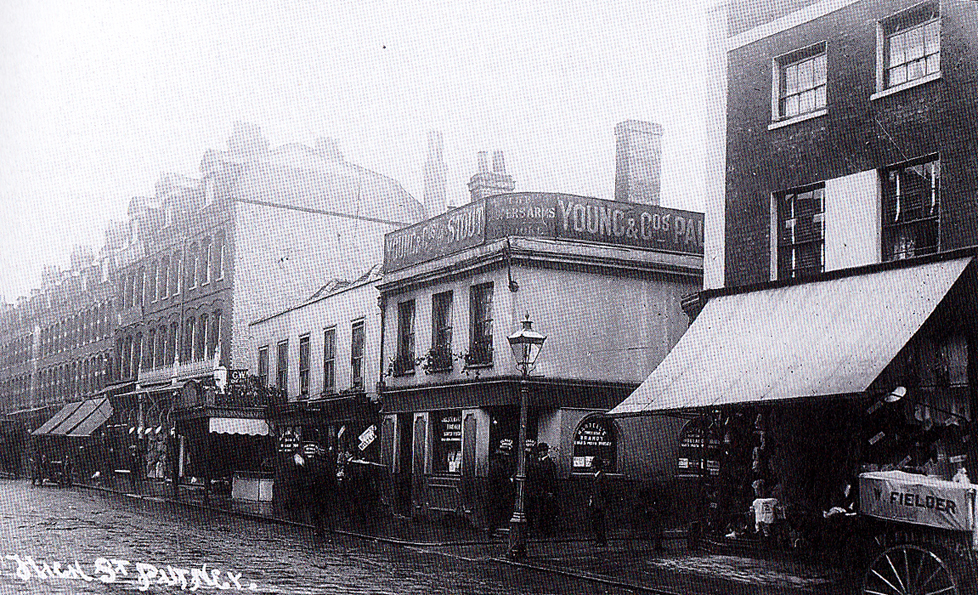
My 3xgreat-grandfather William Sibley (1826-1889) was charged, and later acquitted, in 1860 for conspiring to steal from the publican Thomas Rule of the Coopers' Arms public-house in Putney. When I discovered his name in the Police Intelligence section of The Morning Post (at British Newspaper Archive), I was initially shocked. As I read on, however, I found out that William Sibley was innocent. What follows is an extract from the aforementioned newspaper, dated 30 January 1861:

William Carlton, who described himself as a photographer, and William Sibley, a wheelwright, were placed in the dock before Mr Ingham, charged with being concerned with stealing £5 from the Coopers' Arms public-house in Putney, the property of the landlord Mr Thomas Rule.
The robbery was committed on the 11th of December 1860 and the money, consisting of gold, silver, and halfpence was taken from the bureau in Rule's bedroom. The bureau was locked but not the bedroom. William Sibley was in the house during the said afternoon and was in and out several times and in different parts of the premises. He had a cart at the back door and he went out two or three times to examine it. William Carlton was at the bar with another man, and they had some gin-and-water at the bar. They appeared very fidgety, for they kept going out and returning alternately, and they both left without drinking their gin-and-water. It further appeared that Sibley lived in Putney [in 1861 census he lived at Stratford Grove] and Carlton formerly carried on his photography business opposite to the Coopers' Arms.
My 3xgreat-grandfather denied all knowledge of the robbery, and explained the reason for the cart being at the back of the public-house. He had it to repair and was waiting for assistance to drag it home. Thomas Rule claimed that Sibley had been in his bedroom before, to do repairs to a set of drawers but that he and his daughter [Caroline Rule] were unable to say whether Sibley and Carlton had actually communicated with one another on the day in question.
Mr Ingham refused to allow bail for Sibley, despite Sergeant Blanchard knowing nothing against Sibley before. The evidence of the witness [who was not named during the trial] was that he had evidence that Sibley had known about the robbery one week before it occured.
According to the Criminal Registers on Ancestry, William Sibley and William Carlton were acquitted at Newington on 18 February 1861.

Coopers' Arms public-house, Putney circa 1905

The Coopers' Arms public-house gave its name to Coopers' Arms Lane, which was later renamed Lacy Road. Coopers' Arms Lane was formerly known as Warpell-Way, warp meaning "distinct pieces of ploughed land seperated by the furrows". A thoroughfare in Putney partly preserves the ancient nomenaclature in Warpole Road. The Putney High Street was largely unchanged until Edwardian times when the pub and cottages alongside were demolished and replaced by Edwardian shops. These were removed in the 1980s to make way for the Putney Exchange shopping centre.

Sources used for this blog post: British Newspaper Archive & Ancestry
Putney & Roehampton by Patrick Loobey


Sunday, 21 April 2013

A Place To Call Home

I have neglected my blog here at "Pocketfull", but I do have a good excuse. Well, maybe not a good excuse but an excuse nonetheless. In recent months I've created a new blog which is dedicated to the history of my childhood hometown and I've been contributing to it almost twice weekly (See it here). For now at least, I've run out of steam so I've decided to devote some of my free time back here, amongst my family history.

A new Australian drama is set to start on the Seven Network next week called 'A Place To Call Home' and while I've been rather looking forward to watching this post-world-war-two drama it has got me thinking lately about "home" and what it means to me personally. Even though I have lived in Australia for most of my life, I still have a hankering for my childhood home. Beyond this, I have often found myself wondering what my family and my ancestors would have called home.

Both of my grandmothers were devoted to their homes. My maternal grandmother Lilian always proudly called herself a "Londoner", even long after the war ended in 1945, when she was married and living in a quiet market town in Suffolk. Then, in 1978 she emigrated to Australia. Yet, all her life, at every opportunity she could get, she went back to London. Her heart was always right there and when she died in 1983 of a massive heart attack, I always believed (and still do, to this day) that it was because her heart was broken for home.
My paternal grandmother Freda lived in Beccles all her life. She never moved away from the town, except for a few years when she moved to nearby Brampton but she quickly welcomed a return to Beccles. There was no question of her living anywhere else but Beccles. She was born there, she was married there, she raised four boys there, and it never entered her mind to travel further than was absolutely necessary. She believed in setting down your roots and staying put and, for the most part, she was content with that. It didn't make her small minded but it certainly made her homely and connected to her roots.
My grandfathers? My paternal grandfather Herbert lived in Bungay, London, and later, Beccles. I don't think that any one particular place meant more to him. I believe he went where "duty called" for the most part, even during the Second World War when he was stationed at Sutton Coldfield.
My maternal grandfather was born and lived all his life in Bungay. While he fudged his age slightly on enlistment with the Norfolk Regiment I don't think it was necessarily because he wanted to escape home life. He just wanted to do what he felt was right. He was to travel to India during his pre-World War Two service and later to Dunkirk before his capture and internment in a German Prisoner-of-War camp. Later, in 1944-45, he served with the Royal Army Medical Corps and was stationed at Epsom, county Surrey. After the war, when he married my grandmother Lilian, they remained in Bungay and raised their family there, trying (against impossible odds at times) to live by the post-war standards of a secure family life.

Aerial view of Beccles and the River Waveney

If I look back another generation, to my great-grandparents' idea of what home meant to them, it differs quite dramatically. For example, my maternal great-grandparents Albert and Elizabeth, were born in the exact same town in London. They were both from working-class families and both were baptised at the same church. Their families possibly knew one another and shared a similar social history. Albert was restless though, even as a young boy. He wanted to travel and see the world, stretch his wings and leave Putney well behind him forever. He lied about his age to get into the Royal Navy and his only reason for returning to Putney was to marry his sweetheart, Elizabeth, in 1905. After that they lived in Southwark, Fulham, Tooting, Bloomsbury and later, Sutton (where they settled and remained until Elizabeth's death in 1951).
My other maternal great-grandparents, Percy and Nellie, were much like my paternal grandmother. They remained in the Suffolk market town of Bungay all their lives. There was no question of moving away, although my great-grandfather Percy, as a younger man, did love the sea and he took to fishing on trawler boats off the coast of Lowestoft for many years before settling back to farm life after the Great War (1914-1918).

Putney, in Greater London

My paternal great-grandparents were also a mixed bunch. Albert and Eva were Becclesians to the last, although my great-grandmother Eva was born in Loddon (her parents were Loddon born and raised before moving to Beccles) but she never had a great need to return there. Beccles was her home and Great Yarmouth was her favourite family holiday destination. Albert was born and raised in Beccles, and he remained staunchly faithful to the town and its townsfolk; at home, in religious circles, and in his work.
My other paternal great-grandparents, Arthur and Barbara, lived as a married couple in the market town of Bungay and raised their family there but they were not knowingly tied to their roots. Barbara was born in Holdenhurst, county Hampshire and lived there until she was a young girl, when her father took on a new job as a Railway Gatekeeper in Woodsford, county Dorset. Less than five years later, her mother passed away, her father abandoned her and she moved to London to work in the Domestic Service. Arthur joined the Norfolk Regiment as a young man and served in both the Boer War and the Great War. It was during the Great War that Barbara moved back to London with the children (including my grandfather Herbert) while Arthur was away fighting for King and Country. When the war ended they went back, as a family, to Bungay.


So there we have it; a mixture of loyalties towards home and yet, across the board, so very similar. There are those who willingly left home to fight in the war. Those who wanted to leave their homes for broader horizons. Those who stayed in the same town all their lives, loyal to the last. Those who wanted to run from their past and never look back and those who couldn't let go of their past and so returned again and again.
To this day I share the same tug-of-war with my maternal grandmother Lilian, the Londoner, who always found a way to go back even though the memories of her childhood were not altogether pleasant or heart-warming ones. Something always called her back and she was deeply proud of her London roots, even in the impossible heat and vastness of Australia that she made home for the last remaining years of her life. My own tug-of-war calls me back to Beccles, and sometimes that call is overwhelming. It certainly reflects in my ability to write about it without getting completely caught up and swept away in a sea of nostalgia and sentiment! Even though Australia is now the place I call my home I still carry a piece of Beccles deep within my heart, and I always will. I could never let it go.

Monday, 1 October 2012

Family History Through The Alphabet Challenge : U is for...

Given that I was born in the United Kingdom it would be only fitting to write about it in this week's Alphabet Challenge for the letter U. However, that would be too easy so I am doing it yet again. Writing about something completely different!


The last known address of my 3 x g/grandfather's "wife" was Usk Road in Battersea, in 1881 (I say "wife" because they were not legally married). The census shows us that Sarah Mary Ann (nee Spencer) was living at 35 Usk Road with her husband Thomas Shepherd and three children: William and Charlotte (from her previous relationship with my 3 x g/grandfather) and a three-year-old daughter Emily. I am yet to prove a theory that Sarah died in 1883, aged 36.

Usk Road was not far from where Sarah lived with my 3 x g/grandfather Richard Humphries. In 1871 they lived together with William and Charlotte, as well as Richard's three grown sons from his first marriage, in nearby Putney. On the other side of nearby Wandsworth lies the South West London town of Battersea. Famous for the Dog's Home and the Power Station, Battersea was once a large market garden area and lavender field well before industry took over.

I

I don't believe there was anything quite as romantic as the image above of boats on the River Thames at Battersea for Sarah Shepherd and her children. The whereabouts of my 3 x g/grandfather Richard Humphries (see my post about him) after 1871 continues to baffle me as the paper trail dies off at this time but for Sarah, who remained very much alive, it must have been a very difficult time. She was left with two small children (she had had three but one died in infancy in 1869) and no husband. It is not known how or when she met Thomas Shepherd and the first I knew of him was from the 1881 census. From there I worked back until I found a marriage between he and Sarah in June 1876. Sarah claimed she was a "spinster" which technically was true. Thomas Shepherd, son of Samuel Shepherd, worked in a Candle factory and could not write or sign his name on his marriage certificate.

Sarah Mary Ann Spencer was born in 1846 in Battersea. Records indicate she was the daughter of Christopher Spencer and Mary Ann Hosier. Christopher Spencer was born in Wandsworth about 1822. In 1851 the Spencer family lived in King Street, Battersea but the following census paints a very different picture. Christopher died in 1856 and Mary Ann, along with her four children, were living with George Temple in Red Lion Street, Wandsworth. Interestingly, Mary Ann had only aged three years between 1851 and 1861!

Battersea Power Station
Image courtesy of Wikipedia
Battersea was heavily bombed in 1944/45 and Usk Road was the last recorded road to be hit by a V2 weapon (in the Battersea district) on 27 January 1945. It is recorded that at least seventeen people died that day and more than twenty houses were fully destroyed or damaged.

I wish I knew why Sarah Mary Ann Spencer/Humphries/Shepherd was left abandoned with two small children. It was certainly not common for a bachelor to take up with an unmarried woman with children so what sort of person was Thomas Shepherd to do that so willingly? Then Sarah had a child with him: Emily. What is more intriguing is that by 1881 Sarah gave the children she had with my 3 x g/grandfather her name, Spencer and had totally dropped the name Humphries. Did Thomas know anything at all about Richard Humphries? Surely, you would think that this would totally baffle and confuse any of their descendents. Anybody trying to trace the family tree for their Shepherd or Spencer ancestors would possibly not even know of the connection with the Humphries family and that three children were registered at birth as Humphries (later becoming Spencer). These children were:

William Spencer Humphries born 1868 in Fulham
1881 census: William Spencer, aged 12

Sarah Spencer Humphries born 1869 in Putney
Died in 1869, aged 4 months

Charlotte Amelia Spencer Humphries born 1871 in Putney
1881 census: Charlotte Spencer, aged 8
When Charlotte married in 1893 to William Tilley she gave her father's name as Thomas Spencer, not Thomas Shepherd (just to further confuse the issue!).

Aftermath of V2 bombing in Battersea
Image courtesy of Wikipedia


Tuesday, 12 June 2012

Family History Through the Alphabet Challenge : E is for...

I feel terrible. I am sorely late with this weeks alphabet challenge blog post. My excuse is that I have been working solidly on indexing and editing a family history book. I have been so tired these past few days, I have barely been able to concentrate.

So, here we are at the letter E:


Two of my great-grandmothers had names starting with the letter E so it makes sense to write about them, right? That would be reasonable but, to be honest, I hardly know anything about either of them to do them proper justice here. Both of them died before I was born, one just months before.
Elizabeth was my mother's maternal grandmother. She was born in Putney, county Surrey in 1884. The daughter of a long line of gardeners, Elizabeth was the sixth child of eight born to Richard and Louisa Dare. My mother never met her grandmother Elizabeth, but had just one photograph of her which was inside her mother Lilian's photo album.

Elizabeth Dare
"Fondest Love, Mother"
Elizabeth was particularly fond of the cinema and she would do just about anything to go. In the early twentieth century, before the advent of television, this was her only outlet from a tumultuous home life. Some family members have said she would usually take her coat to the pawnbrokers, or sometimes clothes belonging to her husband and children. This may sound cruel to some but I actually feel quite sorry for her. Being a wife and mother in Elizabeth's time would have been extremely hard. Before the age of welfare and women's rights, women like Elizabeth had to find respite wherever they could. Elizabeth's respite was the cinema.
Elizabeth's love of cinema extended to her daughter (my grandmother Lilian) and to me. One of her favourite actors was Laurence Olivier and a favourite film was Rebecca. I may not know who Elizabeth revered most in the cinema but I can well imagine her sitting in her favourite spot each week, anxiously awaiting the black screen flicker into light and sound, eager to escape into a world of imagination and fairytale.

Eva was my father's maternal grandmother. She was born in Loddon, county Norfolk in 1887. The daughter of a Painter & Glazier, Eva was the eldest child of three born to Robert and Mary Bowes. Eva was the only one of those three to marry and have children. Her brother Fred and sister Winnie lived together in Beccles. My father dearly loved his grandmother Eva, and always talks of her very fondly. She died two months before I was born.

Eva (second from left with her daughters)
Eva was very fond of writing and in her life she wrote many letters to all of her family and also wrote articles for the Beccles Methodist Church parish magazine, of which she was a staunch member alongside her husband who was a Verger (my great-grandfather).
My grandmother Freda always believed I was an exceptional letter writer, and would constantly tell me that I took after her mother Eva. Freda always knew I would be a writer one day, bless her. When I began writing articles for a genealogy society and I told my father about it, he wistfully assured me I was following in Eva's footsteps. I did not know (or had likely forgotten) that she wrote articles for magazines. This made me feel so good inside, I can't begin to articulate what significance that has to me.

Last, but not least, my letter E blog must make mention of Emails. Without the ability to email people I would quite possibly not effectively communicate with half the people I do. All thanks to message boards, genealogy websites, or my website, I know the very lovely June, Angela, Jim, and Terry, today.
Of course, emails don't quite mean the same as a carefully handwritten letter, folded and posted and delivered to your mailbox. That is one of the many things I miss about my grandmothers. Both were keen letter writers, especially Freda. The reality is though, we live in the technological age where everything is faster, speedier and accessible on the internet. Emails are the quickest (and sometimes, only) way to communicate and "keep in touch". Without emails, I would not have half the amount of family photographs in my photo collection or have been able to share and compare the family history information that I have researched. So, thank you Emails.


Sunday, 9 October 2011

An Elusive Ancestor : Richard Humphries

Every now and then an ancestor comes along, destined to elude you. We all have at least one in our family tree, right? I have several but none has proved as elusive (or as frustrating) as Richard Humphries.

Born in Hammersmith in 1829, to John Humphries and Ann Rogers, Richard was the eldest of seven children. They lived on The Mall, which fascinates me because when I was a teenager I lived in a block of units by the river, not unlike the scene here (left).

John and Ann were both employed as Mattress Makers, and when Richard went out to work he got his trade as an Upholsterer.

Around 1849 the Humphries family were dealt a cruel blow when the house they moved to in Putney was infested with the deadly cholera disease. Within days of moving in, one son was dead and the father, John, quickly followed. Suddenly Ann was left alone to raise the remaining children, two of which were mere infants. She sent the youngest four to the North Surrey Industrial School in Penge. The eldest two, including Richard, were old enough to fend for themselves. Richard took work in Lambeth and later that same year, married Mary Ann Smith.

Richard and Mary Ann had four children, the first child (an only daughter) died of Scarlatina. Their remaining three sons were born and raised in Putney and they lived in relative comfort until 1871. Then the real confusion began. The census of that year was very revealing in that Richard was no longer married to Mary Ann. His new wife was listed as Sarah Ann. In addition, there was a new child listed. I automatically assumed that Mary Ann had died and Richard married again. Searches for Mary Ann's death and Richard's second marriage almost caused temporary insanity, as both turned up nothing. Eventually I located Mary Ann as having died at the Wandsworth & Clapham Union Workhouse (oddly, 10 years older than she actually was), being listed in their records as a "Widow". Long story number one...

Richard and Sarah Ann were not married, but they had three children together nonetheless, the last of whom was born in 1871, three months after the census of that year. Then the search goes cold for Richard. He is not in the 1881 census, and interestingly, Sarah Ann is married to someone else and they are living in Battersea. She married in 1876 and used her maiden name of Spencer. Her three children are all listed on the 1881 census as Spencer children, not Humphries!

Which begs the question? What happened to Richard Humphries? All manic searches have proved dead end after dead end. The paper trail has, time and again, gone completely cold, having been thwarted at every turn. For example, there are three possible death registrations for a Richard Humphries, however, all three have been investigated and I can attest with every fibre of my being, that they are not my ancestor. I have several cousins who believe they know when he died (1890 is one theory, 1915 another) but I have gone back through the records with a fine tooth comb and can assuredly disprove their theories. It is maddening to not know the truth. Hence, long story number two...

When I poured over the Putney parish registers seven years ago, I came across a burial for an unknown man, around the age of 40 years, drowned in the Thames at Putney. The year was 1875. He was given a burial at St Mary's Church and a coroner's report found that the unknown man had drowned as a result of his leg being caught in a barge. I know I am an ardent lover of Charles Dickens (see previous post) but could it be? Could it possibly be Richard Humphries? Tell me I am grasping at straws, clutching to a romantic fictional notion but it is the best theory I have to go on. Richard disappeared, without a trace, sometime between 1871 and 1876. His "second wife" who he was not legally married to, but had three children with, marries another man in 1876 and carries on with her life, as though Richard Humphries did not exist.

Where did you go Richard? What on earth happened to you? Why has your trail gone cold? Why don't you want me to find you?

Image from Genea-Musings


Saturday, 20 August 2011

My Grandmother Lilian : 1920 - 1983

Lilian Katie Humphries abt 1940
I have just come home from the Antiques Fair and felt the strongest compulsion yet to write a blog. Admittedly I have wanted to start a blog for the longest time, and have even gone so far as to research different blog sites and sought advice from several people.
However, nerves won out and got the better of me; that, and a serious dose of self-doubt. There are so many topics I want to discuss, but at the end of the day, I kept going back to the same agonising question. Who would want to know, or care, what I have to say?
For as long as I have been alive I have had a passion for family history. As a child I loved to listen to my grandmothers when they talked about their childhoods, family stories, war stories and more importantly for me, showing me photographs and telling me who the photograph was of, where it was taken and the memory associated with that photograph, whether it be a family member, a holiday snap or a wedding portrait.
I thought about dedicating this first blog to both of my grandmothers but, to be quite honest, I don’t think that would be fair. They each deserve their own dedication, in their own right. As tomorrow will mark 28 years since my maternal grandmother passed away, I shall dedicate my very first family blog to her.

My grandmother was born Lilian Katie Humphries, on 26 November 1920. Her birth certificate says she was born in Bloomsbury Square in the district of St Giles, London. I went to visit her childhood home in 2007 and fell in love with both the Square and its surrounds.
Lilian was always known to me as “Nannie Buster” as her second husband (Alfred Sampson) was known to everyone as Buster. Others called her Lil and some of her nieces and nephews knew her as Lily.
Lilian was the seventh child of Albert Humphries and Elizabeth Dare. Before her were three brothers and three sisters, the eldest of which – Violet, or Vi as she was known - she was extremely close to. She would often spend two weeks holiday visiting her sister Vi in Sutton, where she lived with her husband Cyril Lang above the butcher's shop on the High Street.
When Lilian was just a child she was struck with asthma and bronchial ailments, inherited from her father’s side of the family who all suffered from it. When Lilian was eight she contracted Tuberculosis and the family had to leave their London home for the country air. They moved to Leigh-On-Sea and remained there until the 1930s, when the family moved again, to Sutton in county Surrey. They lived on Clyde Road.
Lilian and her sisters volunteered for the ATS when war broke out in 1939, but ill health plagued Lilian and eventually she had to give up several of her posts. It was in 1945, near war’s end in Europe, that she and her sister Stella were sent to clean ambulance trains in Epsom.
There she met my grandfather Percy Preston, who was stationed near Epsom with the Royal Army Medical Corps. Three short months later, Percy and Lilian were married at St Nicholas Church in Sutton. After the wedding, Percy was stationed back to Epsom and Lilian went, supposedly by rail, to county Suffolk to start married life, not with her husband but with her mother-in-law Nellie Preston who ran a boarding house for single working men, in the market town of Bungay.
After the war, Lilian gave birth to four children: Two girls (the eldest being my mother), followed by two boys. Percy held an Urban District Council job in the town for several years and Lilian worked in various shops and factories in Bungay and nearby Flixton. Then in 1962 they bought the CafĂ© in Cross Street, known then as Alfo’s. The tearooms are still there today, although it is now known as the Buttercross Tearooms, named after the infamous Butter Cross at the end of the street.
In May 1966 Percy passed away, of lung cancer. Two years later, Lilian met a local widower by the name of Alfred Sampson and they married in August 1968 at St Mary’s Church, Bungay. Lilian's family of four became a family of nine, as Alf had five children from his previous marriage to Jean Alden. She died of cancer in 1964, aged 35.

As a child I fondly remember visiting my Nannie and Grandad Buster where they lived at St Johns Road, in Bungay. I can still recall the rooms; the front parlour room (which I was never allowed into), the sitting room, the kitchen and walk-in pantry, the narrow staircase and the cupboard under the stairs, and each one of the pokey bedrooms. Whenever I stayed overnight, I loved to explore Nannie’s rooms upstairs, especially her wardrobe filled with flowing dresses and coats, her perfumes and cosmetics on her dressing table, and her endless book shelves crammed with Mills and Boon novels. I would have been around eight or nine years old when I first remember flicking through the pages, fervently looking for the passionate kiss on the last pages! I think she may have caught me out once or twice but I was never severely reprimanded. Perhaps she was mildly amused by my curiosity.
However, I do recall her chastising me for hiding in the cupboard under the stairs or in the kitchen pantry. This was a source of much chagrin between us, as she seemed to forever dislike my need for seeking solitude. She liked me to be where she could see me, not necessarily hear me though!

Lilian with her beloved dog Russ
Lilian loved her dog, a Jack Russell Terrier she named Russ. I shared her love for Russ, and whenever I visited or stayed at my grandparents, he was a delightful playmate for me. We would run amuck outside in the courtyard, or the garages out in the allotment area. Sometimes I would put him in my bicycle basket and wheel him around the yard. Nannie would knock on the kitchen window at me when she felt her poor “doggy woggy” Russ had been through enough torment!
When I was nine years old my grandparents emigrated to Western Australia. Alfred quickly found employment with the Alcoa group, which took him regularly to Dampier, for weeks at a time. Lilian, having been advised by her doctors that the warmer climates of Australia would help her bronchitis and asthma attacks, spent her days mostly indoors by the air conditioner watching the tennis, knitting, or baking. When a relative came to visit they would take her out shopping, which was one of her favourite pastimes.

Lilian was always proud of her London heritage. She always sang “Maybe It's Because I’m a Londoner” and if she was ever pulled up for something or feigned any sort of ignorance she would simply shrug her shoulders and say, “Well, you know it's just because I'm a Londoner”.

When my Nannie was ill, you knew about it the second you walked into her house. The atmosphere was electric when she was confined to her bed. An eerie silence hung on everything around you. Everywhere was deathly silent. There were no sounds of her singing or her slippered footsteps, the kettle wasn't whistling, and not a song could be heard. When she was well however, the atmosphere was the complete opposite. You could hear her bustling around, the washing machine going, the kettle boiling, the dog yapping nearby, her singing at the top of her lungs a tune by Roy Orbison, Bing Crosby or the Andrew Sisters. She would be cleaning, baking, making endless cups of tea or talking idly to Russ, making an absolute fuss over him. I found it funny whenever she threw open the kitchen window and shouted out to Grandad or my Uncle to come in for dinner or a pot of tea.

When my Nannie died, I was in my last year of high school. Her death was sudden and nobody in the family got to say goodbye to her. Lilian had suffered a massive heart attack at home and despite being rushed to Fremantle Hospital, she died on arrival. I was devastated, as was my mother who (understandably) took her mother’s death extremely hard. Losing my Nannie at that time in my life was so intensely shocking because I never had the chance to tell her all the things I would have wanted to. I never had the chance to ask her more about her life in London, and Surrey, or her war experiences. I never even knew her parents names, until 10 years ago when I started the family tree research in earnest.

I will always fondly remember my grandmother Lilian for:

“In the Mood” and Glen Miller Band : Lilian loved to sing this song more than any other I recall in my memory. She would saunter up to me and sing it in my ear or walk around the house with the carpet sweeper or broom.

When getting dressed to go out, Lilian would spend hours applying heated rollers, tweezing, curling her eyelashes, and "putting her face on". There was always singing and dancing involved, and I loved to sit and watch her in the mirror pulling various faces at me or throwing her head back in laughter.

Bourjois Cosmetics : Her rouge pots are still in the family today, and I also love to wear Bourjois products.

Chanel No. 5 perfume : Her most expensive and indulgent perfume, she wore this only for special occasions and always applied the smallest amount in order to make the bottle last!

Merely Musk Impulse : Her everyday perfume, or 4711 or, sometimes, the latest Avon perfumes.

Daphne du Maurier novels : in particular, Rebecca and it was one of her favourite movies of all time.

Engelbert Humperdinck : She was a lover of this "pop" singer.

Bing Crosby and the “White Christmas” movie : Her most passionate love was for all things Bing, for his musical talents and for his acting.

Roy Orbison : Another crooning voice she loved to sing along to whenever she was cooking or cleaning.

Despite her asthma and bronchial ailments. Lilian smoked cigarettes. I recall seeing her often using one of those long black cigarette holders, and I thought she looked just like a movie star! She used to smoke Du Maurier cigarettes or Benson & Hedges.

Her cooking and baking, but for me especially I will always miss her:

Rhurbarb Pie (usually always served hot with lashings of custard)
Apple Crumble (again made with lashings of custard)
Rice Pudding (the sweetest and softest I have ever tasted)
Shepherds Pie (made with any mince she found cheapest on the day)
Nannie's famous Sunday fry-ups: heaped up platefuls of soft runny eggs, oily bacon and grilled tomatoes
Roast dinners of chicken or lamb (mostly) served with lashings of sauce, gravy, peas, over-cooked cabbage, carrots and cauliflower, broad beans (she knew I hated them but she still put them on my plate and made me eat them!), runner beans, swede, and the best ever Yorkshire puddings.
Two weeks ago I found, amongst my mother’s rather extensive photograph and memorabilia boxes, a cassette tape with family members voices recorded onto it. It was recorded in January 1975 and it was intended for family that had recently emigrated to Australia. The very first voice you can hear is my grandmother Lilian. When her voice filled my living room on that day, two weeks ago, it was like having her back again. Hearing her accent, her laugh, her singing, was like I had stepped back into a room with her sitting there.
I cried like I have never cried before. For an instant I was grieving her loss all over again but then, a powerful sense of joy washed over me. Even though my sinuses flared up and my face swelled from excessive crying, I realised that I will always have a piece of her with me. I have some of her favourite things, I have my childhood memories to hold on to, and now I will always be able to hear her voice whenever I want to. All I have to do is press the play button and close my eyes.

“Mr What-you-call-it What you doing tonight?
I hope you’re in the mood cos I’m feeling just right…”

  
Enjoying a boat ride on the Swan River 1982