Showing posts with label London. Show all posts

Thursday, 26 November 2020

Lilian Katie : 100 Years

This is a very special post which is dedicated to my maternal grandmother, Lilian Katie Humphries, who was born on this day 100 years ago.
I have written about her here

Nannie Lilian will always be fondly remembered for many things but the most important thing she taught me, whether intentionally or not, was that combing your hair and putting powder on your face and rouge on your cheeks made you look and feel much better, even if you didn't necessarily feel that way underneath. My Nannie spent almost all of her life unwell, mostly from asthma and bronchial ailments, as well as heart conditions, but she always managed to run a comb through her hair and apply some rouge on her cheeks. I used to watch her apply her favourite Bourjois rouge and I still have her last used blush pot in my archive box, given to me in more recent years by my mother. Nannie Lilian also passed on to me her passionate love for London. Regrettably, I haven't returned there for many years now but whenever I see it on television, in a movie, drama series or documentary, I can feel my heart automatically soar. London is such a wonderful place and as Samuel Johnson once famously said in 1777, "those who tire of London tire of life". For me, that saying lies deep within my psyche even today, because London has always made me feel recharged, fully present and energised whenever I am there. Not only that, I also feel a strong ancestral connection there and that fills me with honour.

I miss you every single day Nannie but please know that I always think of you and often recall childhood memories as I go about my daily life. I am forever grateful that you were a part of my childhood and teenage years. You were taken from us way too soon. I love you.


Thursday, 30 October 2014

Bussey Woodrow

My second great granduncle Bussey Woodrow was born in Fulham, county Middlesex in 1842. He was the first born son of my three times great-grandparents, Bussey Woodrow and Louisa Powell.

Bussey is a unique name, and one I had not heard of in my family history until I received my two times great-grandmother's birth certificate in the post. My first thought on reading the father's name was that it said "Bufsey". Of course, I now realise the written meaning of the double S in transcripts. According to the Ancestry website Bussey means:
English (of Norman origin): habitational name from any of several places in Normandy, France: BoucĂ© in Orne, from which came Robert de Buci mentioned in Domesday Book, Bouce (Manche), or Bucy-le-Long (Aisne). All are named with a Latin personal name Buccius (presumably a derivative of bucca ‘mouth’) + the locative suffix -acum.Altered spelling of German Busse.
I am yet to determine where the name originated from to be used in my family.

Bussey Woodrow was a Letter Carrier, and he lived in various places within the London area including Belgravia, Hanover Square and then later, in Battersea. During his life time he was married three times and had at least five known children. His first wife, Mary Ann, died after they were married for two-and-a-half years. Perhaps she died in childbirth? She was just 25 years old. Around six months later, Bussey married Susannah Catchpole with whom he had five known children, all boys: Harry, Bertie, Walter, Frank and Ernest. Susannah died in 1896, aged 48. The following year Bussey married Emma Chapman.

Bussey joined the British Postal Service on 12 February 1866 as a Letter Carrier. The occupation title was changed to Postman in 1883. This is reflected in the census returns where Bussey's occupation before 1891 was recorded as Letter Carrier and from 1891 onwards, Postman.

The Illustrated London News, 1860
postalheritage.wordpress.com

Today we have airplanes, trains, ferries, motorcycles and motorised vans to deliver all of our mail items across the world. We have a raft of express delivery services, airmail and seamail choices, and vending machines that supply stamps. Before Bussey became a Letter Carrier in the 1860s, horses and coaches were the main method of delivering mail. This was an idea first formed by John Palmer, a theatre owner in Bath, who used carriage services to transport props and actors around the countryside. In 1782 Palmer took his idea of using carriages to transport mail around the country, to London where the Chancellor of the Exchequer, William Pitt, accepted the idea and in 1784 an experimental mail coach journey succeeded in paving the way for a faster, more efficient postal delivery service. The development of the railway saw the demise of the mail coaches, with trains first used for delivering mail in 1830. Later in the 19th century, London would also undergo a massive change with the introduction of the Underground rail system.

In Bussey's time as a Letter Carrier he would have walked the congested London streets hand-delivering mail to businesses and residences in his designated area. He would have walked in all elements of weather, including thick fog and snow. His mail bag would have been made of cloth, which attracted mice so most Post Offices had to employ cats to catch and kill the mice. Horses and ponies were used to deliver mail up and down the country even after the demise of the mail coaches as they pulled the mail carts and vans until the 1930s when motorised vehicles replaced a great many horse-drawn vans (except, of course, for the more remote areas). The last horse-drawn mail van was seen in London in 1949. Bicycles did not become fully popular until the 20th century.

Horse-drawn Mail Cart, 1887
www.postalheritage.org.uk

Bussey Woodrow died in May 1905, aged 68. He was buried at West Norwood Cemetery in Lambeth. Among the notable burials there are Isabella Beeton, Sir Henry Tate and Dr William Marsden. In 1911 Bussey's widow, Emma Woodrow, was living with her sister Sarah in Kentish Town, St Pancras. It is believed that Emma Woodrow died in 1913 (Wandsworth area) but she could have died in 1928 in St Pancras. Bussey's brother, Frederick John Powell Woodrow, lived in Putney which is an area most familiar to my maternal family history. My two times great-grandmother Louisa Woodrow, who was Bussey and Frederick's sister, also lived there as a married woman.

If you have any Postal Service ancestors, I urge you to visit The British Postal Museum & Archive at http://www.postalheritage.org.uk/. There is so much to see there, and it includes just about everything you would ever want to know about the postal service. It has sections for family history, school and further education and provides an extensive history of the Royal Mail dating back to the 1600s.

Friday, 29 August 2014

One Lovely Blog

I've been nominated for the ONE LOVELY BLOG Award by the very lovely Elizabeth Lloyd (thank you for thinking of me). You can find her Lovely Blog Award post here


If I've nominated your blog, please don't feel under any obligation to join in with this; I was just pleased to be nominated so that I could share the blogs that I like.

Here are the rules for the One Lovely Blog Award:

• Thank the person that nominated you and link back to that blog. 
• Share seven things about yourself – see below.
• Nominate 15 bloggers you admire – also listed below (or as many as you can think of!).
• Contact your bloggers to let them know you've tagged them for the One Lovely Blog Award.


Seven Things About Me


1. I love Family History

Ever since I was a child, listening to all the stories my grandmother Freda told me about the family and about the town I grew up in, I have loved it. When I had my daughter there was a strong voice within me that told me to get back into it and pursue it seriously. I took the baton from my mother who had made some inroads into her side of the family. Armed with a notebook I had kept years before, I made a start and have never looked back. My daughter turns 13 next week and I haven't finished yet.

2. Which leads me to my second best love...Beccles

I grew up in the Suffolk market town and even though I left to live in Australia with my Mum at the age of 12, I have never forgotten my roots. Beccles is deep within my heart, and firmly under my skin. I am currently writing a house & street history on Peddars Lane, where I grew up in the 1970s. My e-published novella, Symphony of War, is based in Beccles and I also write a blog about the history of the town called Relics of Beccles. I did have a Twitter account of the same name but I gave it away when it became harder to only tweet 140 characters at a time! My second novel is also based in Beccles and loosely utilizes some of the factual history of the period in which it's written (1912).

Beccles from the Church Tower, 2014
Taken by Brett Ford @ Guru Photo Genix

3. I love Writing

From a very early age I loved to write stories and English was always my favourite subject at school. When I was a little older I became a lover of writing letters and when I moved to Australia that passion flourished as I wrote regularly to my father and grandmother. In my teenage years writing left me (well, I left it) and for a long time stories stayed dormant inside me until I was in my mid-twenties. Even then, I only got so far as the fifth chapter before I threw it away. Then I met my husband. He has spent the last twelve years encouraging me to let loose the inner demons and to start writing again. If it wasn't for his support, I wouldn't have started blogging and writing again. Symphony of War would exist only in my head.

4. I love Cats

I had several cats growing up but it wasn't until 1996 that I really learned what loving a cat meant. I had some nightmare times with Oliver "Ollie" Twist but he came into my life at the right time and he left it only two years ago. In February this year, my husband and I rescued an 18-month-old female cat from the Cat Haven. She has a forever home with us now and we love her to bits. Her given name was Spearmint but we call her Minty Moo.

5. I love London

Don't ask me why, I just do. Whenever I go there, I feel my heart swelling with a deep pride to be British and I can't stop smiling. I love the Underground smells, I love the Embankment, I love the alleyways, the pubs, the lamps, the Thames, the architecture, the whole atmosphere. I walk taller when I'm in London. I watch anything if it is set in London. I read books that are set in London, especially in Victorian London.

Victoria Embankment, London

6. I love Historical Novels/Historical Crime

I cannot get enough of them, especially ones that are set in England. I devour all books by these authors: Kate Morton, Sarah Waters, Essie Fox, D.E. Meredith, Charles Dickens (<3), Lynn Shepherd, Tracy Chevalier, Lena Kennedy and Ruth Park. I love reading all things Victorian Crime such as Squizzy Taylor, Eugenia Falleni, William Palmer and Constance Kent.

7. I love Supernatural

Since its inception in 2005, I have been avidly following the trials and tribulations of those gorgeous hunks, the Winchester brothers, Dean and Sam. I can't get enough of the show and now that my daughter has become a fan, I get to watch the whole series from scratch.


Supernatural

My blog nominations:

A Visitor's Guide to Victorian England  http://visitvictorianengland.blogspot.co.uk
The Virtual Victorian  http://virtualvictorian.blogspot.com 
Family History Across The Seas http://cassmob.wordpress.com
Dance Skeletons http://danceskeletons.blogspot.com.au
Jottings Journeys and Genealogy http://judy-webster.blogspot.com.au
Lone Tester HQ  http://www.lonetester.com
Desperately Seeking Surnames http://www.desperatelyseekingsurnames.com


Wednesday, 21 August 2013

My Nannie and Blogiversary

Today marks 30 years since my Nannie 'Buster' passed away. I was just 16 years old when she left us and today I feel as though I am 16 years old again. My heart is full to bursting, just thinking about her and how much I still miss having her in my life, physically speaking. I know and trust that she is with me spiritually because I sense her presence frequently, especially when I feel I am at a crossroads or when I am facing overwhelming emotions.

I have found out a lot more about my Nannie Lilian (read my blog post about her here) since I became an ardent genealogist and family historian. Things she never spoke about or rarely spoke about, like her parents' lives. I have visited the house, where she was born in 1920, with my husband and daughter and I have researched her ancestry back to the early 1800s when her 2 x great-grandparents John and Ann allegedly left county Somerset to live in the "big smoke" of London. I've made several wonderful connections with Humphries descendents and have been blessed to share documents and precious photographs.

Yesterday also marked my blogiversary. I have been writing posts on this blog for 2 years now and I am so pleased that I found the courage to write about my family and share some of the great wealth of information that I've accumulated and collected over the past 20 years plus of my life. Both of my grandmothers left me a treasure trove of family photographs, as well as their personal stories and an enormous respect for my heritage.

Lilian, taken around 1955

Monday, 8 July 2013

William Sibley : In the wrong place at the wrong time?

My 3xgreat-grandfather William Sibley (1826-1889) was charged, and later acquitted, in 1860 for conspiring to steal from the publican Thomas Rule of the Coopers' Arms public-house in Putney. When I discovered his name in the Police Intelligence section of The Morning Post (at British Newspaper Archive), I was initially shocked. As I read on, however, I found out that William Sibley was innocent. What follows is an extract from the aforementioned newspaper, dated 30 January 1861:

William Carlton, who described himself as a photographer, and William Sibley, a wheelwright, were placed in the dock before Mr Ingham, charged with being concerned with stealing £5 from the Coopers' Arms public-house in Putney, the property of the landlord Mr Thomas Rule.
The robbery was committed on the 11th of December 1860 and the money, consisting of gold, silver, and halfpence was taken from the bureau in Rule's bedroom. The bureau was locked but not the bedroom. William Sibley was in the house during the said afternoon and was in and out several times and in different parts of the premises. He had a cart at the back door and he went out two or three times to examine it. William Carlton was at the bar with another man, and they had some gin-and-water at the bar. They appeared very fidgety, for they kept going out and returning alternately, and they both left without drinking their gin-and-water. It further appeared that Sibley lived in Putney [in 1861 census he lived at Stratford Grove] and Carlton formerly carried on his photography business opposite to the Coopers' Arms.
My 3xgreat-grandfather denied all knowledge of the robbery, and explained the reason for the cart being at the back of the public-house. He had it to repair and was waiting for assistance to drag it home. Thomas Rule claimed that Sibley had been in his bedroom before, to do repairs to a set of drawers but that he and his daughter [Caroline Rule] were unable to say whether Sibley and Carlton had actually communicated with one another on the day in question.
Mr Ingham refused to allow bail for Sibley, despite Sergeant Blanchard knowing nothing against Sibley before. The evidence of the witness [who was not named during the trial] was that he had evidence that Sibley had known about the robbery one week before it occured.
According to the Criminal Registers on Ancestry, William Sibley and William Carlton were acquitted at Newington on 18 February 1861.

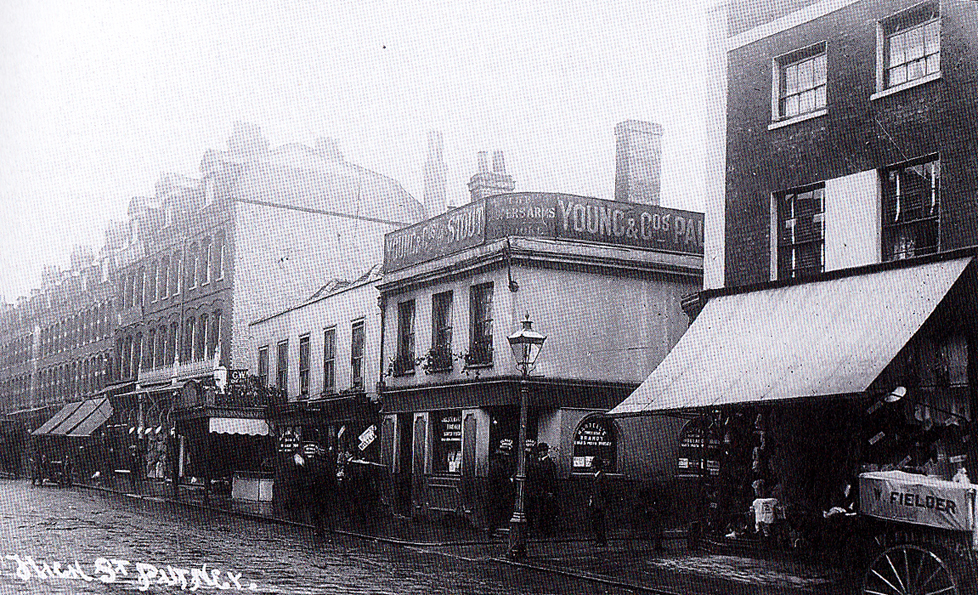
Coopers' Arms public-house, Putney circa 1905

The Coopers' Arms public-house gave its name to Coopers' Arms Lane, which was later renamed Lacy Road. Coopers' Arms Lane was formerly known as Warpell-Way, warp meaning "distinct pieces of ploughed land seperated by the furrows". A thoroughfare in Putney partly preserves the ancient nomenaclature in Warpole Road. The Putney High Street was largely unchanged until Edwardian times when the pub and cottages alongside were demolished and replaced by Edwardian shops. These were removed in the 1980s to make way for the Putney Exchange shopping centre.

Sources used for this blog post: British Newspaper Archive & Ancestry
Putney & Roehampton by Patrick Loobey


Sunday, 21 April 2013

A Place To Call Home

I have neglected my blog here at "Pocketfull", but I do have a good excuse. Well, maybe not a good excuse but an excuse nonetheless. In recent months I've created a new blog which is dedicated to the history of my childhood hometown and I've been contributing to it almost twice weekly (See it here). For now at least, I've run out of steam so I've decided to devote some of my free time back here, amongst my family history.

A new Australian drama is set to start on the Seven Network next week called 'A Place To Call Home' and while I've been rather looking forward to watching this post-world-war-two drama it has got me thinking lately about "home" and what it means to me personally. Even though I have lived in Australia for most of my life, I still have a hankering for my childhood home. Beyond this, I have often found myself wondering what my family and my ancestors would have called home.

Both of my grandmothers were devoted to their homes. My maternal grandmother Lilian always proudly called herself a "Londoner", even long after the war ended in 1945, when she was married and living in a quiet market town in Suffolk. Then, in 1978 she emigrated to Australia. Yet, all her life, at every opportunity she could get, she went back to London. Her heart was always right there and when she died in 1983 of a massive heart attack, I always believed (and still do, to this day) that it was because her heart was broken for home.
My paternal grandmother Freda lived in Beccles all her life. She never moved away from the town, except for a few years when she moved to nearby Brampton but she quickly welcomed a return to Beccles. There was no question of her living anywhere else but Beccles. She was born there, she was married there, she raised four boys there, and it never entered her mind to travel further than was absolutely necessary. She believed in setting down your roots and staying put and, for the most part, she was content with that. It didn't make her small minded but it certainly made her homely and connected to her roots.
My grandfathers? My paternal grandfather Herbert lived in Bungay, London, and later, Beccles. I don't think that any one particular place meant more to him. I believe he went where "duty called" for the most part, even during the Second World War when he was stationed at Sutton Coldfield.
My maternal grandfather was born and lived all his life in Bungay. While he fudged his age slightly on enlistment with the Norfolk Regiment I don't think it was necessarily because he wanted to escape home life. He just wanted to do what he felt was right. He was to travel to India during his pre-World War Two service and later to Dunkirk before his capture and internment in a German Prisoner-of-War camp. Later, in 1944-45, he served with the Royal Army Medical Corps and was stationed at Epsom, county Surrey. After the war, when he married my grandmother Lilian, they remained in Bungay and raised their family there, trying (against impossible odds at times) to live by the post-war standards of a secure family life.

Aerial view of Beccles and the River Waveney

If I look back another generation, to my great-grandparents' idea of what home meant to them, it differs quite dramatically. For example, my maternal great-grandparents Albert and Elizabeth, were born in the exact same town in London. They were both from working-class families and both were baptised at the same church. Their families possibly knew one another and shared a similar social history. Albert was restless though, even as a young boy. He wanted to travel and see the world, stretch his wings and leave Putney well behind him forever. He lied about his age to get into the Royal Navy and his only reason for returning to Putney was to marry his sweetheart, Elizabeth, in 1905. After that they lived in Southwark, Fulham, Tooting, Bloomsbury and later, Sutton (where they settled and remained until Elizabeth's death in 1951).
My other maternal great-grandparents, Percy and Nellie, were much like my paternal grandmother. They remained in the Suffolk market town of Bungay all their lives. There was no question of moving away, although my great-grandfather Percy, as a younger man, did love the sea and he took to fishing on trawler boats off the coast of Lowestoft for many years before settling back to farm life after the Great War (1914-1918).

Putney, in Greater London

My paternal great-grandparents were also a mixed bunch. Albert and Eva were Becclesians to the last, although my great-grandmother Eva was born in Loddon (her parents were Loddon born and raised before moving to Beccles) but she never had a great need to return there. Beccles was her home and Great Yarmouth was her favourite family holiday destination. Albert was born and raised in Beccles, and he remained staunchly faithful to the town and its townsfolk; at home, in religious circles, and in his work.
My other paternal great-grandparents, Arthur and Barbara, lived as a married couple in the market town of Bungay and raised their family there but they were not knowingly tied to their roots. Barbara was born in Holdenhurst, county Hampshire and lived there until she was a young girl, when her father took on a new job as a Railway Gatekeeper in Woodsford, county Dorset. Less than five years later, her mother passed away, her father abandoned her and she moved to London to work in the Domestic Service. Arthur joined the Norfolk Regiment as a young man and served in both the Boer War and the Great War. It was during the Great War that Barbara moved back to London with the children (including my grandfather Herbert) while Arthur was away fighting for King and Country. When the war ended they went back, as a family, to Bungay.


So there we have it; a mixture of loyalties towards home and yet, across the board, so very similar. There are those who willingly left home to fight in the war. Those who wanted to leave their homes for broader horizons. Those who stayed in the same town all their lives, loyal to the last. Those who wanted to run from their past and never look back and those who couldn't let go of their past and so returned again and again.
To this day I share the same tug-of-war with my maternal grandmother Lilian, the Londoner, who always found a way to go back even though the memories of her childhood were not altogether pleasant or heart-warming ones. Something always called her back and she was deeply proud of her London roots, even in the impossible heat and vastness of Australia that she made home for the last remaining years of her life. My own tug-of-war calls me back to Beccles, and sometimes that call is overwhelming. It certainly reflects in my ability to write about it without getting completely caught up and swept away in a sea of nostalgia and sentiment! Even though Australia is now the place I call my home I still carry a piece of Beccles deep within my heart, and I always will. I could never let it go.

Monday, 5 November 2012

Family History Through The Alphabet Blog Challenge : Z is for...

Here we are, the last post (bugle sounds) for the Alphabet Blog Challenge and once again I have to credit somebody else for the topic of the most baffling letter of all. My amazingly perceptive daughter came up with Zeppelin. How could I refuse when I've already blogged about my 4xgreat-grandfather Zachariah Rudd?


It makes perfect sense to write about the Zeppelin raids which affected my ancestors, not least because my ancestors lived in London and along the East Coast of England (the counties of Suffolk, Norfolk, Essex and Kent were repeatedly raided from 1915-17) but because my paternal grandmother Freda often spoke of her parents who saw the Zeppelins as they came across the North Sea.

Before the First World War, Count Ferdinand von Zeppelin developed an airship specifically for long-distance passenger flights. When the war broke out in August 1914, these airships were taken over by the German army. Throughout the war the Germans were prepared to try new forms of warfare and in January 1915 they mounted the first airship raid on England.

On the night of 19 January, two Zeppelins bombed the docks at King's Lynn and Great Yarmouth (county Norfolk) which killed four people. The East Suffolk Gazette reported that a Mr T W Holmes of Denmark Road, Beccles "believes he heard an airship coming over the town, possibly on its way back after its tour in Norfolk". Other raids followed and much damage was inflicted across the Eastern Counties. In the Autumn of 1915 a raid on the City of London killed 38 people and caused extensive damage.

A Zeppelin over Cuffley, county Kent
They look eerily like Alien space-craft

During my research into the Zeppelin raids I was amazed to discover how they were made. Zeppelin airships had a metal frame containing large bags of hydrogen gas, which lifted the craft into the air. They were powered by engines mounted outside the craft. Crew and bombs were carried in a gondola which hung underneath the craft. There was no protection which meant the men were exposed in all weather conditions, and there was nowhere to sit in the gondola which meant long periods of having to stand up. In the early part of the war the bombs had to be dropped by hand!

Most Zeppelins flew too high for British aircraft to catch and attack them but by the autumn of 1916 British airplanes were equipped with explosive shells (and later, incendiary bullets) and on 2 September the first Zeppelin was shot down by a British pilot. After two more unsuccessful raids, the Zeppelins stopped coming. By 1917 most German airships were restricted to reconnaissance work at sea. According to the Illustrated History of the First World War by John Keegan, "Germany flew a total of 115 military Zeppelins during the war, of which 77 were destroyed, 7 captured, 22 scrapped and 9 surrendered to the Allies".

Raid on Great Yarmouth, Norfolk 1915
Zeppelin Raid on Bury St Edmunds, Suffolk 1915

My great-grandparents may not have been directly affected by the Zeppelin raids of 1915-17 but they were certainly witness to its overall destruction and reign of terror across England. I know that my great-grandparents would have seen continual wreckage through both the Zeppelin raids and the Gotha Raids in London.

During the early part of the First World War my great-grandmother Elizabeth was living in Fulham, raising four children alone whilst her husband, my great-grandfather Albert, was fighting off the coast of Turkey with the Royal Navy Reserve. It is known that areas nearby to Fulham were repeatedly targeted and bombed in the 1917 Gotha Raids. I believe that is why Elizabeth and my great-aunts and great-uncles subsequently moved to Edmonton around 1917-18.

My paternal great-grandparents were living close to the coastline of Suffolk during the First World War. My great-grandfather Arthur Ward may have been on the Western Front serving his King and Country but his wife, my great-grandmother Barbara, was living in the heart of London with four of their children, including my grandfather Herbert. It is no small wonder that following 1917, they moved back to Suffolk.


Monday, 1 October 2012

Family History Through The Alphabet Challenge : U is for...

Given that I was born in the United Kingdom it would be only fitting to write about it in this week's Alphabet Challenge for the letter U. However, that would be too easy so I am doing it yet again. Writing about something completely different!


The last known address of my 3 x g/grandfather's "wife" was Usk Road in Battersea, in 1881 (I say "wife" because they were not legally married). The census shows us that Sarah Mary Ann (nee Spencer) was living at 35 Usk Road with her husband Thomas Shepherd and three children: William and Charlotte (from her previous relationship with my 3 x g/grandfather) and a three-year-old daughter Emily. I am yet to prove a theory that Sarah died in 1883, aged 36.

Usk Road was not far from where Sarah lived with my 3 x g/grandfather Richard Humphries. In 1871 they lived together with William and Charlotte, as well as Richard's three grown sons from his first marriage, in nearby Putney. On the other side of nearby Wandsworth lies the South West London town of Battersea. Famous for the Dog's Home and the Power Station, Battersea was once a large market garden area and lavender field well before industry took over.

I

I don't believe there was anything quite as romantic as the image above of boats on the River Thames at Battersea for Sarah Shepherd and her children. The whereabouts of my 3 x g/grandfather Richard Humphries (see my post about him) after 1871 continues to baffle me as the paper trail dies off at this time but for Sarah, who remained very much alive, it must have been a very difficult time. She was left with two small children (she had had three but one died in infancy in 1869) and no husband. It is not known how or when she met Thomas Shepherd and the first I knew of him was from the 1881 census. From there I worked back until I found a marriage between he and Sarah in June 1876. Sarah claimed she was a "spinster" which technically was true. Thomas Shepherd, son of Samuel Shepherd, worked in a Candle factory and could not write or sign his name on his marriage certificate.

Sarah Mary Ann Spencer was born in 1846 in Battersea. Records indicate she was the daughter of Christopher Spencer and Mary Ann Hosier. Christopher Spencer was born in Wandsworth about 1822. In 1851 the Spencer family lived in King Street, Battersea but the following census paints a very different picture. Christopher died in 1856 and Mary Ann, along with her four children, were living with George Temple in Red Lion Street, Wandsworth. Interestingly, Mary Ann had only aged three years between 1851 and 1861!

Battersea Power Station
Image courtesy of Wikipedia
Battersea was heavily bombed in 1944/45 and Usk Road was the last recorded road to be hit by a V2 weapon (in the Battersea district) on 27 January 1945. It is recorded that at least seventeen people died that day and more than twenty houses were fully destroyed or damaged.

I wish I knew why Sarah Mary Ann Spencer/Humphries/Shepherd was left abandoned with two small children. It was certainly not common for a bachelor to take up with an unmarried woman with children so what sort of person was Thomas Shepherd to do that so willingly? Then Sarah had a child with him: Emily. What is more intriguing is that by 1881 Sarah gave the children she had with my 3 x g/grandfather her name, Spencer and had totally dropped the name Humphries. Did Thomas know anything at all about Richard Humphries? Surely, you would think that this would totally baffle and confuse any of their descendents. Anybody trying to trace the family tree for their Shepherd or Spencer ancestors would possibly not even know of the connection with the Humphries family and that three children were registered at birth as Humphries (later becoming Spencer). These children were:

William Spencer Humphries born 1868 in Fulham
1881 census: William Spencer, aged 12

Sarah Spencer Humphries born 1869 in Putney
Died in 1869, aged 4 months

Charlotte Amelia Spencer Humphries born 1871 in Putney
1881 census: Charlotte Spencer, aged 8
When Charlotte married in 1893 to William Tilley she gave her father's name as Thomas Spencer, not Thomas Shepherd (just to further confuse the issue!).

Aftermath of V2 bombing in Battersea
Image courtesy of Wikipedia


Monday, 24 September 2012

Family History Through The Alphabet Challenge : T is for...

I could have chosen a name for this week's Alphabet Challenge post as there are several names in my ancestry that start with the letter T. For example, Thomas (son of) Thomas, (son of) Thomas etcetera. Rather than bore you all with that, I have chosen to write about Travel as my ancestors have proven, they moved around a lot.


In the times we live in today, we think nothing of walking out of our front doors expecting to access all modes of transport such as cars, mopeds, buses, trains, taxis and ferries. It is easy to take it for granted and forget that our humble ancestors had to rely (most often) on one method of travel: Walking. My London ancestors for example, would not have been able to afford the luxury of owning their own horse and cart or liveried carriage and when bicycles became popular in the Edwardian era, not everybody felt safe riding London's busy streets.
 
Let's cast our minds back to the days well before cars and buses. Before well-paved roads were in demand, our ancestors highways were mere ditches and tracks, potholed and uneven, flooded and thick with mud. If you were rich enough to be able to travel by coach or horse and cart you were at the mercy of the highwaymen. I would bet our ancestors were thankful for the likes of Scottish civil engineer Thomas Telford, who singlehandedly changed the way people travelled forever. The Industrial Revolution also put travel on the map, so to speak. Roads, canals, railway, bridges, even the penny post system, which was introduced in 1840, made travel an exciting thing for our ancestors to contemplate. My ancestors used these methods of travel to move from county to county; village to market town. Where before, in the 1600s and 1700s they remained in one village, they were now branching out and exploring a world outside of their own backyards.
 
Thomas Telford
(1757 - 1834)


Before my 4 x great-grandfather moved to Beccles around the year 1809, he came from an unknown area of Norfolk. How did he come to settle for the village of nearby Barnby? I have this rather romantic notion that he travelled by canal boat or wherry. He saw the village from the Waveney River and thought to himself, "This is pretty, this is peaceful, this will do me" and he settled there, married and he later moved to Beccles with his wife where they raised their eight children.
 
My London ancestors moved around a lot. They are found each ten years (by the census return) living in a different street. For example, one family who lived in Putney had moved two or three streets apart, every ten years. When I travelled to Putney in late 2006, I visited all the streets they had lived in and discovered that although the addresses were in close proximity, they were still quite a distance apart in terms of moving house. How did they move their personal effects from one house to another? I had visions of them having to carry everything they owned or perhaps they borrowed a neighbour's cart to put their mattresses and humble effects into. In times past, our ancestors' homes were not heavily furnished. In particular, the working classes of England who possessed little in the way of dining tables, chairs, beds, cabinets, dressers, sideboards and wardrobes. I wonder what they would make of an IKEA store if they could see one today!
 
Image courtesy of www.rushdenheritage.co.uk
 
In the past one hundred years transport and travel methods have vastly improved and we have seen many changes and upgrades with railways, cars, ships and airplanes. My first cousin 3 x removed was the first to embark on a journey from London to New York by airplane in 1947. She well and truly caught the travel bug, as passenger list records prove she travelled back and forth from England and America regularly, both by ship and by plane up until her death in 1975.
 
My great-grandfather refused to drive a motor vehicle, choosing instead to ride a bicycle. He used this method of travel wherever he went and would happily ride for miles and miles at any given journey. He was seen daily in Beccles, from the early 1900s up until around 1970, riding to and from work and to and from church, as well as neighbouring villages and market towns. When he grew much older and age robbed him of his eyesight, his family were very concerned for his safety but he was stubborn and could not bear to part with his trusty cycle. No amount of coercion convinced him to give it up until one day his sons were forced to hide his bicycle away. This story still breaks my heart when I tell it, because I know full well how my great-grandfather must have grieved this enforced loss. I do not drive either. I refuse to just as my great-grandfather did. Instead, I rely on buses, trains, lifts from family and friends, and my two size-seven feet.
 

Edwardian Gent with his Bicycle


Sunday, 24 June 2012

Family History Through the Alphabet Challenge : G is for...

This week I am dedicating my Family History Through the Alphabet Challenge to my grandmother's gloves. That's a strange topic, you might say, but read on. There is a story to everything if you look closely enough.

  
My grandmother Lilian spent most of her life in poor health. As a young child she contracted tuberculosis, while bronchitis and asthma plagued her adulthood. Despite this, Lilian had a glamorous spirit and this is my fondest memory of her. She had style and she carried herself as though she possessed tons of it. Some may argue that she was above her station in life but I always liked that about her. She rose above her illness.

Lilian always wore gloves. She also smoked cigarettes from a black holder (which I tried to emulate once and only ended up looking like a right fool). She may not have been Audrey Hepburn either but, to me, she was pretty darn close to it. Every photograph I have of Lilian, taken at a family wedding, she is wearing gloves.
Lilian (left) and my Mother at a Family Wedding

She had many pairs in all lengths, styles and colours. When she passed away I was given a pair of her gloves and I still treasure them to this day. They are ruched at the wrist which is my favourite style of vintage gloves. I used to wear them in my younger years but nowadays they are kept in my treasure box for safe-keeping. Even my mother wore gloves well into her thirties. I remember she had a short navy blue pair which she always wore in the winter months when driving.
  
Lilian (right) with my Great-Grandmother
at a Family Wedding

The History of Gloves
While gloves have always had a practical nature they also began to develop symbolic meanings. It was good social etiquette when approaching a person of high authority to remove the right hand glove as a mark of respect. The same was also true for approaching an altar. A lady could show her affection or favouritism to a man by taking off her glove and offering her hand to him.

In Freemasonry the glove plays an important symbolic role. Freemasons believe that the glove alludes to the purification of life. They quote Psalm 24:4 from the Bible "He who has clean hands and a pure heart"

The tradition of wearing gloves for Holy Sacrament by Roman Catholic Bishops became a religious ritual and as early as the 10th century, to keep their hands clean, Popes, Cardinals and Bishops wore gloves. Kings began to wear gloves as part of their ceremonial duties and later as more of a fashionable accessory to display their position.
Copyright: © 2011 (Go Planet Gloves)

My grandmother's gloves hold a very special meaning in my heart because my grandmother was special, and because I associate vintage gloves with her. Whenever I go to a vintage clothes market I feel as though I am stepping back in time and seeing my grandmother's world as she would have known and loved it. Gloves, hats, handbags, scarves, brooches, feathers, and long coats. Even through the London Blitz, my grandmother still held her head high. She really did "Keep Calm and Carry On".
  
My Grandmother's Gloves
Photography by Jeff Watkins
http://www.facebook.com/LabrugImages


Tuesday, 1 November 2011

Honouring My World War One Ancestors

We are approaching that time of year where we stop to remember those who served in The Great War 1914-1918; where we honour the memory of those who died, especially our own loved ones. Our great-grandfathers, our great-uncles, our cousins. The loved ones who went to war and were killed in the name of King and Country.

Sharpest in my mind are my ancestors, none of whom I knew but who have become much more real to me since researching my family history in earnest. My local Genealogical Society advised me to visit the CWGC website for further information regarding individual tributes to all war dead. This website holds details of my military ancestors, from both World Wars. The Commonwealth War Graves Commission, established by Royal Charter in 1917, pays tribute to the thousands of men and women of the Commonwealth Forces who died in the two World Wars.

The British Royal Legion held its first official Royal Legion Poppy Day in 1921. Inspired by the now world famous John McCrae poem 'In Flanders' Field' the annual Poppy Appeal is still a key event today. Here in Australia we have an annual Poppy Appeal in April to commemorate our  nation's own 'Remembrance Day' known as ANZAC Day. As we are a Commonwealth nation we also honour Armistice Day with another Poppy Appeal and various war memorial services and a two-minute silence.

Every year, whenever I see the RSL (Returned & Services League of Australia) selling poppies in the shopping centres and around the streets of Perth, a lump always catches in my throat. I have the utmost respect for all those who have served, and those who serve today, for our country. For me personally I experience a double dose of extreme emotions each year, both in April and in November, as I honour my allegiance both countries (of which my heart proudly belongs).


James Jolly was born in 1880 in Bungay, the fourth child and second son of William Jolly and Emma Clarke. It is believed that he enlisted with the Norfolk Regiment at Ditchingham from an early age, and served with the 2nd Battalion, as Private, in the 1899-1902 Second Boer War campaign. When World War One broke out, James (affectionately known as 'Jumbo') served with the 1st Battalion as Acting Lance Corporal and was sent to France. Just two short months later, James Jolly was killed in the First Battle of Ypres, in November 1914. He is buried at the Menin Gate Memorial Cemetery. He was my Great-Granduncle. Lest We Forget.

James Jolly
William Waters was born in 1889 in Beccles, the third child and second son of William Waters and Emily Gunns. William worked as a Coachman in Beccles until war broke out and he enlisted on the 9th of September. According to his Service Record he was born in 1884 and he gave his occupation as 'Chauffeur'. He was listed as having served in the Territorial Force for 5 years. By the time he enlisted to serve with the 1st Battalion Norfolk Regiment (at Norwich) in 1914 he was 7 years married to Elizabeth Poll, and they had five children, the fourth child being born in February 1914. William Waters was wounded in May 1917 and died 9 days later, at Huddersfield Hospital. He is buried in Beccles. He was my Great-Granduncle. Lest We Forget.

War Memorial at Beccles
Sidney Preston was born in 1889 in Holt, the sixth child and third son of Thomas Preston and Sarah England. After leaving Gresham's School in 1905, Sidney had a promising career in London as a Solicitor. Under the tutelage of his eldest brother Thomas, Sidney was sitting his Law examinations when war broke out and he felt a stronger urge to serve for his country, and enlisted with the Middlesex Regiment (but was later given a commission in the Essex Regiment). In 1916, whilst stationed at Aldershot with the Essex Regiment, Sidney married his sweetheart Mabel Gold in Kilburn, Middlesex. In November 1917 Sidney was sent to France and was killed in action in April 1918. He is buried at the Bienvillers Military Cemetery. He was my First Cousin 3 Times Removed. Lest We Forget.

Sidney Preston (1911)

They shall grow not old,
As we that are left grow old,
Age shall not weary them,
Nor the years condemn.
At the going down of the sun,
And in the morning
We will remember them.

Lest We Forget.


Sunday, 9 October 2011

An Elusive Ancestor : Richard Humphries

Every now and then an ancestor comes along, destined to elude you. We all have at least one in our family tree, right? I have several but none has proved as elusive (or as frustrating) as Richard Humphries.

Born in Hammersmith in 1829, to John Humphries and Ann Rogers, Richard was the eldest of seven children. They lived on The Mall, which fascinates me because when I was a teenager I lived in a block of units by the river, not unlike the scene here (left).

John and Ann were both employed as Mattress Makers, and when Richard went out to work he got his trade as an Upholsterer.

Around 1849 the Humphries family were dealt a cruel blow when the house they moved to in Putney was infested with the deadly cholera disease. Within days of moving in, one son was dead and the father, John, quickly followed. Suddenly Ann was left alone to raise the remaining children, two of which were mere infants. She sent the youngest four to the North Surrey Industrial School in Penge. The eldest two, including Richard, were old enough to fend for themselves. Richard took work in Lambeth and later that same year, married Mary Ann Smith.

Richard and Mary Ann had four children, the first child (an only daughter) died of Scarlatina. Their remaining three sons were born and raised in Putney and they lived in relative comfort until 1871. Then the real confusion began. The census of that year was very revealing in that Richard was no longer married to Mary Ann. His new wife was listed as Sarah Ann. In addition, there was a new child listed. I automatically assumed that Mary Ann had died and Richard married again. Searches for Mary Ann's death and Richard's second marriage almost caused temporary insanity, as both turned up nothing. Eventually I located Mary Ann as having died at the Wandsworth & Clapham Union Workhouse (oddly, 10 years older than she actually was), being listed in their records as a "Widow". Long story number one...

Richard and Sarah Ann were not married, but they had three children together nonetheless, the last of whom was born in 1871, three months after the census of that year. Then the search goes cold for Richard. He is not in the 1881 census, and interestingly, Sarah Ann is married to someone else and they are living in Battersea. She married in 1876 and used her maiden name of Spencer. Her three children are all listed on the 1881 census as Spencer children, not Humphries!

Which begs the question? What happened to Richard Humphries? All manic searches have proved dead end after dead end. The paper trail has, time and again, gone completely cold, having been thwarted at every turn. For example, there are three possible death registrations for a Richard Humphries, however, all three have been investigated and I can attest with every fibre of my being, that they are not my ancestor. I have several cousins who believe they know when he died (1890 is one theory, 1915 another) but I have gone back through the records with a fine tooth comb and can assuredly disprove their theories. It is maddening to not know the truth. Hence, long story number two...

When I poured over the Putney parish registers seven years ago, I came across a burial for an unknown man, around the age of 40 years, drowned in the Thames at Putney. The year was 1875. He was given a burial at St Mary's Church and a coroner's report found that the unknown man had drowned as a result of his leg being caught in a barge. I know I am an ardent lover of Charles Dickens (see previous post) but could it be? Could it possibly be Richard Humphries? Tell me I am grasping at straws, clutching to a romantic fictional notion but it is the best theory I have to go on. Richard disappeared, without a trace, sometime between 1871 and 1876. His "second wife" who he was not legally married to, but had three children with, marries another man in 1876 and carries on with her life, as though Richard Humphries did not exist.

Where did you go Richard? What on earth happened to you? Why has your trail gone cold? Why don't you want me to find you?

Image from Genea-Musings