Wednesday, 20 February 2013

When Children Die In Strange Circumstances

Last night my cousin shared a photograph with me. It was taken after the 1908 hurricane hit Bungay and severely damaged two Cemetery chapels. What interested both of us about the photograph was the gravestone in front. It was a Jolly grave. Our common ancestors. Not only that, the grave was for two children - brothers - one aged twelve and the other aged nine, who had drowned. Putting my Miss Marple hat on, I went straight to the British Newspaper Archive website.

Bungay Cemetery Chapel; the aftermath of the 1908 hurricane
The Ipswich Journal dated 7 March 1882 reported the drowning death of nine-year-old James Jolly, the son of James and Charlotte Jolly of Bungay. The report states James was allegedly seen stealing from a broken shop window and upon being asked what he was doing, ran away. He was last seen by a school friend who spoke with James and asked where he was going in such a hurry. James replied that he was going on an errand and ran towards the direction of the Bungay Common. The next day a local butcher found a cap on the Common, by the river, belonging to James Jolly and went to alert Policeman Mann. Upon further searching, they found the body of James Jolly who was drowned. An inquest returned an open verdict of "accidental drowning".

Contacting my cousin with the news, we were both shocked about this newspaper article. Curiosity got the better of me an hour or so later and I went back to the British Newspaper Archive on the off-chance that James Jolly's brother Frederick may have also died under strange circumstances. You would be right in assuming that a large percentage of children died in Victorian times. Sickness, disease, inadequate (or expensive) health care and poverty were rife and it would be considered "normal" for a child to die before being given a proper chance at life. You can therefore imagine my total surprise when I found the newspaper report for Frederick.

The Ipswich Journal dated 27 December 1890 reported that Frederick Jolly "died suddenly". After a brief illness ( a common cold) Frederick, who was an errand boy for a local chemist, complained of feeling unwell and was sent home to recuperate. On the way home he met with some of his friends who began taunting him with snowballs. We all know that kids can be cruel but I am pretty certain that they did not anticipate that would be the last time they would see their friend. Frederick allegedly reported to his friends that he had eaten some poisoned sweets and felt unwell. The next day, after a night of vomiting and diarrhoea, Frederick was pronounced dead by the local surgeon, Mr Garneys. The coroner for the district decided that no inquest was necessary and Frederick had died of "sudden illness".

The gravestone of brothers, Frederick & James Jolly
What frustrates me as a twenty-first century genealogist and social historian is that the circumstances of these children's deaths was brushed aside and not properly dealt with. The newspaper reports throw up all kinds of unanswered questions and leaves me sorely wishing for a time machine. In the case of James, he was a nine-year-old boy. A cheeky larrikin perhaps, but a boy who had his whole life ahead of him. How did he come to drown? Why did he drown? Who is accountable for this boys death? Was it a mere accident or was something bigger going on?

In the case of Frederick, he was a twelve-year-old boy who had been sick with a common cold. The circumstances of how he came to ingest "poisoned sweets" is baffling. He worked for a chemist so it may be safe to assume that Frederick may have been curious about the powders and tablets and maybe the temptation to "try" some overcame him. Did he unwittingly kill himself? Why was this not mentioned in the report? It was just expected that he was a child, and children die every day. No big deal.

I am quite saddened that these two brothers died so young. Their parents James and Charlotte Jolly lost two of their sons to unfair and disadvantaged circumstances. I think I can better understand my great-grandmother Nellie Jolly today. She prayed every night, on her knees, beside her bed, with her rosary beads wrapped around her hands, for everyone in her family. She named every single one - immediate family and extended - and she would not raise from her kneeling position until she had mentioned every person.

It turns out that the photograph (pictured above) is actually on page 93 of Christopher Reeve's 2009 book "Bungay Through Time". The photograph's caption reads:
"Bungay Cemetery, Hillside Road: The Cemetery, established in the late nineteenth century, originally had three mortuary chapels. In 1908, a rare hurricane occured which blew down the north wall of one of them, and it was demolished soon afterwards..."
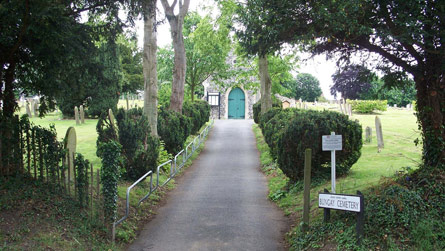
Bungay Cemetery today


Wednesday, 30 January 2013

Peter Lanyon : Cornish Artist

My husband's side of the family tree is rather intriguing and much has been researched on both his father's and his mother's sides of the tree. There are tin merchants, photographers, carpenters, musicians and composers, outfitters and tailors, farmers and pioneers, midwives and Indian Army Majors but one man became a well established name in Cornish history. My husband's maternal grandfather: Peter Lanyon the potter, sculptor, and painter.

One evening not too long ago, I was idly googling Peter for any new images or paintings and on the fifth or sixth line of results I discovered a photograph I had never seen before. It was taken by Ida Kar in 1961 and it's a really lovely shot of him.

There is so much expression in his face. I wish I could've met him.

I remember once listening to an old reel-to-reel audio of Peter Lanyon talking about his love of art and his heady youth in St Ives. Of all the things he said I will never forget when he responded to a question by saying, "I like cliffs. They're very tall...and thin." My husband and I still say that to each other from time and time and fall about laughing. Of course, Peter was referring to the view from his beloved glider. Imagine being an artist, looking for inspiration along the Cornish coastline. You would be absolutely spoiled for choice, and Peter used every opportunity he had to create masses of paintings, drawings and sculptures of Cornwall.

Peter loved each of his children and he took them with him on many walks and hikes around Cornwall, and he taught each of them to appreciate and hone their own unique craft. Today his sons are renowned painters, including Andrew Lanyon and Matthew Lanyon. I didn't get to meet Andrew during our 2006/7 trip to England as he was away in Japan but I did meet Matthew and I recall him being hilarious fun and great with my daughter.

George Peter Lanyon was born in 1918, one of two children born to William Herbert Lanyon and Lilian Vivian. Peter was educated at Clifton College in Bristol but St Ives remained his base and his first love however extensively he travelled throughout his life. As his love of art grew so did his ties with fellow artists Patrick Heron, Borlase Smart, Victor Pasmore, Ben Nicholson, Barbara Hepworth, Adrian Stokes, and Naum Gabo.


Peter at Little Park Owles Studio, 1955

From 1940 to 1945 he served with the Royal Air Force in the Western Desert, Palestine and Italy. In 1946 he married Sheila St John Browne. Peter and Sheila had six children (including my mother-in-law, Jane). Also in 1946 he became an active member of the Crypt Group of Artists, St Ives. During the 1950s he became established as a leading figure in the St. Ives group of artists.


Peter in his glider, c. 1960

Peter took up gliding as a pastime and used the resulting experience extensively in his paintings. One day in August 1964, on a training course with the Devon and Somerset Gliding Club, he came in to land too low; the glider nose-dived and catapulted him out. He died four days later as a result of his injuries. He grave slab carries and inscription from one of his own poems:

I will ride now
The barren kingdoms
In my history
And in my eye


The Returned Seaman, 1949
In The Trees, 1951
Chesil Bank, 1958

http://www.bbc.co.uk/arts/yourpaintings/artists/peter-lanyon

http://www.tate.org.uk/art/artists/peter-lanyon-1467


Monday, 21 January 2013

2013 Australia Day Challenge : My First Ancestor To Reach Australian Shores

Nothing conjures up images of Australia quite like sheilas and blokes on crowded beaches, thongs, stubbies, barbecues, cricket, Aussie Rules football, Holden Utes, Vegemite, and Banana Boat sunscreen. With Australia Day just around the corner, Helen V Smith came up with the brilliant idea of telling the story of our first Australian ancestor. In November 2011 I wrote a blog post about my more "rebellious" ancestors. One of those was my 3 x great-grand uncle Frederick Ward. Born in 1821, Fred was the first ancestor (that I know of) to reach Australian shores from his humble hometown of Bungay in county Suffolk, England.

Remains of Bungay Castle, 1819
William Buckley welcomes Batman
William Buckley meeting John Batman's party, Australia 1835

The following is taken from my previous blog (basically, because I'm feeling lazy):

"My visits to my local genealogical society over the years has seen many interactions with Australians who rather proudly announce that they each have at least one Convict ancestor in their family tree. Many boast that without them they wouldn't be here today. White Australian settlement history rests largely on the shoulders of those Convicts who sailed on Convict ships, from as early as 1788 through to the mid 1840s when criminal transportation was put to an end. The last of those Convicts were known as 'Exiles' because, basically, they were not  really wanted anywhere. There was no room for them in England. Its prisons were fit to bursting, and many were placed on Prison Hulks off the coast until there was a place for them somewhere or a final decision from officials could be arrived at.
Frederick Ward, my third great-grand uncle, was one of those 'exiles'. In December 1844 he was sentenced, at the Beccles Quarter Sessions, to be transported for 7 years, for stealing three stones weight of cows flesh from James Skippon of Bungay. Unfortunately, this was not Fred's only crime. He had been convicted on two previous occasions; in 1843 and 1844, both on accounts of larceny, and was sent to Beccles Gaol.

In December 1844 Fred Ward was sent to Millbank Prison in London. Millbank was intended to house up to 1000 transportation prisoners at any one time. The average stay was for around three months, during which time prisoners would be assessed for future placement. By the early 1840s transportation sentences were ceased but there were still many prisoners who faced the possibility of being sent away.

In 1843 Millbank was converted to house general prisoners and transportation prisoners, including Fred Ward, were moved to Prison Hulks. Finally in January 1847 Fred Ward was placed on the 'Thomas Arbuthnot' with around 288 male prisoners from Millbank, Pentonville & Parkhurst Prisons and sailed from Spithead to Port Philip Settlement (Melbourne), arriving in May 1847. The 621 ton ship began her voyage at Portsmouth, then travelled to the Isle of Wight where she took on 90 Parkhurst boys. The Times newspaper had this to report:

"The Thomas Arthbuthnot convict ship, Captain Therason, sailed from Spithead this morning for Port Philip with a superior class of delinquents, officially called "exiles". These are the first "exiles" sent to the above settlement, which the inhabitants of that respectable place are very wroth at, and have memorialised the Government on the subject..."

Little is known about Fred Ward after his arrival to Port Philip. This is still a work in progress. What is known is that people such as Richard Deeks spent his precious time researching and transcribing all transportee records of Suffolk and turned it into a book. It was this invaluable book, printed in 2000 and entitled, 'Transportees from Suffolk to Australia 1787-1867' (held at the Suffolk Record Office), which helped me to locate and further research Fred Ward."


Tuesday, 1 January 2013

Percy and Nellie : Centenary Anniversary

Happy New Year to everyone! While we are all busy making resolutions for the year ahead I wanted to share something special with you. Today is a very special day in my family history calendar as it marks the centenary of the wedding day of my great-grandparents Percy Preston and Nellie Jolly.

Percy and Nellie were the last of my great-grandparents to marry (Before them, my other great-grandparents married in 1905, 1907 and 1909). Percy and Nellie were married at Holy Trinity Church in Trinity Street, Bungay (Suffolk, England) on 1 January 1913. The day would have been a Wednesday. I don't know what sort of weather they had but being winter, it would have been mightily cold. The following week saw recordings of heavy snowfall across the north of England.

Nellie would have perhaps worn a hand sewn dress (a collaborative effort with her older sister, Alice or one of her sisters-in-law?) made of warm fabric, with lace and/or embroidery detail, with long sleeves and possibly even a long coat to keep her warm during the walk to and from the church. Perhaps she wore a gown which had been passed down from somebody in the family. While it would not have been as expensive or elaborate as the one worn by Princess Patricia of Connaught (seen pictued below), I am certain that Nellie would have looked equally as beautiful.

Example of a late Edwardian Wedding Dress
Edwardian Era Hairstyles
No known photographs exist of Percy and Nellie's wedding day, so I do not know what Nellie would have worn on her wedding day. I can only speculate. However, I like to imagine her walking from her home in Gas House Lane to nearby Trinity Street, and walking with her father, William Jolly, along the stone pathway which leads into the church. It is so heartbreaking that there are no known photographs of Percy and Nellie together, in existence, at any time. I have plenty of photographs of Nellie with her children and Nellie with her brothers but not one single photograph of Nellie with her husband. When Percy died in 1936, Nellie remained a widow for the rest of her life and she always wore navy coloured clothes.

Postcard: Wrench Series
From the Bungay & District Town Guide 1971


Holy Trinity Church History
Holy Trinity Church dates back to Saxon times when the tower was dated at around 1041 with the nave being added about 100 years later. The dormer window in the roof was created in Victorian times to light the organ loft when the organ was installed. The south aisle is fourteenth century, and the chancel was built in 1926. The pulpit was recorded as being set up in 1558 (which cost all of 10 shillings). This is an account from the Suffolk Institute of Archeaology Vol. IV:
"That this tower is old for a round tower will not be doubte by those who examine the interior. The original design appears to have consisted of four circular windows, and directly under each of these (except that which faces the east) a semi-circular-headed window.
There is nothing in the poor Perpendicular architecture of the Church which calls for special notice. A payment was made for erecting a Screen in the Chancel in 1558. As to the conjecture that the original Chancel perished in the fire of 1688, it is certain that there was a chancel, mutilated indeed by the "improvements" of 1754, when the present tasteful east window was erected - but nevertheless a chancel..."

Postcard: HW Short

The 1912 Kelly's Directory describes Holy Trinity Church thus:
"The Church of the Holy Trinity, supposed to have been built in the eleventh century, is an edifice of rubble, faced on the south side with flints, in the Norman style, and consists of nave and aisles (without chancel), south porch and a round embattled western tower...The pulpit of black oak is a very fine example of Elizabethan work. There are 420 sittings, of which 125 are free..."

The Churchwardens' Book of Holy Trinity also makes for very interesting reading but this one rendered me most curious:
1581. Paid for whipping the dogs out of the churche for a whole year, 1/4.

I wonder, did that include the legendary Black Shuck?

My Great-Grandmother Nellie Jolly, aged 12-15

Wednesday, 12 December 2012

2012 "Deck The Halls" Christmas Geneameme


Thanks to Pauleen (cassmob) from Family History Across The Seas and other bloggers I have been inspired to take part in the 2012 "Deck The Halls" Christmas Geneameme. So here is my contribution:

Whilst Christmas in my house may not necessarily be a religious experience it is definitely a part of the whole meaning of Christmas to me and my family. We honour the occasion for what it truly is, and not for the massive commercialisation it has come to be in recent times.


Do you have any special Xmas traditions in your family?
I’m not entirely sure what constitutes as traditional in this day and age but I do like to uphold a routine of early morning present opening, followed by a cooked breakfast and then I get stuck in to preparing and cooking a turkey and trimmings feast for everyone. Then I fall into an exhausted heap and have a nanna nap!


Is church attendance an important part of your Christmas celebrations and do you go the evening before or on Xmas Day?
When I was little, growing up in the UK, it was a very important part of Christmas, as was attending the local cemetery to place a wreath on my paternal grandparents and great-grandparents graves. Nowadays I attend Midnight Mass with my mother but only when I can be bothered to stay up that late!


Did/do you or your grandchildren/children believe in Santa?
I was brought up to believe in Santa and I did until one year when I accidentally ruined everything for my sisters. I distinctly recognised my father’s voice shouting “Ho Ho Ho” at the kitchen door and yelled out “That’s not Santa, that’s you Dad!”. I still feel guilty about that 30+ years on! My daughter was brought up to believe in Santa and the magic of Christmas but a few years ago she pretty much told me her school friends said it was all rubbish. I didn’t deny or confirm, and I still haven’t.


Do you go carolling in your neighbourhood?
I value my life too much to even contemplate doing something like that. In theory it all sounds wonderful and nostalgic but in reality it is just unsafe in our neighbourhood.


What’s your favourite Christmas music?
I don’t have any specific favourites but I do love to play Bing Crosby (as he was my maternal grandmother’s favourite) and Michael Buble but to be quite honest, I usually like to play a mixture from all genres across the board.


What’s your favourite Christmas carol? 
“Joy To the World” is my definite favourite.


Do you have a special Xmas movie/book you like to watch/read? 
For me it has to be Charles Dickens’ “A Christmas Carol” – it delivers such a powerful message and one that hits the heart every single time I watch it or read it. My daughter and I love the Muppets movie version but I also enjoy watching Seymour Hicks’ version.


Does your family do individual gifts, gifts for littlies only, Secret Santa (aka Kris Kringle)?
My mother and my aunts do that sort of thing. I don’t have grandchildren and I’m self-employed so there are no co-workers to worry about buying for.


Is your main Christmas meal indoors or outdoors, at home or away?
There has been a mixture of traditions in my life as I came from England where it was definitely indoors and always at home. When I came to Australia it has been a combination of indoors and outdoors (sometimes both if it’s a particularly hot day) and a combination of home and away, visiting relatives and extended family later in the afternoon or early evening or on Boxing Day.


What do you eat as your main course for the Christmas meal and do you have a special recipe? 
Always a turkey and roast vegetables spread with lashings of gravy and stuffing. I am proud to say that I follow Jamie Oliver’s Christmas recipes and they have not let me down yet. Everyone loves my slap-up feast and there are hardly any leftovers!


Jamie Oliver with his Nan

Does Christmas pudding feature on the Xmas menu?
I remember my maternal great-grandmother always started making her Christmas pudding months before Christmas day, and my grandmother and my mother upheld this tradition for many years. In more recent years my mother likes to make a Christmas Cake.


Do you have any other special Christmas foods? What are they? 
Mince Pies and Shortbread mostly, and Brandy Custard!


Do you give home-made food/craft for gifts at Christmas?
When my daughter was smaller we used to bake gingerbread cookies together, using different Christmas cookie-cutter shapes, but both of us got lazy and stopped doing it. Turns out it is cheaper to buy them from the supermarket anyway!


Do you return to your family for Xmas or vice versa?
Before I had my own family, yes always. I do have family in the UK as well and it has been nice to spend Christmas with them whenever money permits (which sadly is not often enough for my liking).


Is your Christmas celebrated differently from your childhood ones? If yes, how does it differ?
Naturally it is different as I grew up the UK and now live in Australia as an adult where traditions and weather is quite different. I do try to continue some childhood traditions for my own family but we like to make our own unique memories too.


How do you celebrate Xmas with your friends? Lunch? Pre-Xmas outings? Drop-ins?
I used to when I was a teenager and young twenty-something, gadding about and catching up with everyone I knew. Nowadays I spend Christmas primarily with my family and loved ones.


Do you decorate your house with lights? A little or a lot?
No, I am a tad fire-hazard and electricity-bill conscious so we only have lights on the Christmas tree which are carefully monitored and are only switched on for a few hours per night.


Is your neighbourhood a “Xmas lights” tour venue?
I have to admit, that comes and goes in our neighbourhood. One year we went out and found several houses in the area which were festooned with light displays but in recent years they have either moved away or just become electricity-bill conscious like so many of us these days.


Does your family attend Carols by Candlelight singalongs/concerts? Where?
We've been going to Carols By Candlelight at my mother’s local church group in recent years. This has been really wonderful for all the family and it’s great to have the local Salvation Army Band being a part of it.


Have any of your Christmases been spent camping (unlikely for our northern-hemisphere friends)? 
No, not ever although I did spend my first Christmas in Australia on the beach (which I hated and was very depressed, so vowed I would never do again).


Is Christmas spent at your home, with family or at a holiday venue? 
These day it is always spent at my home, with my family. Twice I have returned to the UK for Christmas there, which was equally as lovely and wish I could do more often.


Do you have snow for Christmas where you live?
That is funny! NO. It has never snowed in Perth (as far as I know at least!)


Do you have a Christmas tree every year?
Of course. Usually a tree lasts in our house for about 3-4 years before we need to go out and buy a new one and we always try to go for one that is at least 6 foot tall.


Is your Christmas tree a live tree (potted/harvested) or an imitation?
Imitation *shame-faced* and it is always, always green. I DO NOT believe in Christmas trees that are pink, blue or purple!


Do you have special Xmas tree decorations?
I like to use traditional colours such as red and green, silver and gold ornaments and tinsel. Every 5 years or so I invest in new ornaments (in the post-Christmas sales) but I like to keep and use a mixture of old and new.


Which is more important to your family, Christmas or Thanksgiving?
We don’t celebrate Thanksgiving here in Australia which is good and bad. Good because I don’t think the average Australian housewife and/or mother could handle the stress of two turkey dinners in a month and bad because I think some Australians could benefit from learning the value of being thankful.


Saturday, 10 November 2012

We Will Remember Them : Lest We Forget

It's that time of year again. Poppies are everywhere and it is a time of reflection for many people all over the world. Those with ancestors who fought in the war that was meant to be over in less than four months. Men (and women) all over the world, leaving their homes, their families, their lovers, their friends. Off to fight for a war they either wanted no part of or wanted initailly because of a fire in their bellies. I would bet none of them anticipated the repercussions, the legacy, the pain and tears, or the sorrow that it would leave behind and instill in our hearts and souls even today, 98 years on.


For my distant cousins Sidney Preston, James Jolly, William Waters and for those ancestors that came home to their loved ones and their beloved home soil. To those that raised families and struggled daily with their own personal nightmares and private hell, I thank each and every one of you. One of my favourite war poems was written by Rupert Brooke (1887-1915):

The Soldier

If I should die, think of me:
That there's some corner of a foreign field
That is forever England. There shall be
In that rich earth a richer dust concealed;
A dust whom England bore, shaped, made aware,
Gave, once, her flowers to love, her ways to roam,
A body of England's, breathing English air,
Washed by the rivers, blest by suns of home.
And think, this heart, all evil shed away,
A pulse in the eternal mind, no less
Gives somewhere back the thoughts by England given;
Her sights and sounds; dream happy as her day;
And laughter, learnt of friends; and gentleness,
In hearts of peace, under an English heaven.

James Jolly, Bungay War Memorial
William Waters, Beccles War Memorial
Sidney Preston, Holt War Memorial


"My subject is War, and the pity of War. The Poetry is in the pity."
                                                          ----- Wilfred Owen

Monday, 5 November 2012

Family History Through The Alphabet Blog Challenge : Z is for...

Here we are, the last post (bugle sounds) for the Alphabet Blog Challenge and once again I have to credit somebody else for the topic of the most baffling letter of all. My amazingly perceptive daughter came up with Zeppelin. How could I refuse when I've already blogged about my 4xgreat-grandfather Zachariah Rudd?


It makes perfect sense to write about the Zeppelin raids which affected my ancestors, not least because my ancestors lived in London and along the East Coast of England (the counties of Suffolk, Norfolk, Essex and Kent were repeatedly raided from 1915-17) but because my paternal grandmother Freda often spoke of her parents who saw the Zeppelins as they came across the North Sea.

Before the First World War, Count Ferdinand von Zeppelin developed an airship specifically for long-distance passenger flights. When the war broke out in August 1914, these airships were taken over by the German army. Throughout the war the Germans were prepared to try new forms of warfare and in January 1915 they mounted the first airship raid on England.

On the night of 19 January, two Zeppelins bombed the docks at King's Lynn and Great Yarmouth (county Norfolk) which killed four people. The East Suffolk Gazette reported that a Mr T W Holmes of Denmark Road, Beccles "believes he heard an airship coming over the town, possibly on its way back after its tour in Norfolk". Other raids followed and much damage was inflicted across the Eastern Counties. In the Autumn of 1915 a raid on the City of London killed 38 people and caused extensive damage.

A Zeppelin over Cuffley, county Kent
They look eerily like Alien space-craft

During my research into the Zeppelin raids I was amazed to discover how they were made. Zeppelin airships had a metal frame containing large bags of hydrogen gas, which lifted the craft into the air. They were powered by engines mounted outside the craft. Crew and bombs were carried in a gondola which hung underneath the craft. There was no protection which meant the men were exposed in all weather conditions, and there was nowhere to sit in the gondola which meant long periods of having to stand up. In the early part of the war the bombs had to be dropped by hand!

Most Zeppelins flew too high for British aircraft to catch and attack them but by the autumn of 1916 British airplanes were equipped with explosive shells (and later, incendiary bullets) and on 2 September the first Zeppelin was shot down by a British pilot. After two more unsuccessful raids, the Zeppelins stopped coming. By 1917 most German airships were restricted to reconnaissance work at sea. According to the Illustrated History of the First World War by John Keegan, "Germany flew a total of 115 military Zeppelins during the war, of which 77 were destroyed, 7 captured, 22 scrapped and 9 surrendered to the Allies".

Raid on Great Yarmouth, Norfolk 1915
Zeppelin Raid on Bury St Edmunds, Suffolk 1915

My great-grandparents may not have been directly affected by the Zeppelin raids of 1915-17 but they were certainly witness to its overall destruction and reign of terror across England. I know that my great-grandparents would have seen continual wreckage through both the Zeppelin raids and the Gotha Raids in London.

During the early part of the First World War my great-grandmother Elizabeth was living in Fulham, raising four children alone whilst her husband, my great-grandfather Albert, was fighting off the coast of Turkey with the Royal Navy Reserve. It is known that areas nearby to Fulham were repeatedly targeted and bombed in the 1917 Gotha Raids. I believe that is why Elizabeth and my great-aunts and great-uncles subsequently moved to Edmonton around 1917-18.

My paternal great-grandparents were living close to the coastline of Suffolk during the First World War. My great-grandfather Arthur Ward may have been on the Western Front serving his King and Country but his wife, my great-grandmother Barbara, was living in the heart of London with four of their children, including my grandfather Herbert. It is no small wonder that following 1917, they moved back to Suffolk.