Showing posts with label past. Show all posts

Monday, 8 July 2013

William Sibley : In the wrong place at the wrong time?

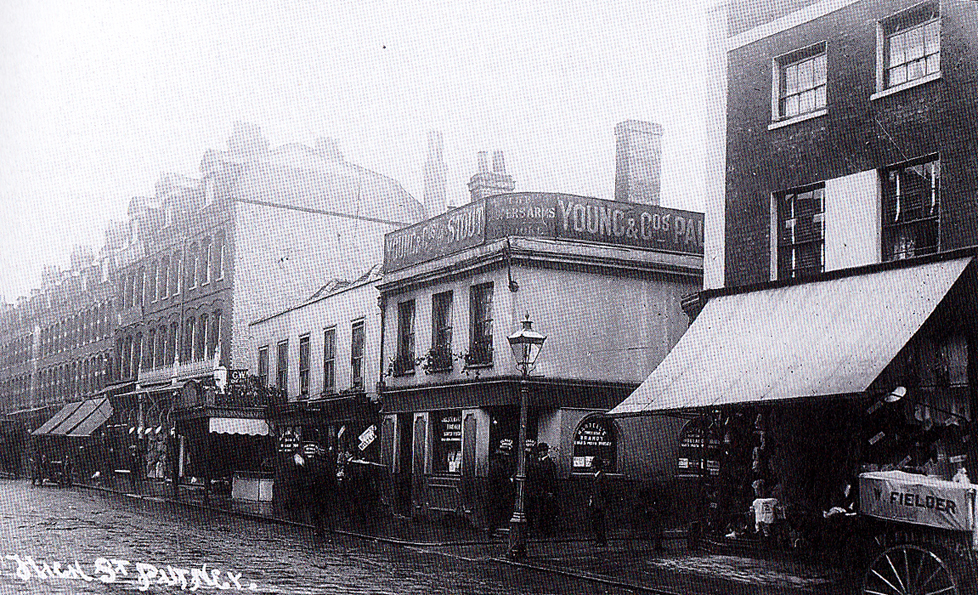
My 3xgreat-grandfather William Sibley (1826-1889) was charged, and later acquitted, in 1860 for conspiring to steal from the publican Thomas Rule of the Coopers' Arms public-house in Putney. When I discovered his name in the Police Intelligence section of The Morning Post (at British Newspaper Archive), I was initially shocked. As I read on, however, I found out that William Sibley was innocent. What follows is an extract from the aforementioned newspaper, dated 30 January 1861:

William Carlton, who described himself as a photographer, and William Sibley, a wheelwright, were placed in the dock before Mr Ingham, charged with being concerned with stealing £5 from the Coopers' Arms public-house in Putney, the property of the landlord Mr Thomas Rule.
The robbery was committed on the 11th of December 1860 and the money, consisting of gold, silver, and halfpence was taken from the bureau in Rule's bedroom. The bureau was locked but not the bedroom. William Sibley was in the house during the said afternoon and was in and out several times and in different parts of the premises. He had a cart at the back door and he went out two or three times to examine it. William Carlton was at the bar with another man, and they had some gin-and-water at the bar. They appeared very fidgety, for they kept going out and returning alternately, and they both left without drinking their gin-and-water. It further appeared that Sibley lived in Putney [in 1861 census he lived at Stratford Grove] and Carlton formerly carried on his photography business opposite to the Coopers' Arms.
My 3xgreat-grandfather denied all knowledge of the robbery, and explained the reason for the cart being at the back of the public-house. He had it to repair and was waiting for assistance to drag it home. Thomas Rule claimed that Sibley had been in his bedroom before, to do repairs to a set of drawers but that he and his daughter [Caroline Rule] were unable to say whether Sibley and Carlton had actually communicated with one another on the day in question.
Mr Ingham refused to allow bail for Sibley, despite Sergeant Blanchard knowing nothing against Sibley before. The evidence of the witness [who was not named during the trial] was that he had evidence that Sibley had known about the robbery one week before it occured.
According to the Criminal Registers on Ancestry, William Sibley and William Carlton were acquitted at Newington on 18 February 1861.

Coopers' Arms public-house, Putney circa 1905

The Coopers' Arms public-house gave its name to Coopers' Arms Lane, which was later renamed Lacy Road. Coopers' Arms Lane was formerly known as Warpell-Way, warp meaning "distinct pieces of ploughed land seperated by the furrows". A thoroughfare in Putney partly preserves the ancient nomenaclature in Warpole Road. The Putney High Street was largely unchanged until Edwardian times when the pub and cottages alongside were demolished and replaced by Edwardian shops. These were removed in the 1980s to make way for the Putney Exchange shopping centre.

Sources used for this blog post: British Newspaper Archive & Ancestry
Putney & Roehampton by Patrick Loobey


Monday, 24 September 2012

Family History Through The Alphabet Challenge : T is for...

I could have chosen a name for this week's Alphabet Challenge post as there are several names in my ancestry that start with the letter T. For example, Thomas (son of) Thomas, (son of) Thomas etcetera. Rather than bore you all with that, I have chosen to write about Travel as my ancestors have proven, they moved around a lot.


In the times we live in today, we think nothing of walking out of our front doors expecting to access all modes of transport such as cars, mopeds, buses, trains, taxis and ferries. It is easy to take it for granted and forget that our humble ancestors had to rely (most often) on one method of travel: Walking. My London ancestors for example, would not have been able to afford the luxury of owning their own horse and cart or liveried carriage and when bicycles became popular in the Edwardian era, not everybody felt safe riding London's busy streets.
 
Let's cast our minds back to the days well before cars and buses. Before well-paved roads were in demand, our ancestors highways were mere ditches and tracks, potholed and uneven, flooded and thick with mud. If you were rich enough to be able to travel by coach or horse and cart you were at the mercy of the highwaymen. I would bet our ancestors were thankful for the likes of Scottish civil engineer Thomas Telford, who singlehandedly changed the way people travelled forever. The Industrial Revolution also put travel on the map, so to speak. Roads, canals, railway, bridges, even the penny post system, which was introduced in 1840, made travel an exciting thing for our ancestors to contemplate. My ancestors used these methods of travel to move from county to county; village to market town. Where before, in the 1600s and 1700s they remained in one village, they were now branching out and exploring a world outside of their own backyards.
 
Thomas Telford
(1757 - 1834)


Before my 4 x great-grandfather moved to Beccles around the year 1809, he came from an unknown area of Norfolk. How did he come to settle for the village of nearby Barnby? I have this rather romantic notion that he travelled by canal boat or wherry. He saw the village from the Waveney River and thought to himself, "This is pretty, this is peaceful, this will do me" and he settled there, married and he later moved to Beccles with his wife where they raised their eight children.
 
My London ancestors moved around a lot. They are found each ten years (by the census return) living in a different street. For example, one family who lived in Putney had moved two or three streets apart, every ten years. When I travelled to Putney in late 2006, I visited all the streets they had lived in and discovered that although the addresses were in close proximity, they were still quite a distance apart in terms of moving house. How did they move their personal effects from one house to another? I had visions of them having to carry everything they owned or perhaps they borrowed a neighbour's cart to put their mattresses and humble effects into. In times past, our ancestors' homes were not heavily furnished. In particular, the working classes of England who possessed little in the way of dining tables, chairs, beds, cabinets, dressers, sideboards and wardrobes. I wonder what they would make of an IKEA store if they could see one today!
 
Image courtesy of www.rushdenheritage.co.uk
 
In the past one hundred years transport and travel methods have vastly improved and we have seen many changes and upgrades with railways, cars, ships and airplanes. My first cousin 3 x removed was the first to embark on a journey from London to New York by airplane in 1947. She well and truly caught the travel bug, as passenger list records prove she travelled back and forth from England and America regularly, both by ship and by plane up until her death in 1975.
 
My great-grandfather refused to drive a motor vehicle, choosing instead to ride a bicycle. He used this method of travel wherever he went and would happily ride for miles and miles at any given journey. He was seen daily in Beccles, from the early 1900s up until around 1970, riding to and from work and to and from church, as well as neighbouring villages and market towns. When he grew much older and age robbed him of his eyesight, his family were very concerned for his safety but he was stubborn and could not bear to part with his trusty cycle. No amount of coercion convinced him to give it up until one day his sons were forced to hide his bicycle away. This story still breaks my heart when I tell it, because I know full well how my great-grandfather must have grieved this enforced loss. I do not drive either. I refuse to just as my great-grandfather did. Instead, I rely on buses, trains, lifts from family and friends, and my two size-seven feet.
 

Edwardian Gent with his Bicycle


Thursday, 23 February 2012

Finding Traces of Your Ancestors Lives in Unexpected Places

We are all familiar with the buzz you get from making contact with a distant cousin who just happens to have a wealth of family photographs that they are happy to share. I know I do, and thanks to some very special people I have come to know over the years (June, Angie, Jim), I have looked into the faces of my great-grandparents, some for the very first time.

This past month or so I have investigated different avenues of research into my family history, largely using archive newspapers (http://www.britishnewspaperarchive.co.uk/) and local history society transcriptions. These websites have proven to be invaluable resources into the lives of my ancestors, from discovering advertisements to Quarter Sessions reports. This past week alone I have found two ancestors from the same family line (uncle & nephew) in newspaper reports, sixty years apart. In 1882 one of my great-grand uncles, then aged thirteen, was charged with stealing fruit from a garden, and later the following year, he was charged for stealing a purse from a six-year-old boy. Subsequently, he was sent to Buxton Reformatory for five years. This news was equally disturbing and surprising, but in the end I had to concede that I have discovered a truly valuable addition to my family story.

Sixty years on, one of his nephews (my maternal grandfather), was in the newspaper for an entirely different reason. In 1943 he was repatriated home to England from Germany, where he had spent three years in a Prisoner of War Camp after being captured in Dunkirk in June 1940. His return home made local news and he even managed to get his mug shot on the front page!

The first paragraph brought unexpected tears to my eyes

Then there is one of my favourite resources for local history: eBay. That's right, I did say eBay. An unexpected source I grant you, but one that I have come to value almost as much as postcard fairs and emails from distant cousins. A few years ago, whilst conducting a google image search for one of my favourite childhood locations there were several links to the eBay website. At first I ignored them all because I didn't believe it would be relevant to my search. Then I relented, and I haven't looked back since. Not only have I found postcards of my own home town in Suffolk but several of those of my ancestors; a variety of towns, villages, and locations in Norfolk, Suffolk, London, Surrey, and Yorkshire.

I found one faded black & white or sepia toned postcard image of an ancestral town or picnic spot or a street, which turned into another find, and yet another and another. Sometimes I win the bid, sometimes I miss out. It has become my one weakness (thank you Dorcas Lane). One postcard that stands out in my memory from last year was an image of Holt Lodge in Norfolk. This building was not particularly relevant to my ancestry but the seller had also uploaded the back of the postcard which had been written on. It was from my 2 x great-grand uncle (in Norfolk) to his nephew (in Hampstead). I missed out on the item, but I did manage to keep a copy.

The back of a Postcard sent by my 2 x great-grand Uncle to his Nephew
Last week I bid on a postcard from Holt. It was a fairly ordinary image (a pond!), quite faded with the heavy-handed postmark stamp creating a nice little crater on the top left corner. I never expected to have it arrive on my doorstep and find it was written to my first cousin, three times removed. My initial findings had me thinking it was written by my 2 x great-grand uncle - the same one as described above - but further investigations and cross-referencing of the handwriting, proved that it was written by an unknown person. Even so, it was definitely addressed to my cousin who was then living in Richmond, county Surrey. Four years after the postcard was sent, she was married and living in Richmond with her widowed husband and step-daughter.

Postcard sent to my distant Cousin in 1904
The moral of this post is, leave no stone unturned. Investigate every possible avenue, and when you think it couldn't be likely, it really could be likely. If you don't ask, you won't find out. I took the chance on my grandfather's newspaper report. I already had several sources of information into his repatriation and I had found a link to a local newspaper report but until I approached the local Record Office, not only did I gain a personal account of his return from my great-grandmother (who had obviously been interviewed for the story) but I also gained a new photograph, albeit grainy.


My Grandfather in the Local Newspaper

And as far as eBay is concerned: it is game of chance. It is pot-luck. Sometimes I have found some treasures, and sometimes I have missed out. Sometimes I have paid pittance and sometimes I have paid exorbitant amounts. What I have discovered and gained from it all though, is absolutely priceless.

This post is dedicated to my Uncle who is currently recovering from a recent hospital stay following an operation and intensive health issues. Get Well Soon M xxx

xxxxxxx

Thursday, 9 February 2012

My Genealogy Bucket List

Inspired by Jill Ball at Geniaus http://geniaus.blogspot.com.au/ I thought I would complete her GeneaMeme Bucket List. It goes something like this:

The Bucket List GeneaMeme
The list should be annotated in the following manner:
Things you would like to do or find: Bold Type

Things you haven’t done or found and don’t care to: plain type
You are encouraged to add extra comments after each item

So here is my Bucket List:
1. The genealogy conference I would most like to attend is... WDYTYA Live
2. The genealogy speaker I would most like to hear and see is...
3. The geneablogger I would most like to meet in person is... Where do I start? There are many to be honest, most of whom reside in the UK
4. The genealogy writer I would most like to have dinner with is... Nick Barratt
5. The genealogy lecture I would most like to present is... I had an opportunity to do this a few years ago but I bottled out. It was on the watermen of the Thames
6. I would like to go on a genealogy cruise that visits...
7. The photo I would most like to find is... My great-grandfather, Percy Preston
8. The repository in a foreign land I would most like to visit is... LMA and Wellcome Library
9. The place of worship I would most like to visit is... Any in East Anglia
10. The cemetery I would most like to visit is... Horbury, Yorkshire & Holt, Norfolk

My favourite place in all the world
11. The ancestral town or village I would most like to visit is... There are too many to list here. I would love to see Horbury & Fakenham and also re-visit several towns around the UK
12. The brick wall I most want to smash is... Richard Humphries (see my post) and also trace further back than John Waters.
13. The piece of software I most want to buy is...
14. The tech toy I want to purchase next is...
15. The expensive book I would like to purchase is...
16. The library I would most like to visit is... British Library
17. The genealogy related book I would most like to write is... I have several individual Family History projects in the works but I would love to write House Histories
18. The genealogy blog I would most like to start would be about...
19. The journal article I would most like to write would be about... Richard Humphries
20. The ancestor I most want to meet in the afterlife would be... That Richard chap!!
Also I would love to meet Elizabeth Humphries, Eva Bowes, Sidney Preston & Joseph Powell.

Two 'Jolly' Ladies

Saturday, 17 December 2011

Story-tellers Through Time : A Griotte in the Making

When I was trying to come up with a theme for my next blog one thing stuck with me. The origins of storytelling and the many cultures around the world who use words (oral and written), paintings, ceremonies, music and dance, and, in the modern age, film to convey their family history and traditional beliefs.

Photo by Alastair McNaughton
When I came to Australia, on the verge of my teenage years, I was immediately effected by the Aboriginal culture and folklore. I was less interested in the history books about James Cook and White Settlement and more engrossed with the Aboriginal customs and, in particular, their Dreamtime.
The ways in which the Aborigines honour the land on which they live, their spiritual beliefs and their deep-rooted affinity with their people has continually effected me over the years. The family stories they tell, through the Dreamtime or Dreaming, has been altered dramatically with the coming of the White people and many tribes and families, and many traditional Aboriginal customs have been lost or systematically driven out of their daily lives. There are still those today who embrace their ancestral culture and who live day-by-day with their family stories because it is psychologically entrenched within them, and they cannot be expected to ignore what is rightfully theirs.

Madina (Griotte)
Whilst reading Cherry Gilchrist's book 'Growing Your Family Tree" recently, I became intrigued by a passage in the last chapter where she describes the African storytellers. Known as griots (male) and griottes (female), they traditionally sing their family stories and play an instrument known as the Kora. The griots are keepers of family stories, genealogy and histories. The female griotte is known more widely for sharing family stories through song and one well known musician is Madina N'Diaye (pictured right).

In Western societies our ancestors used tapestry, murals and paintings, and in medieval times there were minstrels and bards to tell our stories. Then came the age of stagecraft where men acted out stories in front of a paying audience. Newspapers and books, penny dreadfuls quickly followed and people all over the world began to express themselves through some form of the written word. However, print was not easily accessable or affordable to the working class and humble poor and so the centuries-old tradition of oral storytelling never lost its favour. Opportunities for embellishment meant that the line between fact and fiction were oftentimes blurred!

The family who sits around the fireside listening to and sharing family stories is easily conjured up in one's mind. One such special occasion for me, as a child, was Christmas time. When my grandmother's had enjoyed a nip or two of sherry with their Turkey dinner, their tongues were loosened and many stories were shared and regaled. I loved those times, and still today I try to continue their legacy of storytelling (and not just with the sherry to help me along!).
There are so many opportunities at Christmas to sit down with a loved one or favourite relative and ask them questions. I have bored my own long-suffering parents and aunts with questions about their own childhood memories, and I have notebooks filled with many lovely stories.

I will share one with you here. My mother remembers when her father would bring home the Christmas tree ( a real one of course) and the whole family would decorate it the day before Christmas. On the tree would be small bauble decorations and candles, and even sugar mice! On Christmas Eve the family would sit by the hearth and tell stories and my grandmother would light the candles on the tree.

I would like to close this blog with a message of love and hope for a very merry Christmas to all my faithful readers and all newcomers. Thank you for reading my blogs, and leaving such heart-warming comments. I would like to give my special thanks to my family and to also acknowledge and thank Jo W, Luke, Mike, Angela B, Ann, Lynn H, Emma, Suzie & Rosemary for encouraging me throughout the year to share my special family stories through this blog.


Saturday, 24 September 2011

My Love of Writing : Family Letters

This morning I started reading The Shadow of the Wind and already I am completely bewitched. In it, the character Daniel Sempere, describes his passion for fountain pens and immediately I was transported to my father’s study.

For as long as I can remember my father always wrote with a fountain pen. I don’t think I ever saw him use an ordinary ink pen, unless it was passed to a client to sign his or her insurance papers. My memory of my father writing is always holding a fountain pen.
 
Since very early in my childhood the giving and receiving of letters and note-cards played a significant part in my family life. From a tender age I learned to love writing. When I was around five years of age my aunt and cousin emigrated to Australia and letters were frequently passed betwixt my family. Many is the time I would come home from school and find my mother ensconced on the settee, lost in a letter from her sister. The emotions they evoked; the pleasure and the pain I witnessed on my mother’s face; hearing her on the telephone excitedly telling my grandmother the latest letter had arrived; hours spent at my grandmother’s house, drinking copious cups of tea and exchanging letters – all filled me with a deepening love of writing.

When my mother emigrated to Australia four years later, it was my turn to write letters. Now I knew first-hand the effects of receiving a new letter, getting to know the style and colour of the aerogramme and airmail envelopes, the thickness of the folded letter inside, and the anticipation of reading its contents. I loved my mother’s writing; always so curly, neat and decorative. Her life, in the written word, lifted off the pages (Years later, she took calligraphy classes and further improved her individual style of writing). Two years later, it would be my turn to write letters to my father and my paternal grandmother. Then the love of writing letters using a fountain pen grew for me.

As I have already mentioned, my father always wrote with a fountain pen. All of his letters to me were written with flowing, blue ink. There were no blotches or spills, never once. I loved his writing style too, very neat and precise. His words flowed beautifully in the most perfect ink I had ever seen. When I returned to England for the first time since I had left, I sought out my father’s fountain pen. I desperately wanted to replicate his penmanship. I pleaded with him to tell me what pen he used in his letters to me. He told me it was an Osmiroid so I rushed to WH Smith’s in Lowestoft and bought myself one. I was so enthralled and so excited, I couldn’t wait to try it out. However, no matter how much I practiced, I could never replicate my father and his unique writing style. The ink wouldn’t flow properly, the nib would always snag or the ink would blotch everywhere. I was disappointed beyond words, but I never lost my love for the fountain pen or indeed pens in general.

Even today, more than twenty years later, I am still searching for the perfect writing pen. I have bought hundreds of different ball-point varieties and brands. I always prefer to use medium point as fine point simply irritates me. When I compose stories and for journaling purposes, I usually always turn to a Pilot ball-point pen. Even with my scrapbook journaling and page layouts, I prefer to always use medium point pens.

Where does my love of writing come from? The seed was planted during my formative years when I loved writing stories and letters. As a teenager, I was rarely seen without my diary and I kept one religiously for many years, buying only the best, beautifully crafted covers. During my late teens I joined a pen-pal service and enjoyed sharing letters with friends in Scotland, France, Germany and Sweden. The giving and receiving of family letters over the years, until the age of email and internet took away the more traditional methods, increased my love of story-telling.
Then there was my love of books, and the passion for researching my family history. Anybody who has seen an original document or transcription showing his or her ancestor’s very own handwriting knows the exquisite thrill it gives! This is my 4 x great-grandparent’s signature on their wedding certificate of 1846:


My paternal grandmother always used to tell me that I would be a writer. She had utmost faith that I had inherited her mother’s love of writing. For many years I automatically assumed that she only meant writing letters. It was not until recently that my father told me my great-grandmother wrote articles for the Beccles Parish magazine. I felt truly moved by that. As my maternal forebears were printers and stationers and postcard sellers, I also strongly believe that I have inherited their natural flair for the written and the printed word.

My great-grandmother


Monday, 19 September 2011

Joseph Powell 1786 - 1857 : Thames Waterman

Anybody who knows me well, knows that I am an avid admirer of Charles Dickens and his literary works. In 1998 the ABC aired the serial adaptation of 'Our Mutual Friend'. Being a fan of the actor Steven Mackintosh it was added incentive to tune in!
It was not for another 4 years that I discovered that one of my own ancestors was a waterman on the Thames. In that very moment, my favourite Charles Dickens book was thrust into sharper focus and exuberant reality. My very own my family history could tell the tale of the 'Great Stink' of London, the daily menace of gridlocked water traffic and demanding customers, and London's dead found in the River.

My 4 x great-grandfather Joseph Powell was baptised at St Paul's Church in Hammersmith in 1786, son of Bartholomew Powell. When he was 15, in 1802, Joseph was apprenticed to Nicholas Taylor. Joseph was bound to him for a full seven years until he qualified as a Waterman of the Thames in 1809.


Men like Joseph Powell were especially skilled as rowers and as navigators and as tidesmen. So skilled was this job that the Company of Watermen Guild was set up in 1555 and later in 1700, the Thames Lightermen amalgamated with the Watermen (The difference between the Thames Watermen and the Thames Lightermen was that the Watermen carried passengers and the Lightermen carried goods). Once Joseph had completed his apprenticeship and could work alone fully qualified, he had to apply to obtain a license from the Port of London Authority who issued him with a numbered badge which, by law, was sewn onto his coat sleeve. He would have then purchased or hired for himself a Wherry or Skiff to carry his passengers and he was responsible for keeping his boat in sound working order at all times.
Strict rules were in place by the Watermen’s Guild which ordered that Watermen not consume any alcohol whilst ‘on the job’ but despite this, they still had a reputation for being extremely obnoxious, uncouth, abusive and foul-mouthed. Come on! I think they had to be given the circumstances, don’t you? You have to remember that in the early centuries there was no sewerage systems in place and all raw effluent of the London populus went straight into the Thames so the Watermen were - pardon the pun - 'in the thick of it' all day every day!
Add to that the fact that the Thames was extremely busy all the time, filled with navy and merchant ships, cargo ships, ferries, Lighter barges, as well as their fellow Watermen. It would have been utter stinking chaos! Other foul conditions were things like floods, mud, slime, sludge, stench, rats, other people’s diseases and infections, even dead bodies were sometimes found. That’s not to mention the weather conditions!


By the 1760s there were well over a thousand ‘Hackney hell-carts’ as the Watermen had dubbed them, and it was causing considerable congestion. London streets couldn’t cope with the demand, and the increasing bottle-neck and deaths through accidents meant something had to give. London needed bridges to ease traffic flow and enforce safety for its people. You could imagine the outcry from the Watermen.
Until 1750 there was only one bridge in London and even that had caused upset when it was put in place hundreds of years before there was any talk of subsequent bridges being built in London. When Westminster Bridge was built in 1750 the Watermen strongly opposed and lobbied their case in Parliament but over time, they were defeated. The Watermen’s further appeals made even less impact as the years went on, causing only temporary delays but in the end they just could not prevent the building of bridges. The Watermen were losing the fight for their livelihood as the demand for road traffic ease grew ever stronger.

My 4 x great-grandfather Joseph Powell endured, through the extremes of weather, inestimable stink and traffic congestion. His daily route took him from Fulham, where he lived on the High Street with his wife and family, to his final destination at Hungerford Stairs  (yet another connection with Charles Dickens!).
According to the 1819 Post Office Directory his stops would have been:
Queenhithe
The Globe Wharf
Hungerford Stairs

The 1826 Pigots Directory water conveyance listing from FULHAM:

King's Arms, Rose and Crown, Queenhithe, Waterman's Arms & Globe Wharf, Hungerford

A few good reasons to stop for alcoholic refreshments in amongst that list, wouldn't you say?!
I may be ridiculed for having a rather nostalgic, or even romantic, viewpoint of my ancestor Joseph Powell, but I would dearly love to have known him. He could well have been quite a feisty character like Gaffer Hexam, or calculating and cunning like Rogue Riderhood. He would have to have been a good mix of both to abide the stink of the Thames!

Lizzie and Gaffer Hexam in 'Our Mutual Friend'

For further reading on the life of a Thames Waterman you may like to search out Robert Cottrell and Christopher O'Riordan's meticulous works, and you may also like to read the great novels of Charles Dickens and Clare Clark for further inspiration! x

Monday, 12 September 2011

An ancestral town remembered: Holt

The first time I visited Holt in Norfolk, was during a holiday in 1993. My father took me there for the day and I vividly remember feeling an unexplained strange sensation about the place. At that moment in time, I had absolutely no idea why I felt that way. Dismissing the feeling, I forgot about Holt until years later when my research into my Preston ancestry was well under way. One day, whilst browsing the 1901 census, I located my great-grandfather and his parents living in Bungay. My 2 x great-grandfather was born in Holt. The hairs on my neck prickled!

When I visited Holt again, in 2007, it was a miserable misty day and I remember being annoyed because the rain never let up the entire time I was there.
Holt was home to my ancestors and I wanted to see the place properly! My 3 x great-grandfather William Preston had moved to Holt, from Fakenham, when he was in his early twenties. This would have been in the 1840s. He married a local girl by the name of Eliza Bunnett and they had five children; three sons and two daughters. The first-born was my 2 x great-grandfather William Gowen Preston.

William Gowen Preston lived in Holt up until he was 17, when mysteriously, he left Holt with his girlfriend and moved to Norwich. The day I came back to Holt, I hoped that somebody could help me understand why this had happened. Was he cast out of the family? Out of the town? If so, why? I wanted to find the answer to that and more, in the streets and the shops, the houses and the people of Holt. Irrationally, I hoped that somebody would spot me, know who I was and why I was there, and tell me everything I needed to know. This never happened of course but the rain and mist almost prevented me from discovering anything about my ancestors life there.

High Street, Holt circa 1905
Arthur Preston's Printing Works on the right
After a few hours of walking the streets, meeting up with a local historian and writer, the late Keith Entwistle, and taking photographs and video footage, I went to the local church. I did not know, or fully comprehend even at that time, the strong connections that my ancestors had had with this church. Years later, with more research, I have a better understanding and a deeper sense of their devoted years to St Andrews. Standing on the footpath leading up to the church, gravestones to my left and to my right, I looked feverishly for any ancestral graves. I walked right past my 3 x great-grandparents' grave and didn't realise that I had until I had come full circle around the entire churchyard. I followed the track around to the right hand side of the church, to the back. There were many gravestones there, surrounded by mushy and muddy grass mounds, unkempt in the harsh winter months.

After a short while I found the grave of my 2 x Great Uncle and Aunt (with her parents) and I stood talking to them, cleaning the stone, taking video footage and photographs, and then asked them to guide me to my 3 x great-grandparents' grave. However, as I pressed on, the rain worsened and the muddy sludge underfoot was beginning to depress me. The graves led to nothing and nobody. I was growing heavily down-trodden and yet I was still determined to find something. My stubborness kept me searching.
I walked around again, becoming tired, hungry and cranky. I felt as though I was going to burst. Then came a breakthrough...
At long last I recognised the name: Eliza Preston. And right there, in front of me, at the very spot I had started out from! I could have kissed the stone, I was so relieved. The video footage I have is proof of my emotional rollercoaster in that moment. I wept tears of sadness and relief. It was rather sad to see the stone is in such a poor state, the bottom of which is barely readable.


Here in Holt I found a connection to my heritage, in particular to my maternal grandfather who I never knew. I felt a strong connection deep in my soul that day.

One day I will return again to Holt, and the weather will be perfect. There will be clear blue skies and sunshine, and I will discover even more about my Preston ancestors and the glorious market town of Holt.

Saturday, 27 August 2011

My Grandmother Freda: 1915 - 1996

 
After I posted my debut blog last weekend, I was pumped with excitement. I couldn’t wait to write another one. Then the days passed and the nagging doubts returned with a vengeance. At the end of the day, I told myself, my doubts are not going to get my stories written, it will not give my ancestors any credit (or recognition) and my memories will go unheard and unshared.

This blog is dedicated my paternal grandmother. From the outset I thought this one would be harder to write because I did not get to see her as often as I would have liked to as a child, and when I moved away to Australia my relationship with her was mostly through the exchange of letters, and cards at Christmas, Easter and birthdays. Up until two years before she passed away, she was still writing to me regularly.
Somehow Nannie always knew that I would be a writer and pursue the family history. She loved to tell me stories about her family, show me photographs of family members from her vast collection and when I had to write a family tree project for school, she was more than willing to help me with it. I kept my scribbled notes from all those years ago and am continually amazed at how much she knew and remembered about her family history (Even down to finer details such as birth addresses and dates).

Freda Waters
 My grandmother was born Winifred Ellen Waters on 17 April 1915. Named after two of her aunts (Winifred Bowes and Sarah Ellen Waters), everyone who knew her called her Freda.
Freda was born in the market town of Beccles, in the county of Suffolk, and she lived there her whole life.

Freda was the third child of Albert Waters and Eva Bowes. Before her was one sister and one brother – her sister Muriel a lifetime friend and close companion. After Freda, came two more brothers, both of whom Freda doted on and always spoke of with the deepest affection.

When Freda was a girl she had a doll she named Germolene. This name would later prove ironic in the extreme as in her adult years she would rely on the aseptic ointment for her troubled ulcerated legs.
When she was just fourteen years of age Freda met her future husband Herbert Ward. According to a diary entry of January 1930, Herbert wrote that he had met Freda at the Methodist Chapel in Station Road, Beccles. Freda’s father was a staunch Methodist and for many years worked as a verger there.
Freda worked as a Seamstress in Beccles. My research into Freda’s maternal ancestry revealed that her grandmother Mary Leman came from a family of drapers and tailors so it is no real surprise that Freda’s interests lay in sewing. She worked for George William Bond in Exchange Square. Bond opened his draper & millinery shop in 1903 and ran a successful business until well into the 1970s. An advertisement in the local newspaper of 1903 reads:
“Flannelettes, Calicoes and Shirtings at the very lowest price”.
In the 1930s Ronald Martindale took over the running of the drapery shop at St Andrews House in New Market, Beccles. His predecessors, Womack Brooks and Arthur Dare, were both prominent tailors and local charity fundraisers. Freda and her sister Muriel went to work for Martindale who ran his store for almost four years until Woolworths took over the premises in 1937. In 1933 an advertisement ran in the local paper:
“R Martindale the Leading Draper Fashion-Wear Specialist Household Furnisher and Undertaker’.
All her life Freda loved sewing and fancy goods. All her handkerchiefs were made with the finest embroidery and lace-work. She was a lover of embroidered tablecloths and lace napery. She was very proud of her sewing achievements.
In September 1933 Freda, having turned 18 years of age, married her sweetheart Herbert Ward. Before the outbreak of World War Two Freda had two sons and in August 1940 she was faced with home life alone when Herbert joined the Royal Army Service Corps. As Herbert was 30 years old and married he was not sent to serve on the front line but was posted to the East Midlands town of Sutton-in-Ashfield.
Freda talked of how, when the winds were right, people living on the East coast of England could hear the shelling and bombing from Europe. Nearby Ellough and Flixton airfields were used as practice for the USAAF & RAF and Freda said she was relieved to hear “our boys” flying over rather than enemy aircraft. In 1944 Ellough Airfield was used to drop prototype spinning or bouncing bombs, which were called “Highball” bombs.

After the war, Freda gave birth to my father and six years later, came her forth, and last, son. By this time Freda and Herbert had moved from their home in Blyburgate Street to Ingate Street.

Freda (left) and Muriel

Freda lived for company and summer holidays. Every year she would go to the seaside with her parents and siblings and as the years passed, she would holiday with her own children and with her sister Muriel. Mostly they holidayed in Lowestoft and Great Yarmouth, two of Suffolk’s most popular seaside holiday destinations.

In August 1977 Freda lost her husband of forty-four years, to cancer, and my dear Nannie was understandably devastated. She had known him almost all her life and she had grown up with him and bore his children. She was alone for the first time in her life and it cut her deeply. Her compensation was her sister Muriel and her four sons, though now grown up and married with families of their own. Freda relied heavily on her family to ease the increasing ache of loneliness, which constantly plagued her. Two of her sons lived away from Beccles so she would visit with them. She looked forward to these little holidays and trips away but preferred the comforts of her own home.
In the 1980s Freda and Muriel became regular visitors to the local day-care centre called “The Dell”. It was here Freda met Arthur Gilbert, a local widower. They were firm friends from the outset of their meeting and eventually, as romance blossomed, they married in 1986. Their life together was short-lived though when Arthur passed away unexpectedly, as a result of a stroke in 1990.
Freda’s unabated loneliness took its toll and when Muriel passed away just one year later, Freda never really recovered emotionally.
Freda was not blessed with good health for the best part of her life, especially after the birth of her children. She suffered with circulatory problems in her legs for a great many years and her heart caused her to suffer greatly. She spent many weeks at a time in and out of hospital for most of her adult life, more so in her later years when she continually required heart monitoring or investigative procedures. She made the joke to me once that the hospital was her second home.
One problem, which ailed Freda in her later years, was her eyesight. This frustrated and upset her more than her legs or heart troubles ever did. Her letters to me often spoke of her impatience and irritability at not being able to see well enough to write, relying on sunny days to help her to see clearer.

My fondest memories of my Nannie are:

Nannie loved writing and receiving letters, and sending special cards and notelets to her extended family. I will forever treasure the letters she wrote to me.

Nannie absolutely loved bathing. She loved to collect scented bath salts, soaps and bath foams. My sister remembers how the Avon catalogue would be eagerly raided for the latest bath smells and scents. Nannie liked to wear perfumes, such as Pagan by Lentheric.

As a child I remember going to stay with Nannie for the night. She loved having her grandchildren to stay, and she would spoil them and dote on them lovingly. I especially remember she would fry up ‘Bubble and Squeak’ on a Sunday morning for the two of us. That was always my favourite!

I fondly remember that Nannie loved a good laugh. She had the kind of laugh that was almost like a girlish giggle and she always had an expression of faint embarrassment if she laughed too loud. She professed to me once that she was painfully shy as a girl and even had a photograph of herself where she had written on the back “Shy Freda”. My father was a connoisseur for making her laugh and he always managed to have her in stitches. He would tease and mock, and she loved and welcomed it in equal measure. Her bashful laughter was adorable to me and still today, whenever I think of her I remember her in a fit of the giggles.

Nannie loved songs and singing. It didn’t matter the song, as long as it had a quirky tempo or catchy beat. A clever advertising jingle on the television, a cartoon theme tune or game-show theme, Christmas carols or even a Cockney knees-up song, Nannie would be humming or singing along happily. She loved in particular, “Lambeth Walk” which was one of her and Grandad’s favourites.
Nannie lived for outings with the family, fish and chips for tea on Fridays from Peck’s in Beccles, and having her hair washed and regularly permed by her daughter-in-law. She always joined in with games and liked to play cards and she never tired of hearing what her grandchildren were getting up to in their lives, good or bad.

The last time I saw her was in 1995, and it was one of the most turbulent periods of my life. Nannie was desperate to see me happy, and sadly I wasn’t always patient with her or willing to listen to her advice. However, she still managed to sit me down to give me a small collection of her family photographs. She was deeply afraid that I wouldn’t see her again. In my stupidity, I didn’t believe her. She was right. In January 1996 she passed away, knowing she would never live past the age of 80 (just as her mother Eva had believed of herself).

Freda (Taken in 1995)
Soon after my first child was born I had a dream that I walked into a room to see my Nannie sitting in an armchair in the middle of the room. I knelt at her feet and cuddled into the softness of her lap whilst she quietly stroked my hair. She had neither bandages or any pain in her legs. It was a beautiful dream and I still remember it so clearly ten years on. When I asked my sister about her memories of our Nannie recently, she wrote to me about one of her memories of laying on the sofa with her head in Nannie’s lap!


Saturday, 20 August 2011

My Grandmother Lilian : 1920 - 1983

Lilian Katie Humphries abt 1940
I have just come home from the Antiques Fair and felt the strongest compulsion yet to write a blog. Admittedly I have wanted to start a blog for the longest time, and have even gone so far as to research different blog sites and sought advice from several people.
However, nerves won out and got the better of me; that, and a serious dose of self-doubt. There are so many topics I want to discuss, but at the end of the day, I kept going back to the same agonising question. Who would want to know, or care, what I have to say?
For as long as I have been alive I have had a passion for family history. As a child I loved to listen to my grandmothers when they talked about their childhoods, family stories, war stories and more importantly for me, showing me photographs and telling me who the photograph was of, where it was taken and the memory associated with that photograph, whether it be a family member, a holiday snap or a wedding portrait.
I thought about dedicating this first blog to both of my grandmothers but, to be quite honest, I don’t think that would be fair. They each deserve their own dedication, in their own right. As tomorrow will mark 28 years since my maternal grandmother passed away, I shall dedicate my very first family blog to her.

My grandmother was born Lilian Katie Humphries, on 26 November 1920. Her birth certificate says she was born in Bloomsbury Square in the district of St Giles, London. I went to visit her childhood home in 2007 and fell in love with both the Square and its surrounds.
Lilian was always known to me as “Nannie Buster” as her second husband (Alfred Sampson) was known to everyone as Buster. Others called her Lil and some of her nieces and nephews knew her as Lily.
Lilian was the seventh child of Albert Humphries and Elizabeth Dare. Before her were three brothers and three sisters, the eldest of which – Violet, or Vi as she was known - she was extremely close to. She would often spend two weeks holiday visiting her sister Vi in Sutton, where she lived with her husband Cyril Lang above the butcher's shop on the High Street.
When Lilian was just a child she was struck with asthma and bronchial ailments, inherited from her father’s side of the family who all suffered from it. When Lilian was eight she contracted Tuberculosis and the family had to leave their London home for the country air. They moved to Leigh-On-Sea and remained there until the 1930s, when the family moved again, to Sutton in county Surrey. They lived on Clyde Road.
Lilian and her sisters volunteered for the ATS when war broke out in 1939, but ill health plagued Lilian and eventually she had to give up several of her posts. It was in 1945, near war’s end in Europe, that she and her sister Stella were sent to clean ambulance trains in Epsom.
There she met my grandfather Percy Preston, who was stationed near Epsom with the Royal Army Medical Corps. Three short months later, Percy and Lilian were married at St Nicholas Church in Sutton. After the wedding, Percy was stationed back to Epsom and Lilian went, supposedly by rail, to county Suffolk to start married life, not with her husband but with her mother-in-law Nellie Preston who ran a boarding house for single working men, in the market town of Bungay.
After the war, Lilian gave birth to four children: Two girls (the eldest being my mother), followed by two boys. Percy held an Urban District Council job in the town for several years and Lilian worked in various shops and factories in Bungay and nearby Flixton. Then in 1962 they bought the CafĂ© in Cross Street, known then as Alfo’s. The tearooms are still there today, although it is now known as the Buttercross Tearooms, named after the infamous Butter Cross at the end of the street.
In May 1966 Percy passed away, of lung cancer. Two years later, Lilian met a local widower by the name of Alfred Sampson and they married in August 1968 at St Mary’s Church, Bungay. Lilian's family of four became a family of nine, as Alf had five children from his previous marriage to Jean Alden. She died of cancer in 1964, aged 35.

As a child I fondly remember visiting my Nannie and Grandad Buster where they lived at St Johns Road, in Bungay. I can still recall the rooms; the front parlour room (which I was never allowed into), the sitting room, the kitchen and walk-in pantry, the narrow staircase and the cupboard under the stairs, and each one of the pokey bedrooms. Whenever I stayed overnight, I loved to explore Nannie’s rooms upstairs, especially her wardrobe filled with flowing dresses and coats, her perfumes and cosmetics on her dressing table, and her endless book shelves crammed with Mills and Boon novels. I would have been around eight or nine years old when I first remember flicking through the pages, fervently looking for the passionate kiss on the last pages! I think she may have caught me out once or twice but I was never severely reprimanded. Perhaps she was mildly amused by my curiosity.
However, I do recall her chastising me for hiding in the cupboard under the stairs or in the kitchen pantry. This was a source of much chagrin between us, as she seemed to forever dislike my need for seeking solitude. She liked me to be where she could see me, not necessarily hear me though!

Lilian with her beloved dog Russ
Lilian loved her dog, a Jack Russell Terrier she named Russ. I shared her love for Russ, and whenever I visited or stayed at my grandparents, he was a delightful playmate for me. We would run amuck outside in the courtyard, or the garages out in the allotment area. Sometimes I would put him in my bicycle basket and wheel him around the yard. Nannie would knock on the kitchen window at me when she felt her poor “doggy woggy” Russ had been through enough torment!
When I was nine years old my grandparents emigrated to Western Australia. Alfred quickly found employment with the Alcoa group, which took him regularly to Dampier, for weeks at a time. Lilian, having been advised by her doctors that the warmer climates of Australia would help her bronchitis and asthma attacks, spent her days mostly indoors by the air conditioner watching the tennis, knitting, or baking. When a relative came to visit they would take her out shopping, which was one of her favourite pastimes.

Lilian was always proud of her London heritage. She always sang “Maybe It's Because I’m a Londoner” and if she was ever pulled up for something or feigned any sort of ignorance she would simply shrug her shoulders and say, “Well, you know it's just because I'm a Londoner”.

When my Nannie was ill, you knew about it the second you walked into her house. The atmosphere was electric when she was confined to her bed. An eerie silence hung on everything around you. Everywhere was deathly silent. There were no sounds of her singing or her slippered footsteps, the kettle wasn't whistling, and not a song could be heard. When she was well however, the atmosphere was the complete opposite. You could hear her bustling around, the washing machine going, the kettle boiling, the dog yapping nearby, her singing at the top of her lungs a tune by Roy Orbison, Bing Crosby or the Andrew Sisters. She would be cleaning, baking, making endless cups of tea or talking idly to Russ, making an absolute fuss over him. I found it funny whenever she threw open the kitchen window and shouted out to Grandad or my Uncle to come in for dinner or a pot of tea.

When my Nannie died, I was in my last year of high school. Her death was sudden and nobody in the family got to say goodbye to her. Lilian had suffered a massive heart attack at home and despite being rushed to Fremantle Hospital, she died on arrival. I was devastated, as was my mother who (understandably) took her mother’s death extremely hard. Losing my Nannie at that time in my life was so intensely shocking because I never had the chance to tell her all the things I would have wanted to. I never had the chance to ask her more about her life in London, and Surrey, or her war experiences. I never even knew her parents names, until 10 years ago when I started the family tree research in earnest.

I will always fondly remember my grandmother Lilian for:

“In the Mood” and Glen Miller Band : Lilian loved to sing this song more than any other I recall in my memory. She would saunter up to me and sing it in my ear or walk around the house with the carpet sweeper or broom.

When getting dressed to go out, Lilian would spend hours applying heated rollers, tweezing, curling her eyelashes, and "putting her face on". There was always singing and dancing involved, and I loved to sit and watch her in the mirror pulling various faces at me or throwing her head back in laughter.

Bourjois Cosmetics : Her rouge pots are still in the family today, and I also love to wear Bourjois products.

Chanel No. 5 perfume : Her most expensive and indulgent perfume, she wore this only for special occasions and always applied the smallest amount in order to make the bottle last!

Merely Musk Impulse : Her everyday perfume, or 4711 or, sometimes, the latest Avon perfumes.

Daphne du Maurier novels : in particular, Rebecca and it was one of her favourite movies of all time.

Engelbert Humperdinck : She was a lover of this "pop" singer.

Bing Crosby and the “White Christmas” movie : Her most passionate love was for all things Bing, for his musical talents and for his acting.

Roy Orbison : Another crooning voice she loved to sing along to whenever she was cooking or cleaning.

Despite her asthma and bronchial ailments. Lilian smoked cigarettes. I recall seeing her often using one of those long black cigarette holders, and I thought she looked just like a movie star! She used to smoke Du Maurier cigarettes or Benson & Hedges.

Her cooking and baking, but for me especially I will always miss her:

Rhurbarb Pie (usually always served hot with lashings of custard)
Apple Crumble (again made with lashings of custard)
Rice Pudding (the sweetest and softest I have ever tasted)
Shepherds Pie (made with any mince she found cheapest on the day)
Nannie's famous Sunday fry-ups: heaped up platefuls of soft runny eggs, oily bacon and grilled tomatoes
Roast dinners of chicken or lamb (mostly) served with lashings of sauce, gravy, peas, over-cooked cabbage, carrots and cauliflower, broad beans (she knew I hated them but she still put them on my plate and made me eat them!), runner beans, swede, and the best ever Yorkshire puddings.
Two weeks ago I found, amongst my mother’s rather extensive photograph and memorabilia boxes, a cassette tape with family members voices recorded onto it. It was recorded in January 1975 and it was intended for family that had recently emigrated to Australia. The very first voice you can hear is my grandmother Lilian. When her voice filled my living room on that day, two weeks ago, it was like having her back again. Hearing her accent, her laugh, her singing, was like I had stepped back into a room with her sitting there.
I cried like I have never cried before. For an instant I was grieving her loss all over again but then, a powerful sense of joy washed over me. Even though my sinuses flared up and my face swelled from excessive crying, I realised that I will always have a piece of her with me. I have some of her favourite things, I have my childhood memories to hold on to, and now I will always be able to hear her voice whenever I want to. All I have to do is press the play button and close my eyes.

“Mr What-you-call-it What you doing tonight?
I hope you’re in the mood cos I’m feeling just right…”

  
Enjoying a boat ride on the Swan River 1982