Tuesday, 17 September 2013

Dedicated to Trevor

On Sunday I enjoyed a lovely afternoon with my dear Mum, and while we sat eating cakes and drinking coffee she handed me a pile of old notebooks. When I looked closer, I saw that my name was written on the covers. They were my old school books, both from England and from Australia, and she had kept them all these years.

Some had been damaged over time while in storage but most were thankfully salvaged. What a complete joy it was to sit with my Mum and my husband and daughter, sharing a hearty laugh over my handwriting, my spelling test results, teachers comments and especially my drawings and doodles. There were projects on Japan and Holland and reflective writing exercises about my holiays, along with many coloured-in pictures. How strange it felt to sit down and read those when my daughter has been doing the exact same thing at school, writing reflective pieces and drawing pictures to complement the story.

One such story which struck a chord with me was the one I wrote, titled:

My Two Days Holiday

On Thursday I went to my friends house for a little while. Then I went home with Mummy and Norman. I stayed up until 10 o'clock because I watched The Six Million Dollar Woman. And then I went to bed and read and wrote some letters until 10 to 10.
On Friday I went to work like I did Thursday morning and took my teaset and my doll and I played with my friend Trevor. He was Daddy and I was Mummy and my doll was baby. We played in the ballroom where ladies and gentlemen go in there for meetings and so on. 
When it was home time which is 12 o'clock Trevor and Mummy and me went home. When we got home we all had some dinner at 1 o'clock. Then we went outside playing with Josie our dog. Then at half past 3 we took Trevor back to the Kings Head and then did some shopping. Then we went home and had some tea. Then Grandad and we watched Gambit at 7 o'clock and had a cup of tea. Then Grandad went and I stayed up until half past 8.

Trevor and me

Trevor's life was tragically and painfully cut short when he became terminally ill in his late teens. Before he reached his twenty-third birthday he had passed away. I went to visit him shortly before he died, and we had some laughs together about the "old days" when we played at the Kings Head Hotel in Beccles (Trevor's Mum and my Mum both worked there as chambermaids and that was how Trevor and I became friends). We used to fight like mad some days and he followed me around a lot which used to irritate me, especially if I just wanted to go off wandering around by myself. I never would have imagined in my wildest dreams that my childhood friend's life would be cut short in such terrible circumstances.

I have written a novella which I have dedicated to my childhood friend Trevor and he also makes a very special posthumous cameo appearance as one of my characters.

Trevor with his beloved dog

Trevor's grave, 1993

Wednesday, 21 August 2013

My Nannie and Blogiversary

Today marks 30 years since my Nannie 'Buster' passed away. I was just 16 years old when she left us and today I feel as though I am 16 years old again. My heart is full to bursting, just thinking about her and how much I still miss having her in my life, physically speaking. I know and trust that she is with me spiritually because I sense her presence frequently, especially when I feel I am at a crossroads or when I am facing overwhelming emotions.

I have found out a lot more about my Nannie Lilian (read my blog post about her here) since I became an ardent genealogist and family historian. Things she never spoke about or rarely spoke about, like her parents' lives. I have visited the house, where she was born in 1920, with my husband and daughter and I have researched her ancestry back to the early 1800s when her 2 x great-grandparents John and Ann allegedly left county Somerset to live in the "big smoke" of London. I've made several wonderful connections with Humphries descendents and have been blessed to share documents and precious photographs.

Yesterday also marked my blogiversary. I have been writing posts on this blog for 2 years now and I am so pleased that I found the courage to write about my family and share some of the great wealth of information that I've accumulated and collected over the past 20 years plus of my life. Both of my grandmothers left me a treasure trove of family photographs, as well as their personal stories and an enormous respect for my heritage.

Lilian, taken around 1955

Friday, 26 July 2013

Family Letters and Strange Dreams

Last night I had some very strange dreams, from leaving my daughter in the middle of the busy city to catch a train home on her own to finding letters that were written by my paternal grandmother. I just knew that I had to blog about the latter.

Freda wrote to me frequently when I left England in 1978 to live in Australia with my mother. She always wrote at least one page, even when she was in hospital (which was often) and she sent cards to my mother and I every year, without fail. I wish I had kept more of her letters to me but over time I threw many of them out (my way of downsizing during my frequent moves from house to house in my twenties). It was only the last letters that she wrote me, before her eyesight failed her completely, that I had the good sense to keep. What a relief, I did something right then.

My letters from Freda (1990-1993)

When my great-aunt Joan passed away in 2005, her son Terry sent me some letters and cards, written by my grandmother Freda to Joan and my great-uncle Billy, which he found amongst his mother's personal effects.

When I woke up from my dream this morning I had a strong sense that Freda was trying to communicate something to me. In the dream I opened a drawer and took out some papers. Among the handful of papers were letters and I immediately recognised the handwriting as my grandmother's and started to cry. My tears were of happiness and relief that I had found her letters but sadness as well because I really miss her. One of the letters I held in my hand was typed and was dated 1933. It talked of all sorts of historical facts about pre-war threats and her feelings on the subject. I folded it up and made a mental note to read it in greater detail later. The second letter is more vague in my waking memory but it was definitely her handwriting and on seeing it, I burst into tears. Then I woke up.

Freda, about 1933

Here is a transcript from a letter that my grandmother Freda wrote to my great-aunt Joan in 1961. My cousin Robert was a newborn and she was writing to send her congratulations:

Dear Joan & Billy,
Many Congratulations on the birth of your little Son. I am so glad it all went off well & that you are both well.
I am writing to your home address Joan, as I don't know how long you stay in Hospital. I bet you felt important being waited on, its nice for a change, but I expect you're like me you rather be up & about.
Julian [my cousin, who was eighteen at the time] seemed quite pleased to tell the news to everyone, you'll have plenty to think about now.
I'm sorry I haven't written before, but time flies & I haven't been too well with my legs, when it comes to tea-time I can't do another thing.
We shall look forward to seeing him now.
Love from us all,
Freda

On the subject of family letters, I also have a letter that was written to my great-aunt Muriel from my great-uncle Billy in 1941. Muriel's first husband died suddenly, aged 31, and the news was devastating to the say the least (They had only been married four years and they had no children).

Dear Muriel,
Very sorry to hear bad news received from Joan by telegram: it does seem so cruel after you being so very happy with Jack but I suppose God has a time for us all.
Well Muriel I will never forget the happy evenings we three had at No. 15 and I'm sure wherever Jack is he will never forget either. Now Muriel old girl if there is anything I can do for you anytime, don't be afraid to ask. Myself & Joan will willingly do anything, anytime. You don't forget that cause I mean it....If you feel like taking little Terry out on your own, Joan would only be too pleased. I know you like children & little Terry so don't be afraid to say so. (Now can you keep a secret Muriel, don't say anything to anybody, not a word. Don't even let Joan know. Promise? Well we are expecting an extra in the family. Sometime next June [1942, which would have been Julian]. Now promise not to breath a word...

I love his closing salutation:
Yours for always,
Your loving brother, 
Billy
xxxxxx

Brother and Sister: Billy & Muriel, 1935

I can't begin to express just how much I truly miss Freda. She was such a lovely woman and a fabulous grandmother to me and my sisters.


Monday, 8 July 2013

William Sibley : In the wrong place at the wrong time?

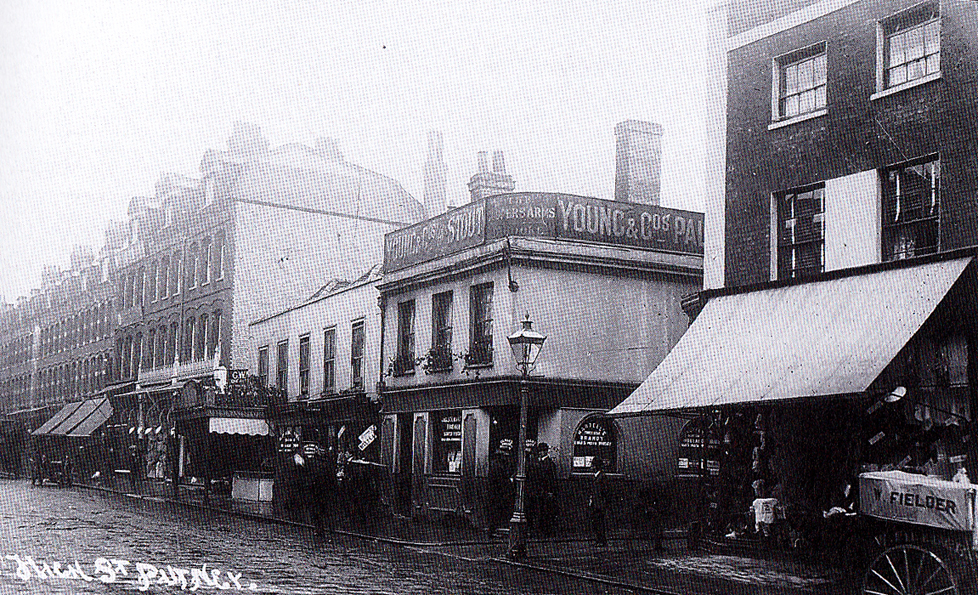
My 3xgreat-grandfather William Sibley (1826-1889) was charged, and later acquitted, in 1860 for conspiring to steal from the publican Thomas Rule of the Coopers' Arms public-house in Putney. When I discovered his name in the Police Intelligence section of The Morning Post (at British Newspaper Archive), I was initially shocked. As I read on, however, I found out that William Sibley was innocent. What follows is an extract from the aforementioned newspaper, dated 30 January 1861:

William Carlton, who described himself as a photographer, and William Sibley, a wheelwright, were placed in the dock before Mr Ingham, charged with being concerned with stealing £5 from the Coopers' Arms public-house in Putney, the property of the landlord Mr Thomas Rule.
The robbery was committed on the 11th of December 1860 and the money, consisting of gold, silver, and halfpence was taken from the bureau in Rule's bedroom. The bureau was locked but not the bedroom. William Sibley was in the house during the said afternoon and was in and out several times and in different parts of the premises. He had a cart at the back door and he went out two or three times to examine it. William Carlton was at the bar with another man, and they had some gin-and-water at the bar. They appeared very fidgety, for they kept going out and returning alternately, and they both left without drinking their gin-and-water. It further appeared that Sibley lived in Putney [in 1861 census he lived at Stratford Grove] and Carlton formerly carried on his photography business opposite to the Coopers' Arms.
My 3xgreat-grandfather denied all knowledge of the robbery, and explained the reason for the cart being at the back of the public-house. He had it to repair and was waiting for assistance to drag it home. Thomas Rule claimed that Sibley had been in his bedroom before, to do repairs to a set of drawers but that he and his daughter [Caroline Rule] were unable to say whether Sibley and Carlton had actually communicated with one another on the day in question.
Mr Ingham refused to allow bail for Sibley, despite Sergeant Blanchard knowing nothing against Sibley before. The evidence of the witness [who was not named during the trial] was that he had evidence that Sibley had known about the robbery one week before it occured.
According to the Criminal Registers on Ancestry, William Sibley and William Carlton were acquitted at Newington on 18 February 1861.

Coopers' Arms public-house, Putney circa 1905

The Coopers' Arms public-house gave its name to Coopers' Arms Lane, which was later renamed Lacy Road. Coopers' Arms Lane was formerly known as Warpell-Way, warp meaning "distinct pieces of ploughed land seperated by the furrows". A thoroughfare in Putney partly preserves the ancient nomenaclature in Warpole Road. The Putney High Street was largely unchanged until Edwardian times when the pub and cottages alongside were demolished and replaced by Edwardian shops. These were removed in the 1980s to make way for the Putney Exchange shopping centre.

Sources used for this blog post: British Newspaper Archive & Ancestry
Putney & Roehampton by Patrick Loobey


Saturday, 11 May 2013

For My Mum

Tomorrow is a special day on the Australian calendar for it marks the celebration we know as Mother's Day. I get to take part in this special opportunity to be thankful for my Mum by being on the receiving end as well as the giving end. As my mother is currently not in the same state of Australia as I am, I won't be able to have her over for a luncheon and shower her with cups of tea,  home-made cakes and nostalgic anecdotes of gratitude. A blog post will have to suffice this time around, sorry Mum.

I have long been thankful to my Mum for being there for me. Now that I am a mature (cough) adult and I have a daughter of my own, I have grown to really appreciate what she went through in life. She really was a trooper and she did it tough for many years as a single mother, especially when we were living in England. What a blessing it was that she took the plunge and decided all those years ago to emigrate to Australia - the land of opportunity for many. She got stuck in almost immediately and wasn't afraid to grab the bull by the horns. She got a job within weeks of landing in Perth, and quickly found herself a place to live. She got her driver's licence and bought herself a white Ford Escort. Remember Betsy, Mum? Or was it "The Little White Chicken"? :-)

However, my appreciation for my mother really hit home this past week. Over the past five weeks the SBS television network aired the five-part BBC series "Turn Back Time: The Family". This series charts the evolution of the family, as one of Britain's most important institutions. Blending living history with genealogy, "Turn Back Time" explores what it means to be a mother, father and child in British society today and historically. Three modern day families (The Meadows; The Taylors; The Goldings) return to the 1900s and through five pivotal eras of family life:
Episode One : The Edwardian Era
Episode Two: The Inter-War Years
Episode Three: The 1940s
Episode Four: The 1960s
Episode Five: The 1970s

Turn Back Time : The Family
www.sbs.com.au

What made the last episode most special to me personally was that I was a child of the 1970s and my mother was the parent. She was a single mother who had to work two jobs just to keep us afloat. She made most of our clothes (on her trusty Singer sewing machine) because she couldn't afford new, and our jumpers were usually made by my grandmother Lilian. I was babysat a lot as a child (thank you, Brenda G xxx), while my mother was out earning, and I resented this for many years solely because I missed her so much. When we did spend time together though, it was precious. We danced and sang to all the latest chart toppers, we watched The Liver Birds, T.O.T.P, Whodunnit, Opportunity Knocks, Are You Being Served? and Crossroads together. We made cassette tapes (usually from comedies scripts like The Two Ronnies) for loved ones and family in Australia. I used to love sitting behind her on the sofa so that I could brush her hair. Those were my favourite times. But "Turn Back Time" made me see the 1970s from a different perspective - my mother's.

1970s Britain was a time of political upheaval with strikes, power cuts, water shortages, the introduction of the three-day week, and women's liberation. I didn't fully realise the impact all this would have had on my family, I was too busy worrying about my scooter and if we'd had a decent amount of snowfall to run around in. "Turn Back Time" illustrates the upheavals faced in the 1970s perfectly, showing scenes where families were plunged into darkness, having to fill their kettles and pans with water from the street tap, and constant worrying about the weekly wage. The Rhodes family joined the "T.B.T" families in this last episode: Lisa (single mother) and her two young sons, Harrison and Daniel. My heart went out to Lisa Rhodes as she symbolised everything about my own mother, doing it tough in the 1970s, and she had two children to clothe and feed! They were housed in one of the upstairs bed-sits where Lisa's kitchenette was sparse in every capacity. She had a temperamental immersion heater, a tiny sink, draining board, worktop and a two-burner, camping-style stove. At least my Mum and I had a decent sized kitchen with a proper stove! And we had seperate bedrooms, whereas the Rhodes family were cramped together in one room.

I used to complain a lot when I was growing up, wondering why we had so little when others had so much. I was jealous of my sisters (sorry lovelies xxx) and jealous of my school friends, and I did give my Mum a hard time, asking her for things she just couldn't afford to give me. I'm sorry for being so selfish Mum, I know you did your utmost best for both of us, and you did it almost single-handedly (you were a stubborn little buggger at times!). I didn't mean to take you for granted and I didn't mean to continually harp on at you about what I wanted differently.
Happy Mother's Day Mumsy. Thank you. I love you very much xxx xxx xxx xxx


Sunday, 21 April 2013

A Place To Call Home

I have neglected my blog here at "Pocketfull", but I do have a good excuse. Well, maybe not a good excuse but an excuse nonetheless. In recent months I've created a new blog which is dedicated to the history of my childhood hometown and I've been contributing to it almost twice weekly (See it here). For now at least, I've run out of steam so I've decided to devote some of my free time back here, amongst my family history.

A new Australian drama is set to start on the Seven Network next week called 'A Place To Call Home' and while I've been rather looking forward to watching this post-world-war-two drama it has got me thinking lately about "home" and what it means to me personally. Even though I have lived in Australia for most of my life, I still have a hankering for my childhood home. Beyond this, I have often found myself wondering what my family and my ancestors would have called home.

Both of my grandmothers were devoted to their homes. My maternal grandmother Lilian always proudly called herself a "Londoner", even long after the war ended in 1945, when she was married and living in a quiet market town in Suffolk. Then, in 1978 she emigrated to Australia. Yet, all her life, at every opportunity she could get, she went back to London. Her heart was always right there and when she died in 1983 of a massive heart attack, I always believed (and still do, to this day) that it was because her heart was broken for home.
My paternal grandmother Freda lived in Beccles all her life. She never moved away from the town, except for a few years when she moved to nearby Brampton but she quickly welcomed a return to Beccles. There was no question of her living anywhere else but Beccles. She was born there, she was married there, she raised four boys there, and it never entered her mind to travel further than was absolutely necessary. She believed in setting down your roots and staying put and, for the most part, she was content with that. It didn't make her small minded but it certainly made her homely and connected to her roots.
My grandfathers? My paternal grandfather Herbert lived in Bungay, London, and later, Beccles. I don't think that any one particular place meant more to him. I believe he went where "duty called" for the most part, even during the Second World War when he was stationed at Sutton Coldfield.
My maternal grandfather was born and lived all his life in Bungay. While he fudged his age slightly on enlistment with the Norfolk Regiment I don't think it was necessarily because he wanted to escape home life. He just wanted to do what he felt was right. He was to travel to India during his pre-World War Two service and later to Dunkirk before his capture and internment in a German Prisoner-of-War camp. Later, in 1944-45, he served with the Royal Army Medical Corps and was stationed at Epsom, county Surrey. After the war, when he married my grandmother Lilian, they remained in Bungay and raised their family there, trying (against impossible odds at times) to live by the post-war standards of a secure family life.

Aerial view of Beccles and the River Waveney

If I look back another generation, to my great-grandparents' idea of what home meant to them, it differs quite dramatically. For example, my maternal great-grandparents Albert and Elizabeth, were born in the exact same town in London. They were both from working-class families and both were baptised at the same church. Their families possibly knew one another and shared a similar social history. Albert was restless though, even as a young boy. He wanted to travel and see the world, stretch his wings and leave Putney well behind him forever. He lied about his age to get into the Royal Navy and his only reason for returning to Putney was to marry his sweetheart, Elizabeth, in 1905. After that they lived in Southwark, Fulham, Tooting, Bloomsbury and later, Sutton (where they settled and remained until Elizabeth's death in 1951).
My other maternal great-grandparents, Percy and Nellie, were much like my paternal grandmother. They remained in the Suffolk market town of Bungay all their lives. There was no question of moving away, although my great-grandfather Percy, as a younger man, did love the sea and he took to fishing on trawler boats off the coast of Lowestoft for many years before settling back to farm life after the Great War (1914-1918).

Putney, in Greater London

My paternal great-grandparents were also a mixed bunch. Albert and Eva were Becclesians to the last, although my great-grandmother Eva was born in Loddon (her parents were Loddon born and raised before moving to Beccles) but she never had a great need to return there. Beccles was her home and Great Yarmouth was her favourite family holiday destination. Albert was born and raised in Beccles, and he remained staunchly faithful to the town and its townsfolk; at home, in religious circles, and in his work.
My other paternal great-grandparents, Arthur and Barbara, lived as a married couple in the market town of Bungay and raised their family there but they were not knowingly tied to their roots. Barbara was born in Holdenhurst, county Hampshire and lived there until she was a young girl, when her father took on a new job as a Railway Gatekeeper in Woodsford, county Dorset. Less than five years later, her mother passed away, her father abandoned her and she moved to London to work in the Domestic Service. Arthur joined the Norfolk Regiment as a young man and served in both the Boer War and the Great War. It was during the Great War that Barbara moved back to London with the children (including my grandfather Herbert) while Arthur was away fighting for King and Country. When the war ended they went back, as a family, to Bungay.


So there we have it; a mixture of loyalties towards home and yet, across the board, so very similar. There are those who willingly left home to fight in the war. Those who wanted to leave their homes for broader horizons. Those who stayed in the same town all their lives, loyal to the last. Those who wanted to run from their past and never look back and those who couldn't let go of their past and so returned again and again.
To this day I share the same tug-of-war with my maternal grandmother Lilian, the Londoner, who always found a way to go back even though the memories of her childhood were not altogether pleasant or heart-warming ones. Something always called her back and she was deeply proud of her London roots, even in the impossible heat and vastness of Australia that she made home for the last remaining years of her life. My own tug-of-war calls me back to Beccles, and sometimes that call is overwhelming. It certainly reflects in my ability to write about it without getting completely caught up and swept away in a sea of nostalgia and sentiment! Even though Australia is now the place I call my home I still carry a piece of Beccles deep within my heart, and I always will. I could never let it go.

Tuesday, 19 March 2013

Body of a Child : My Ancestors Involved in a Mystery

My last blog post referred to two of my Jolly cousins - well, second cousins three times removed to be precise. This time I'm embarking on another Jolly story, as shared recently by my third cousin. She has contact with a Jolly descendent who sent her an article which involves our 3 x great-grandfather Josiah Jolly, who was with two of his sons Josiah Jolly (jnr) and Charles or David Jolly (our second great-grand uncles), when Josiah (jnr) discovered the body of a baby in a field.

*At the time of this event Josiah Jolly (snr) and his wife Susan were living in Plough Street, Bungay. The Plough Inn mentioned below was on this street. Today, Plough Street is known as Wingfield Street. Josiah Jolly (jnr) had married the previous December and the 1851 census return (taken 30 March 1851) puts them both at Shipmeadow Workhouse as Inmates.

The Bury and Norwich Post Newspaper, dated 27 August 1851, reported:

BUNGAY
Body of a child found: -- On Saturday evening, as a labouring man, named Jolly, was going home from his work, in the company of his father and brother, he went into a barley-field near St John's-Hill, to gather some rabbits' meat. He saw a parcel lying there, three or four yards from the gate, apparently done up in white cloth. He mentioned it to his father, who told him to leave it alone, as someone might have placed it there intentionally and would come for it. On the following Monday morning, on going to work, he again saw the parcel, and on examining it, found it was an old basket, wrapped up in a cloth, and inside another cloth he found the body of a female infant. The cloth round the body was marked with red cotton, "C.E.O.T." Information was sent to the police, and an inquest was held before Mr Lawrence, on Tuesday, at the Plough Inn*, where Chas. W. Currie, surgeon, who made a post-mortem examination of the body, deposed that it was that of a full-grown infant, and must have been perfectly healthy when born. He did not discover any external marks of violence : it had lived but a very short time, if it had lived at all...

Postcard

The article my cousin received was from The Bungay Society Journal, No 71, dated December 2010. Here is an extract:

A LOCAL VICTORIAN TRAGEDY
On Monday 18 August 1851 the police received information that the body of an infant had been found on a field near St John's Hill. Local Inspector Nagle went immediately to the spot, and was handed a basket, containing the body of a child by a labourer, Josiah Jolly, who had discovered it.
The following day an inquest into the death was held in the town. Mr Lawrence, a coroner from Ipswich had been summoned to attend, and the sessions were held at the Plough Inn, in Wingfield Street. At that time pubs were often used for such proceedings if there were no other public building available. The Plough was an ancient tavern, and was the last building in Bungay to retain a thatch when it was finally demolished in 1964.
The coroner heard this evidence from Josiah Jolly. "I am a labouring man, and live at Bungay. About half past seven on Saturday evening, as I, my father and brother went to the gate of a field near St John's Hill, intending to gather some rabbits' victuals, and as I was getting over the gate, I saw a parcel lying in the field, about four yards from me, which I pointed out to my father. He desired me to leave it alone...When we reached Mr Sewell's house on the Ollands, I saw him standing by the gate talking to three persons who appeared to be begging and I told him what I had seen...On the Monday morning, as I, my father and brother were going past the same field I went to the gate to see if the parcel was still there and on seeing it, took it up, and brought it into the road to my father. I untied the cloth and found an old basket, on opening which I saw something pinned up in a cloth. I took out the pin and began to remove the cloth, when I observed a child's foot...

On 22 August 1851 the police apprehended a woman named Leggate, against whom there were some peculiarly suspicious circumstances. She was remanded in custody until the 28th, and afterwards consented to a medical examination, but it was certified that she had not given birth to a child, and was discharged.
The final inquest was conducted on 6 September, with negative conclusions. The Jury returned a verdict that the child had "been found dead, but whether born alive or not, the Jury have not sufficient evidence".
It as further reported that many rumours had been in circulation, one traced to a man named George Codling, who was said to have stated that the parcel containing the body had been seen at Jolly's house on the Sunday preceding the day of the discovery in the field. As Codling refused to attend the inquest and confirm his statement before the Jury, the coroner concluded that it was just malicious fabrication: for which he regretted that there was no punishment...

Ordnance Survey Map of Bungay
Shows St John's Hill, The Ollands & Wingfield Street
Click to enlarge


It would appear that my Jolly ancestors had a penchant for being in the wrong place at the wrong time or were mixed up with and embroiled in misdemeanours, rumours, and, pardon me for saying so, a series of unfortunate events.